


Page 1294 - Hematology_ Basic Principles and Practice ( PDFDrive )
P. 1294
1140   Part VII  Hematologic Malignancies


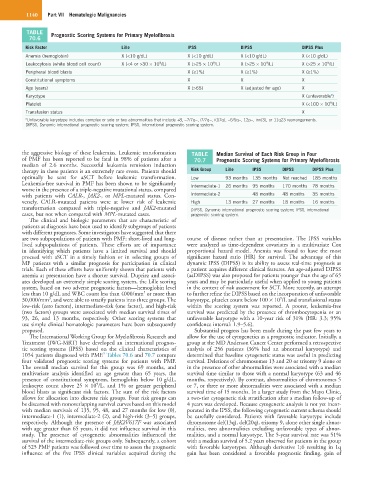
          TABLE   Prognostic Scoring Systems for Primary Myelofibrosis
          70.6
         Risk Factor                     Lille                IPSS              DIPSS               DIPSS Plus
         Anemia (hemoglobin)             X (<10 g/dL)         X (<10 g/dL)      X (<10 g/dL)        X (<10 g/dL)
                                                     9
                                                                                        9
                                                                       9
         Leukocytosis (white blood cell count)  X (<4 or >30 × 10 /L)  X (>25 × 10 /L)  X (>25 × 10 /L)  X (>25 × 10 /L)
                                                                                                            9
         Peripheral blood blasts                              X (≥1%)           X (≥1%)             X (≥1%)
         Constitutional symptoms                              X                 X                   X
         Age (years)                                          X (>65)           X (adjusted for age)  X
                                                                                                             a
         Karyotype                                                                                  X (unfavorable )
         Platelet                                                                                   X (<100 × 10 /L)
                                                                                                             9
         Transfusion status                                                                         X
         a Unfavorable karyotype includes complex or sole or two abnormalities that include +8, −7/7q−, i7/7q−, i(17q), −5/5q−, 12p−, inv(3), or 11q23 rearrangements.
         DIPSS, Dynamic international prognostic scoring system; IPSS, international prognostic scoring system.


        the aggressive biology of these leukemias. Leukemic transformation   TABLE   Median Survival of Each Risk Group in Four
        of  PMF  has  been  reported  to  be  fatal  in  98%  of  patients  after  a   70.7  Prognostic Scoring Systems for Primary Myelofibrosis
        median  of  2.6  months.  Successful  leukemia  remission  induction
        therapy in these patients is an extremely rare event. Patients should   Risk Group  Lille  IPSS  DIPSS  DIPSS Plus
        optimally  be  sent  for  aSCT  before  leukemic  transformation.   Low  93 months  135 months  Not reached  185 months
        Leukemia-free survival in PMF has been shown to be significantly   Intermediate-1  26 months  95 months  170 months  78 months
        worse in the presence of a triple-negative mutational status, compared
        with  patients  with  CALR-,  JAK2-,  or  MPL-mutated  status.  Con-  Intermediate-2  48 months  48 months  35 months
        versely,  CALR-mutated  patients  were  at  lower  risk  of  leukemic   High  13 months  27 months  18 months  16 months
        transformation  compared  with  triple-negative  and  JAK2-mutated   DIPSS, Dynamic international prognostic scoring system; IPSS, international
        cases, but not when compared with MPL-mutated cases.   prognostic scoring system.
           The  clinical  and  biologic  parameters  that  are  characteristic  of
        patients at diagnosis have been used to identify subgroups of patients
        with different prognoses. Some investigators have suggested that there
        are two subpopulations of patients with PMF; short-lived and long-  course  of  disease  rather  than  at  presentation.  The  IPSS  variables
        lived  subpopulations  of  patients.  These  efforts  are  of  importance   were  analyzed  as  time-dependent  covariates  in  a  multivariate  Cox
        in  identifying  which  patients  have  a  limited  survival  and  should   proportional  hazard  model.  Anemia  was  found  to  have  the  most
        proceed  with  aSCT  in  a  timely  fashion  or  in  selecting  groups  of   significant  hazard  ratio  (HR)  for  survival.  The  advantage  of  this
        MF  patients  with  a  similar  prognosis  for  participation  in  clinical   dynamic IPSS (DIPSS) is its ability to assess real-time prognosis as
        trials. Each of these efforts have uniformly shown that patients with   a patient acquires different clinical features. An age-adjusted DIPSS
        anemia at presentation have a shorter survival. Dupriez and associ-  (aaDIPSS) was also proposed for patients younger than the age of 65
        ates developed an extremely simple scoring system, the Lille scoring   years and may be particularly useful when applied to young patients
        system, based on two adverse prognostic factors—hemoglobin level   in the context of risk assessment for SCT. More recently, an attempt
                                                3
        less than 10 g/dL and WBC count less than 4000/mm  or more than   to further refine the DIPSS based on the incorporation of unfavorable
                 3
                                                                                             9
        30,000/mm , and were able to stratify patients into three groups. The   karyotype, platelet count below 100 × 10 /L and transfusional status
        low-risk (zero factors), intermediate-risk (one factor), and high-risk   within  the  scoring  system  was  reported.  A  poorer,  leukemia-free
        (two factors) groups were associated with median survival times of   survival was predicted by the presence of thrombocytopenia or an
        93,  26,  and  13  months,  respectively.  Other  scoring  systems  that   unfavorable karyotype with a 10-year risk of 31% (HR: 3.3; 95%
        use simple clinical hematologic parameters have been subsequently     confidence interval: 1.9–5.6).
        proposed.                                                Substantial progress has been made during the past few years to
           The International Working Group for Myelofibrosis Research and   allow for the use of cytogenetics as a prognostic indicator. Initially, a
        Treatment  (IWG-MRT)  have  developed  an  international  prognos-  group at the MD Anderson Cancer Center performed a retrospective
        tic  scoring  systems  (IPSS)  based  on  the  clinical  characteristics  of   analysis  of  256  patients  (36%  had  an  abnormal  karyotype)  and
                                   9
        1054 patients diagnosed with PMF.  Tables 70.6 and 70.7 compare   determined that baseline cytogenetic status was useful in predicting
        four  validated  prognostic  scoring  systems  for  patients  with  PMF.   survival. Deletions of chromosomes 13 and 20 or trisomy 9 alone or
        The  overall  median  survival  for  this  group  was  69  months,  and   in the presence of other abnormalities were associated with a median
        multivariate  analysis  identified  an  age  greater  than  65  years,  the   survival time similar to those with a normal karyotype (63 and 46
        presence  of  constitutional  symptoms,  hemoglobin  below  10 g/dL,   months, respectively). By contrast, abnormalities of chromosomes 5
                                 9
        leukocyte  count  above  25  ×  10 /L,  and  1%  or  greater  peripheral   or 7, or three or more abnormalities were associated with a median
        blood blasts as significant risk factors. The sum of the risk factors   survival time of 15 months. In a larger study from the Mayo Clinic,
        allows for allocation into discrete risk groups. Four risk groups can   a two-tier cytogenetic risk stratification after a median follow-up of
        be discerned with nonoverlapping survival curves based on this model   4 years was developed. Because cytogenetic analysis is not yet incor-
        with median survivals of 135, 95, 48, and 27 months for low (0),   porated in the IPSS, the following cytogenetic current schema should
        intermediate-1 (1), intermediate-2 (2), and high-risk (3–5) groups,   be  carefully  considered.  Patients  with  favorable  karyotype  include
        respectively.  Although  the  presence  of  JAK2V617F  was  associated   chromosome del(13q), del(20q), trisomy 9, alone other single abnor-
        with age greater than 65 years, it did not influence survival in this   malities,  two  abnormalities  excluding  unfavorable  types  of  abnor-
        study.  The  presence  of  cytogenetic  abnormalities  influenced  the   malities, and a normal karyotype. The 5-year survival rate was 51%
        survival of the intermediate-risk groups only. Subsequently, a cohort   with a median survival of 5.2 years observed for patients in the group
        of 525 PMF patients was followed over time to assess the prognostic   with favorable  karyotypes.  Although  derivative  1;6  resulting  in 1q
        influence  of  the  five  IPSS  clinical  variables  acquired  during  the   gain  has  been  considered  a  favorable  prognostic  finding,  gain  of

