


Page 1293 - Hematology_ Basic Principles and Practice ( PDFDrive )
P. 1293
Chapter 70  Primary Myelofibrosis  1139


            may present with MF in the setting of established SLE or in patients   transformation at 1 and 5 years after diagnosis has been reported to
            with  minimal  manifestations  of  an  autoimmune  disorder,  as  in   be 2% and 16%, respectively. Immunologic and morphologic char-
            primary AIMF. The presence of teardrop erythrocytes or leukoeryth-  acterization of the blast cell phenotypes comprising these leukemias
            roblastosis in a patient with lupus suggests autoimmune MF. Such   reveals that a typical myeloid phenotype is most commonly detected;
            patients universally have a positive ANA test result or an elevated   other cell lineages, such as megakaryocytic, erythroid, lymphoid, and
            anti-DNA  titer.  Because  the  physical  manifestations  of  an  auto-  even stem cell phenotype, may also be involved, leading to the exis-
            immune disease may not be evident, all patients with MF should have   tence of mixed myeloid and hybrid transformations. Megakaryoblastic
            an  ANA  test  to  exclude  an  autoimmune  etiology.  Primary  AIMF   transformations have been detected in one-third of cases in one series,
            patients lack MPN mutations such as JAK2V617F, MPL W515L/K,   an incidence higher than that found in de novo AML. In 50% of
            and  CALR,  or  marker  cytogenetic  abnormalities  consistent  with   cases of JAK2V617F MPNs, the blast cells that represent the progeny
            polyclonal rather than clonal hematopoiesis           of the leukemia initiating clone are JAK2V617F negative, suggesting
                                                                  that  the  leukemia  originates  from  a  clone  distinct  from  the
                                                                  JAK2V617F-positive  clone.  This  coexistent  JAK2V617F-negative
            PROGNOSIS                                             clone  appears  to  have  a  higher  propensity  to  undergo  leukemic
                                                                  transformation. JAK2V617F therefore does not appear to be a pre-
            The median OS period from the time of diagnosis of PMF varies   requisite  for  leukemic  transformation  of  MPNs,  suggesting  that
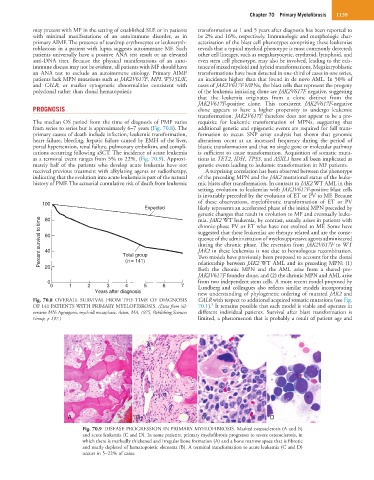
            from series to series but is approximately 6–7 years (Fig. 70.8). The   additional genetic and epigenetic events are required for full trans-
            primary causes of death include infection, leukemic transformation,   formation  to  occur.  SNP  array  analysis  has  shown  that  genomic
            heart failure, bleeding, hepatic failure caused by EMH of the liver,   alterations  occur  at  an  increased  frequency  during  the  period  of
            portal hypertension, renal failure, pulmonary embolism, and compli-  blastic transformation and that no single gene or molecular pathway
            cations occurring following aSCT. The incidence of acute leukemia   is sufficient to cause transformation. Acquisition of somatic muta-
            as a terminal event ranges from 5% to 22%, (Fig. 70.9). Approxi-  tions in TET2, IDH, TP53, and ASXL1 have all been implicated as
            mately  half  of  the  patients  who  develop  acute  leukemia  have  not   genetic events leading to leukemic transformation in MF patients.
            received previous treatment with alkylating agents or radiotherapy,   A surprising correlation has been observed between the phenotype
            indicating that the evolution into acute leukemia is part of the natural   of the preceding MPN and the JAK2 mutational status of the leuke-
            history of PMF. The actuarial cumulative risk of death from leukemic   mic blasts after transformation. In contrast to JAK2 WT AML in this
                                                                  setting, evolution to leukemias with JAK2V617F-positive blast cells
                                                                  is invariably preceded by the evolution of ET or PV to MF. Because
               100                                                of  these  observations,  myelofibrotic  transformation  of  ET  or  PV
                                                Expected          likely represents an accelerated phase of the initial MPN preceded by
                                                                  genetic changes that result in evolution to MF and eventually leuke-
                80
              Percent survival to time  60  Total group           suggested that these leukemias are therapy related and are the conse-
                                                                  mia. JAK2 WT leukemia, by contrast, usually arises in patients with
                                                                  chronic-phase PV or ET who have not evolved to MF. Some have
                                                                  quence of the administration of myelosuppressive agents administered
                                                                  during the chronic phase. The reversion from JAK2V617F to WT
                40
                                                                  JAK2 in these leukemias is not due to homologous recombination.
                                                                  Two models have previously been proposed to account for the clonal
                                          (n = 141)
                                                                  relationship between JAK2 WT AML and its preceding MPN: (1)
                20
                                                                  Both  the  chronic  MPN  and  the  AML  arise  from  a  shared  pre-
                                                                  JAK2V617F founder clone, and (2) the chronic MPN and AML arise
                 0                                                from two independent stem cells. A more recent model proposed by
                 0      1     2     3     4     5     6     7     Lundberg and colleagues also reflects similar models incorporating
                                Years after diagnosis             new understanding of phylogenetic ordering of mutated JAK2 and
            Fig. 70.8  OVERALL SURVIVAL FROM THE TIME OF DIAGNOSIS   CALR with respect to additional acquired somatic mutations (see Fig.
                                                                      8
            OF 141 PATIENTS WITH PRIMARY MYELOFIBROSIS. (Data from Sil-  70.1).  It remains possible that each model is viable and operates in
            verstein MN: Agnogenic myeloid metaplasia, Acton, MA, 1975, Publishing Sciences   different  individual  patients.  Survival  after  blast  transformation  is
            Group, p 197.)                                        limited, a phenomenon that is probably a result of patient age and


                       A                      B                    C                     D

                            Fig. 70.9  DISEASE PROGRESSION IN PRIMARY MYELOFIBROSIS. Marked osteosclerosis (A and B)
                            and acute leukemia (C and D). In some patients, primary myelofibrosis progresses to severe osteosclerosis, in
                            which there is markedly thickened and irregular bone formation (A) and a bone marrow space that is fibrotic
                            and nearly depleted of hematopoietic elements (B). A terminal transformation to acute leukemia (C and D)
                            occurs in 5–22% of cases.

