


Page 1306 - Hematology_ Basic Principles and Practice ( PDFDrive )
P. 1306
1152   Part VII  Hematologic Malignancies


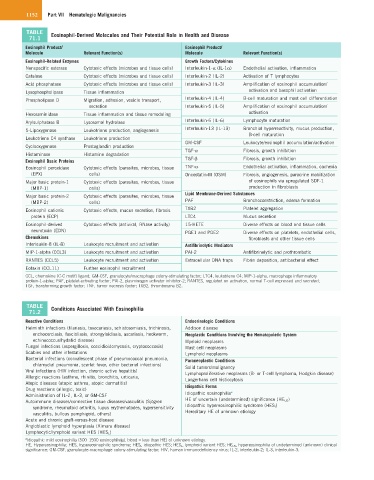
          TABLE   Eosinophil-Derived Molecules and Their Potential Role in Health and Disease
          71.1
         Eosinophil Product/                                  Eosinophil Product/
         Molecule           Relevant Function(s)              Molecule           Relevant Function(s)
         Eosinophil-Related Enzymes                           Growth Factors/Cytokines
         Nonspecific esterase  Cytotoxic effects (microbes and tissue cells)  Interleukin-1-α (IL-1α)  Endothelial activation, inflammation
         Catalase           Cytotoxic effects (microbes and tissue cells)  Interleukin-2 (IL-2)  Activation of T lymphocytes
         Acid phosphatase   Cytotoxic effects (microbes and tissue cells)  Interleukin-3 (IL-3)  Amplification of eosinophil accumulation/
         Lysophospholipase  Tissue inflammation                                   activation and basophil activation
         Phospholipase D    Migration, adhesion, vesicle transport,   Interleukin-4 (IL-4)  B-cell maturation and mast cell differentiation
                              secretion                       Interleukin-5 (IL-5)  Amplification of eosinophil accumulation/
         Hexosaminidase     Tissue inflammation and tissue remodeling             activation
         Arylsulphatase B   Lysosomal hydrolase               Interleukin-6 (IL-6)  Lymphocyte maturation
         5-Lipoxygenase     Leukotriene production, angiogenesis  Interleukin-13 (IL-13)  Bronchial hyperreactivity, mucus production,
                                                                                  B-cell maturation
         Leukotriene C4 synthase  Leukotriene production
                                                              GM-CSF             Leukocyte/eosinophil accumulation/activation
         Cyclooxygenase     Prostaglandin production
                                                              TGF-α              Fibrosis, growth inhibition
         Histaminase        Histamine degradation
         Eosinophil Basic Proteins                            TGF-β              Fibrosis, growth inhibition
         Eosinophil peroxidase   Cytotoxic effects (parasites, microbes, tissue   TNF-α  Endothelial activation, inflammation, cachexia
           (EPX)              cells)                          Oncostatin-M (OSM)  Fibrosis, angiogenesis, paracrine mobilization
         Major basic protein-1   Cytotoxic effects (parasites, microbes, tissue   of eosinophils via upregulated SDF-1
           (MBP-1)            cells)                                              production in fibroblasts
                                                              Lipid Membrane-Derived Substances
         Major basic protein-2   Cytotoxic effects (parasites, microbes, tissue
           (MBP-2)            cells)                          PAF                Bronchoconstriction, edema formation
         Eosinophil cationic   Cytotoxic effects, mucus secretion, fibrosis  TXB2  Platelet aggregation
           protein (ECP)                                      LTC4               Mucus secretion
         Eosinophil-derived   Cytotoxic effects (antiviral, RNase activity)  15-HETE  Diverse effects on blood and tissue cells
           neurotoxin (EDN)                                   PGE1 and PGE2      Diverse effects on platelets, endothelial cells,
         Chemokines                                                               fibroblasts and other tissue cells
         Interleukin-8 (IL-8)  Leukocyte recruitment and activation  Antifibrinolytic Mediators
         MIP-1-alpha (CCL3)  Leukocyte recruitment and activation  PAI-2         Antifibrinolytic and prothrombotic
         RANTES (CCL5)      Leukocyte recruitment and activation  Extracellular DNA traps  Fibrin deposition, antibacterial effect
         Eotaxin (CCL11)    Further eosinophil recruitment
         CCL, chemokine (C-C motif) ligand; GM-CSF, granulocyte/macrophage colony-stimulating factor; LTC4, leukotriene C4; MIP-1-alpha, macrophage inflammatory
         protein-1-alpha; PAF, platelet-activating factor; PAI-2, plasminogen activator inhibitor-2; RANTES, regulated on activation, normal T-cell expressed and secreted;
         TGF, transforming growth factor; TNF, tumor necrosis factor; TXB2, thromboxane B2.


          TABLE   Conditions Associated With Eosinophilia
          71.2
         Reactive Conditions                                  Endocrinologic Conditions
         Helminth infections (filariasis, toxocariasis, schistosomiasis, trichinosis,   Addison disease
            onchocerciasis, fascioliasis, strongyloidiasis, ascariasis, hookworm,   Neoplastic Conditions Involving the Hematopoietic System
            echinococcus/hydatid disease)                     Myeloid neoplasms
         Fungal infections (aspergillosis, coccidioidomycosis, cryptococcosis)  Mast cell neoplasms
         Scabies and other infestations                       Lymphoid neoplasms
         Bacterial infections (convalescent phase of pneumococcal pneumonia,   Paraneoplastic Conditions
            chlamydial pneumonia, scarlet fever, other bacterial infections)
         Viral infections (HIV infection, chronic active hepatitis)  Solid tumors/malignancy
                                                              Lymphoproliferative neoplasms (B- or T-cell lymphoma, Hodgkin disease)
         Allergic reactions (asthma, rhinitis, bronchitis, urticaria,  Langerhans cell histiocytosis
         Atopic diseases (atopic asthma, atopic dermatitis)
         Drug reactions (allergic, toxic)                     Idiopathic Forms  a
         Administration of IL-2, IL-3, or GM-CSF              Idiopathic eosinophilia
         Autoimmune diseases/connective tissue diseases/vasculitis (Sjögren   HE of uncertain (undetermined) significance (HE US )
            syndrome, rheumatoid arthritis, lupus erythematodes, hypersensitivity   Idiopathic hypereosinophilic syndrome (HES I )
            vasculitis, bullous pemphigoid, others)           Hereditary HE of unknown etiology
         Acute and chronic graft-versus-host disease
         Angioblastic lymphoid hyperplasia (Kimura disease)
         Lymphocytic/lymphoid variant HES (HES L )
         a Idiopathic mild eosinophilia (500–1500 eosinophils/µL blood = less than HE) of unknown etiology.
         HE, Hypereosinophilia; HES, hypereosinophilic syndrome; HES I , idiopathic HES; HES L, lymphoid variant HES; HE US, hypereosinophilia of undetermined (unknown) clinical
         significance; GM-CSF, granulocyte-macrophage colony-stimulating factor; HIV, human immunodeficiency virus; IL-2, interleukin-2; IL-3, interleukin-3.

