


Page 1308 - Hematology_ Basic Principles and Practice ( PDFDrive )
P. 1308
1154   Part VII  Hematologic Malignancies


        eosinophil eicosanoide-forming enzymes, including 5-lipoxygenase,             Monocytes
        leukotriene C4 synthase, and cyclooxygenase (see Table 71.1).       100
           The immunophenotype of human eosinophils is well established
        and  may  assist  in  eosinophil  detection  and  enumeration  by  flow   80
        cytometry. In common with all leukocytes, eosinophils express leu-   60
        kosialin (CD43), the homing cell adhesion molecule HCAM (CD44),
                                                 5
        and the pan-leukocyte tyrosine phosphatase C (CD45).  In addition,   Relative cell number (%)  40
        eosinophils express several myeloid differentiation antigens, including
        LFA-1  (CD11a/CD18)  and  Siglec-3  (CD33).  These  cell  surface    20
        antigens are also expressed on other myeloid cells, including mono-
        cytes and basophils. However, a few cell surface structures are largely   0
        restricted  to  eosinophils  and  thus  serve  as  cell-specific  markers   10 0  10 1  10 2  10 3  10 4
        through which eosinophils can be detected and isolated. One of these           Siglec-8
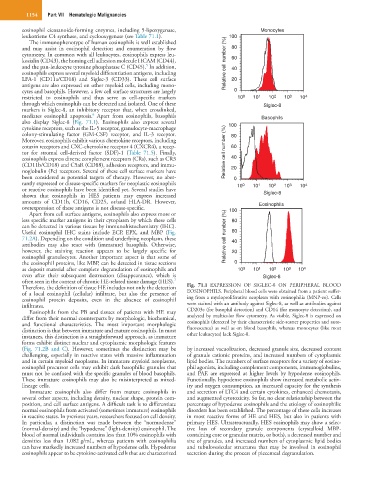
        markers  is  Siglec-8,  an  inhibitory  receptor  that,  when  crosslinked,
                               6
        mediates  eosinophil  apoptosis.   Apart  from  eosinophils,  basophils        Basophils
        also  display  Siglec-8  (Fig.  71.1).  Eosinophils  also  express  several   100
        cytokine receptors, such as the IL-5 receptor, granulocyte-macrophage
        colony-stimulating  factor  (GM-CSF)  receptor,  and  IL-3  receptor.   80
        Moreover, eosinophils exhibit various chemokine receptors, including
        eotaxin receptors and CXC-chemokine receptor 4 (CXCR4), a recep-     60
        tor  for  stromal  cell-derived  factor  (SDF)-1  (Table  71.5).  Finally,   Relative cell number (%)
        eosinophils express diverse complement receptors (CRs), such as CR3   40
        (CD11b/CD18) and C5aR (CD88), adhesion receptors, and immu-          20
        noglobulin (Fc) receptors. Several of these cell surface markers have
        been considered as potential targets of therapy. However, no aber-    0
        rantly expressed or disease-specific markers for neoplastic eosinophils   10 0  10 1  10 2  10 3  10 4
        or reactive eosinophils have been identified yet. Several studies have
        shown  that  eosinophils  in  HES  patients  may  express  increased           Siglec-8
        amounts  of  CD11b,  CD16,  CD25,  or/and  HLA-DR.  However,                  Eosinophils
        overexpression of these antigens is not disease-specific.           100
           Apart from cell surface antigens, eosinophils also express more or
        less specific marker antigens in their cytoplasm by which these cells   80
        can be detected in various tissues by immunohistochemistry (IHC).
        Useful  eosinophil  IHC  stains  include  ECP,  EPX,  and  MBP  (Fig.   60
        71.2A). Depending on the condition and underlying neoplasm, these   Relative cell number (%)  40
        antibodies  may  also  react  with  (immature)  basophils.  Otherwise,
        however,  the  staining  reaction  appears  to  be  largely  specific  for   20
        eosinophil granulocytes. Another important aspect is that some of
        the eosinophil proteins, like MBP, can be detected in tissue sections   0
        as deposit material after complete degranulation of eosinophils and    10 0  10 1  10 2  10 3  10 4
        even  after  their  subsequent  destruction  (disappearance),  which  is       Siglec-8
                                                          7
        often seen in the context of chronic HE-related tissue damage (HES).
        Therefore, the definition of tissue HE includes not only the detection   Fig.  71.1  EXPRESSION  OF  SIGLEC-8  ON  PERIPHERAL  BLOOD
        of  a  local  eosinophil  (cellular)  infiltrate,  but  also  the  presence  of   EOSINOPHILS. Peripheral blood cells were obtained from a patient suffer-
        eosinophil  protein  deposits,  even  in  the  absence  of  eosinophil   ing from a myeloproliferative neoplasm with eosinophilia (MNP-eo). Cells
        infiltrates.                                          were stained with an antibody against Siglec-8, as well as antibodies against
           Eosinophils  from  the  PB  and  tissues  of  patients  with  HE  may   CD203c (for basophil detection) and CD14 (for monocyte detection), and
        differ from their normal counterparts by morphologic, biochemical,   analyzed by multicolor flow cytometry. As visible, Siglec-8 is expressed on
        and  functional  characteristics.  The  most  important  morphologic   eosinophils (detected by their characteristic side-scatter properties and auto-
        distinction is that between immature and mature eosinophils. In most   fluorescence) as well as on blood basophils, whereas monocytes (like most
        instances, this distinction is a straightforward approach, as immature   other leukocytes) lack Siglec-8.
        forms exhibit distinct nuclear and cytoplasmic morphologic features
        (Fig.  71.2B  and  C).  However,  sometimes  the  distinction  may  be   by increased vacuolization, decreased granule size, decreased content
        challenging, especially in reactive states with massive inflammation   of granule cationic proteins, and increased numbers of cytoplasmic
        and in certain myeloid neoplasms. In immature myeloid neoplasms,   lipid bodies. The numbers of surface receptors for a variety of eosino-
        eosinophil precursor cells may exhibit dark basophilic granules that   phil agonists, including complement components, immunoglobulins,
        must not be confused with the specific granules of blood basophils.   and  PAF,  are  expressed  at  higher  levels  by  hypodense  eosinophils.
        These immature eosinophils may also be misinterpreted as mixed-  Functionally, hypodense eosinophils show increased metabolic activ-
        lineage cells.                                        ity and oxygen consumption, an increased capacity for the synthesis
           Immature  eosinophils  also  differ  from  mature  eosinophils  in   and secretion of LTC4 and certain cytokines, enhanced chemotaxis,
        several other aspects, including density, nuclear shape, protein com-  and augmented cytotoxicity. So far, no clear relationship between the
        position, and cell surface antigens. A difficult task is to differentiate   percentage of hypodense eosinophils and the etiology of eosinophilic
        normal eosinophils from activated (sometimes immature) eosinophils   disorders has been established. The percentage of these cells increases
        in reactive states. In previous years, researchers focused on cell density.   in most reactive forms of HE and HES, but also in patients with
        In  particular,  a  distinction  was  made  between  the  “normodense”   primary HES. Ultrastructurally, HES eosinophils may show a selec-
        (normal-density) and the “hypodense” (light-density) eosinophil. The   tive  loss  of  secondary  granule  components  (crystalloid  MBP-
        blood of normal individuals contains less than 10% eosinophils with   containing core or granular matrix, or both), a decreased number and
        densities  less  than  1.082 g/mL,  whereas  patients  with  eosinophilia   size of granules, and increased numbers of cytoplasmic lipid bodies
        can have markedly increased numbers of hypodense cells. Hypodense   and  tubulovesicular  structures  that  may  be  involved  in  eosinophil
        eosinophils appear to be cytokine-activated cells that are characterized   secretion during the process of piecemeal degranulation.

