


Page 1311 - Hematology_ Basic Principles and Practice ( PDFDrive )
P. 1311
Chapter 71  Eosinophilia, Eosinophil-Associated Diseases, Eosinophilic Leukemias, and the Hypereosinophilic Syndromes  1157


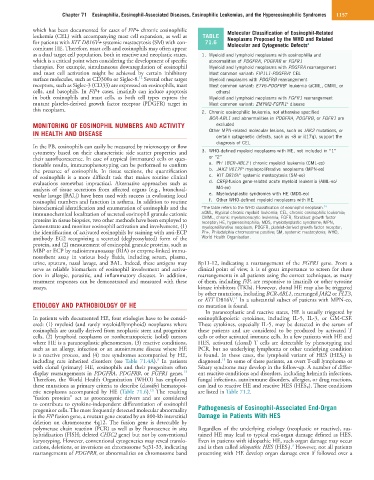
            which has been documented for cases of F/P+ chronic eosinophilic   Molecular Classification of Eosinophil-Related
            leukemia (CEL) with accompanying mast cell expansion, as well as   TABLE   Neoplasms Proposed by the WHO and Related
            for patients with KIT D816V+ systemic mastocytosis (SM) with con-  71.6  Molecular and Cytogenetic Defects a
            comitant HE. Therefore, mast cells and eosinophils may often appear
            as a dual target cell population, both in reactive and neoplastic states,   1.  Myeloid and lymphoid neoplasms with eosinophilia and
            which is a critical point when considering the development of specific   abnormalities of PDGFRA, PDGFRB or FGFR1
            therapies. For example, simultaneous downregulation of eosinophil   Myeloid and lymphoid neoplasms with PDGFRA rearrangement
            and  mast  cell  activation  might  be  achieved  by  certain  inhibitory   Most common variant: FIP1L1-PDGFRA  CEL
                                                                                                +
                                              12
            surface molecules, such as CD300a or Siglec-8.  Several other target   Myeloid neoplasms with PDGFRB rearrangement
            receptors, such as Siglec-3 (CD33) are expressed on eosinophils, mast   Most common variant: ETV6-PDGFRB  leukemia (aCML, CMML or
                                                                                              +
            cells,  and  basophils.  In  F/P+  cases,  imatinib  can  induce  apoptosis   others)
            in  both  eosinophils  and  mast  cells,  as  both  cell  types  express  the   Myeloid and lymphoid neoplasms with FGFR1 rearrangement
            mutant platelet-derived growth factor receptor (PDGFR) target in   Most common variant: ZMYM2-FGFR1  disease
                                                                                               +
            this neoplasm.                                         2.  Chronic eosinophilic leukemia, not otherwise specified
                                                                     BCR-ABL1 and abnormalities in PDGFRA, PDGFRB, or FGFR1 are
            MONITORING OF EOSINOPHIL NUMBERS AND ACTIVITY               excluded
            IN HEALTH AND DISEASE                                    Other MPN-related molecular lesions, such as JAK2 mutations, or
                                                                        certain cytogenetic defects, such as +8 or i(17q), support the
                                                                        diagnosis of CEL
            In the PB, eosinophils can easily be measured by microscopy or flow
            cytometry  based  on  their  characteristic  side  scatter  properties  and   3.  WHO-defined myeloid neoplasms with HE, not included in “1”
            their autofluorescence. In case of atypical (immature) cells or ques-  or “2” +  +
            tionable results, immunophenotyping can be performed to confirm    a.  Ph  (BCR-ABL1 ) chronic myeloid leukemia (CML-eo)
                                                                                +
            the  presence  of  eosinophils.  In  tissue  sections,  the  quantification    b.  JAK2 V617F  myeloproliferative neoplasms (MPN-eo)
                                                                               +
            of  eosinophils  is  a  more  difficult  task  that  makes  routine  clinical    c.  KIT D816V  systemic mastocytosis (SM-eo)
            evaluations  somewhat  impractical.  Alternative  approaches  such  as    d.  CBFβ-fusion gene-related acute myeloid leukemia (AML-eo/
            analysis  of  tissue  secretions  from  affected  organs  (e.g.,  bronchoal-  M4-eo)
            veolar lavage [BAL]) have been used with success in evaluating local    e.  Myelodysplastic syndromes with HE (MDS-eo)
            eosinophil numbers and function in asthma. In addition to routine    f.  Other WHO-defined myeloid neoplasms with HE
            histochemical identification and enumeration of eosinophils and the   a The table refers to the WHO classification of eosinophil neoplasm. 14
            immunochemical localization of secreted eosinophil granule cationic   aCML, Atypical chronic myeloid leukemia; CEL, chronic eosinophilic leukemia;
            proteins in tissue biopsies, two other methods have been employed to   CMML, chronic myelomonocytic leukemia; FGFR, fibroblast growth factor
                                                                   receptor; HE, hypereosinophilia; MDS, myelodysplastic syndrome; MPN,
            demonstrate and monitor eosinophil activation and involvement, (1)   myeloproliferative neoplasm; PDGFR, platelet-derived growth factor receptor;
            the identification of activated eosinophils by staining with anti-ECP   Ph+, Philadelphia chromosome positive; SM, systemic mastocytosis; WHO,
            antibody  EG2  recognizing  a  secreted  (deglycosylated)  form  of  the   World Health Organisation.
            protein, and (2) measurement of eosinophil granule proteins, such as
            MBP or ECP by radioimmunoassay (RIA) or enzyme-linked immu-
            nosorbent  assay  in  various  body  fluids,  including  serum,  plasma,
            urine, sputum, nasal lavage, and BAL. Indeed, these antigens may   8p11-12,  indicating  a  rearrangement  of  the  FGFR1  gene.  From  a
            serve  as  reliable  biomarkers  of  eosinophil  involvement  and  activa-  clinical point of view, it is of great importance to screen for these
            tion  in  allergic,  parasitic,  and  inflammatory  diseases.  In  addition,   rearrangements in all patients using the correct techniques, as many
            treatment responses can be demonstrated and measured with these    of them, including F/P, are responsive to imatinib or other tyrosine
            assays.                                               kinase inhibitors (TKIs). However, clonal HE may also be triggered
                                                                  by other mutations, including BCR-ABL1, rearranged JAK2 or FLT3,
                                                                              14
                                                                  or KIT D816V.  In a substantial subset of patients with MPN-eo,
            ETIOLOGY AND PATHOBIOLOGY OF HE                       no mutation is found.
                                                                    In paraneoplastic and reactive states, HE is usually triggered by
            In patients with documented HE, four etiologies have to be consid-  eosinophilopoietic  cytokines,  including  IL-5,  IL-3,  or  GM-CSF.
            ered: (1) myeloid (and rarely myeloid/lymphoid) neoplasms where   These cytokines, especially IL-5, may be detected in the serum of
            eosinophils are usually derived from neoplastic stem and progenitor   these  patients  and  are  considered  to  be  produced  by  activated  T
            cells, (2) lymphoid neoplasms or nonhematopoietic (solid) tumors   cells or other activated immune cells. In a few patients with HE and
            where HE is a paraneoplastic phenomenon, (3) reactive conditions,   HES, activated (clonal) T cells are detectable by phenotyping and
            such as an allergy, infection  or an autoimmune disease where HE   PCR, but no underlying lymphoma or other underlying condition
            is a reactive process, and (4) rare syndromes accompanied by HE,   is  found.  In  these  cases,  the  lymphoid  variant  of  HES  (HES L )  is
                                                    3
                                                                          15
            including  rare  inherited  disorders  (see  Table  71.4A).   In  patients   diagnosed.  In some of these patients, an overt T-cell lymphoma or
            with clonal (primary) HE, eosinophils and their progenitors often   Sézary syndrome may develop in the follow-up. A number of differ-
                                                             13
            display rearrangements in PDGFRA, PDGFRB, or FGFR1 genes.    ent reactive conditions and disorders, including helminth infections,
            Therefore,  the World  Health  Organization  (WHO)  has  employed   fungal infections, autoimmune disorders, allergies, or drug reactions,
            these mutations as primary criteria to describe (classify) hematopoi-  can lead to reactive HE and reactive HES (HES R ). These conditions
                                                  14
            etic  neoplasms  accompanied  by  HE  (Table  71.6).   The  resulting   are listed in Table 71.2.
            “fusion  proteins”  act  as  prooncogenic  drivers  and  are  considered
            to contribute to cytokine-independent differentiation of eosinophil
            progenitor cells. The most frequently detected molecular abnormality   Pathogenesis of Eosinophil-Associated End-Organ
            is the F/P fusion gene, a mutant gene created by an 800-kb interstitial   Damage in Patients With HES
            deletion  on  chromosome  4q12.  The  fusion  gene  is  detectable  by
            polymerase chain reaction (PCR) as well as by fluorescence in situ   Regardless  of  the  underlying  etiology  (neoplastic  or  reactive),  sus-
            hybridization (FISH; deleted CHIC2 gene) but not by conventional   tained HE may lead to typical end-organ damage defined as HES.
            karyotyping. However, conventional cytogenetics may reveal translo-  Even in patients with idiopathic HE, such organ damage may occur
                                                                                                 3
            cations, deletions, or inversions on chromosome 5q31-33, indicating   and is then called idiopathic HES (HES I ).  However, not all patients
            rearrangements of PDGFRB, or abnormalities on chromosome band   presenting with HE develop organ damage even if followed over a

