


Page 1309 - Hematology_ Basic Principles and Practice ( PDFDrive )
P. 1309
Chapter 71  Eosinophilia, Eosinophil-Associated Diseases, Eosinophilic Leukemias, and the Hypereosinophilic Syndromes  1155


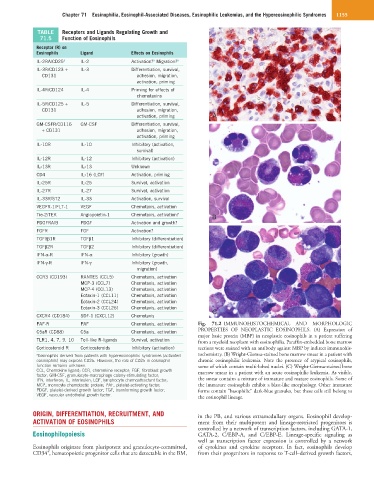
             TABLE   Receptors and Ligands Regulating Growth and
              71.5   Function of Eosinophils
             Receptor (R) on
             Eosinophils   Ligand           Effects on Eosinophils
             IL-2RA/CD25 a  IL-2            Activation?  Migration? a
                                                   a
             IL-3R/CD123 +   IL-3           Differentiation, survival,
               CD131                          adhesion, migration,
                                              activation, priming
             IL-4R/CD124   IL-4             Priming for effects of
                                              chemotaxins
             IL-5R/CD125 +   IL-5           Differentiation, survival,
               CD131                          adhesion, migration,
                                              activation, priming      A
             GM-CSFR/CD116   GM-CSF         Differentiation, survival,
               + CD131                        adhesion, migration,
                                              activation, priming
             IL-10R        IL-10            Inhibitory (activation,
                                              survival)
             IL-12R        IL-12            Inhibitory (activation)
             IL-13R        IL-13            Unknown
             CD4           IL-16 (LCF)      Activation, priming
             IL-25R        IL-25            Survival, activation
             IL-27R        IL-27            Survival, activation
             IL-33R/ST2    IL-33            Activation, survival
             VEGFR-1/FLT-1  VEGF            Chemotaxis, activation
             Tie-2/TEK     Angiopoietin-1   Chemotaxis, activation?   B
             PDGFRA/B      PDGF             Activation and growth?
             FGFR          FGF              Activation?
             TGFßβ1R       TGFβ1            Inhibitory (differentiation)
             TGFβ2R        TGFβ2            Inhibitory (differentiation)
             IFN-α-R       IFN-α            Inhibitory (growth)
             IFN-γ-R       IFN-γ            Inhibitory (growth,
                                              migration)
             CCR3 (CD193)  RANTES (CCL5)    Chemotaxis, activation
                           MCP-3 (CCL7)     Chemotaxis, activation
                           MCP-4 (CCL13)    Chemotaxis, activation
                           Eotaxin-1 (CCL11)  Chemotaxis, activation
                           Eotaxin-2 (CCL24)  Chemotaxis, activation
                           Eotaxin-3 (CCL26)  Chemotaxis, activation
                                                                       C
             CXCR4 (CD184)  SDF-1 (CXCL12)  Chemotaxis
             PAF-R         PAF              Chemotaxis, activation  Fig.  71.2  IMMUNOHISTOCHEMICAL  AND  MORPHOLOGIC
                                                                  PROPERTIES  OF  NEOPLASTIC  EOSINOPHILS.  (A)  Expression  of
             C5aR (CD88)   C5a              Chemotaxis, activation
                                                                  major basic protein (MBP) in neoplastic eosinophils in a patient suffering
             TLR1, 4, 7, 9, 10  Toll-like R-ligands  Survival, activation  from a myeloid neoplasm with eosinophilia. Paraffin-embedded bone marrow
             Corticosteroid R  Corticosteroids  Inhibitory (activation)  sections were stained with an antibody against MBP by indirect immunohis-
             a Eosinophils derived from patients with hypereosinophilic syndromes (activated   tochemistry. (B) Wright-Giemsa-stained bone marrow smear in a patient with
             eosinophils) may express CD25. However, the role of CD25 in eosinophil   chronic  eosinophilic  leukemia.  Note  the  presence  of  atypical  eosinophils,
             function remains unknown.                            some of which contain multi-lobed nuclei. (C) Wright-Giemsa-stained bone
             CCL, Chemokine ligand; CCR, chemokine receptor; FGF, fibroblast growth   marrow smear in a patient with an acute eosinophilic leukemia. As visible,
             factor; GM-CSF, granulocyte-macrophage colony-stimulating factor;
             IFN, interferon; IL, interleukin; LCF, lymphocyte chemoattractant factor;    the smear contains a mixture of immature and mature eosinophils. Some of
             MCP, monocyte chemotactic protein; PAF, platelet-activating factor;    the immature eosinophils exhibit a blast-like morphology. Other immature
             PDGF, platelet-derived growth factor; TGF, transforming growth factor;    forms contain “basophilic” dark-blue granules, but these cells still belong to
             VEGF, vascular endothelial growth factor.
                                                                  the eosinophil lineage.

            ORIGIN, DIFFERENTIATION, RECRUITMENT, AND             in the PB, and various extramedullary organs. Eosinophil develop-
            ACTIVATION OF EOSINOPHILS                             ment  from  their  multipotent  and  lineage-restricted  progenitors  is
                                                                  controlled by a network of transcription factors, including GATA-1,
            Eosinophilopoiesis                                    GATA-2,  C/EBP-A,  and  C/EBP-E.  Lineage-specific  signaling  as
                                                                  well  as  transcription  factor  expression  is  controlled  by  a  network
            Eosinophils originate from pluripotent and granulocyte-committed,   of  cytokines  and  cytokine  receptors.  In  fact,  eosinophils  develop
                 +
            CD34 , hematopoietic progenitor cells that are detectable in the BM,   from their progenitors in response to T-cell–derived growth factors,

