


Page 1325 - Hematology_ Basic Principles and Practice ( PDFDrive )
P. 1325
Chapter 72  Mast Cells and Mastocytosis  1171


            lies between the TM and TK domains. KIT is expressed on hemato-  have shown that certain cytokines or hormonal factors exert inhibi-
            poietic stem/progenitor cells and is also essential for gametogenesis   tory effects on MCs (e.g., interferon [IFN]-γ), and some cytokine
            and melanogenesis. KIT expression is lost when hematopoietic cells   pairs  counterbalance  each  other’s  effects  (e.g.,  T-helper  2  [Th2]
            undergo differentiation. However, the exception is MCs, which retain   cytokine interleukin [IL]-4 vs. regulatory T cell cytokine TGF-β1)
            persistent and high-level expression of KIT (CD117). This can be   on MC homeostasis. Expression of the death receptor tumor necrosis
            exploited  for  the  purposes  of  MC  identification  by  immunohisto-  factor–related  apoptosis-inducing  ligand  and  inhibitor  receptors
            chemistry  and/or  flow  immunophenotyping  (in  conjunction  with   CD300a and Siglec-8 may also contribute to downregulation of MC
            other surface and cytoplasmic markers).               activation, survival, and IgE-mediated responses.
              The two major splice variants of KIT differ by the presence or
            absence of four amino acids (GNNK) at the extracellular JM region.
                                    −
            In  NIH3T3  cells,  the  GNNK   isoform  induced  loss  of  contact   MAST CELL ACTIVATION AND FUNCTION
            inhibition,  anchorage-independent  growth,  and  tumorigenicity  in
                                +
            mice,  whereas  the  GNNK   isoform  did  not  exhibit  most  of  these   MCs commonly reside at the interface between the host and environ-
            characteristics.  Also,  despite  similar  binding  of  SCF  to  KIT,  the   ment,  usually  in  the  skin,  or  in  the  mucosa  lining  the  lungs  or
                 −
            GNNK  isoform displayed more rapid and extensive tyrosine auto-  gastrointestinal tract. Migration and homing of MCs to various sites
            phosphorylation and faster internalization. Preferential expression of   is regulated by the interaction between surface expression of numer-
            the GNNK isoform has been noted in small cohorts of patients with   ous types of chemokine receptors (e.g., CXC chemokine receptor 2)
            SM and germ cell tumors, but larger series are needed to determine   and integrins (e.g., α4β7, α4β1) on MCs to tissue-specific endothe-
            the relevance of these KIT isoforms to disease pathogenesis.  lial binding sites such as mucosal vascular address in cell adhesion
                                                                  molecule-1  (MAdCAM-1)  and  vascular  cell  adhesion  molecule-1
                                                                  (VCAM-1).  In  addition  to  playing  a  primary  role  in  mediating
            Stem Cell Factor                                      allergic  responses  and  inflammation,  MCs  act  as  one  arm  of  the
                                                                  adaptive immune system by playing a role in host defense against
            SCF  (KIT  ligand)  was  identified  by  three  groups  in  1990  as  the   pathogens such as bacteria, fungi, and viruses.
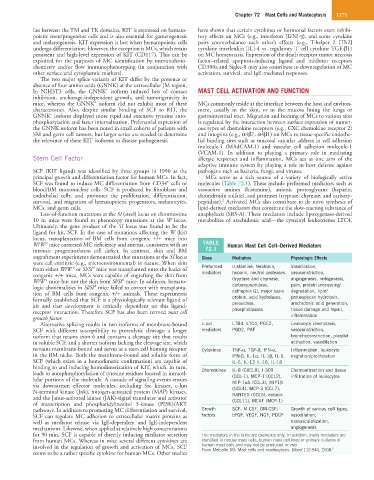
            principal growth and differentiation factor for human MCs. In fact,   MCs  serve  as  a  rich  source  of  a  variety  of  biologically  active
                                                        +
            SCF was found to induce MC differentiation from CD34  cells or   molecules (Table 72.1). These include preformed mediators such as
            blood/BM  mononuclear  cells.  SCF  is  produced  by  fibroblasts  and   vasoactive  amines  (histamine),  anionic  proteoglycans  (heparin,
            endothelial  cells,  and  promotes  the  proliferation,  differentiation,   chrondroitin sulfate), and proteases (tryptase, chymase, and carboxy-
                                                                          2
            survival, and migration of hematopoietic progenitors, melanocytes,   peptidase).  Activated MCs also contribute to de novo synthesis of
            MCs, and germ cells.                                  lipid-derived mediators that constitute the slow-reacting substance of
              Loss-of-function mutations at the SI (steel) locus on chromosome   anaphylaxis (SRS-A). These mediators include lipoxygenase-derived
            10  in  mice  were  found  to  phenocopy  mutations  at  the  W  locus.   metabolites  of  arachidonic  acid—the  cysteinyl  leukotrienes  LTC4,
            Ultimately,  the  gene  product  of  the  SI  locus  was  found  to  be  the
            ligand for kit, SCF. In the case of mutations affecting the W (kit)
            locus,  transplantation  of  BM  cells  from  congenic  +/+  mice  into
                v
            W/W  mice corrected MC deficiency and anemia, consistent with an   TABLE   Human Mast Cell Cell–Derived Mediators
            intrinsic  progenitor/stem  cell  defect.  In  contrast,  skin  and  BM   72.1
            engraftment experiments demonstrated that mutations at the SI locus   Class  Mediators  Physiologic Effects
            were cell extrinsic (e.g., microenvironmental) in nature. When skin
                               d
                         v
            from either W/W  or Sl/Sl  mice was transplanted onto the backs of   Preformed   Histamine, serotonin,   Vasodilation,
            congenic +/+ mice, MCs were capable of engrafting the skin from   mediators  heparin, neutral proteases   vasoconstriction,
                v
                                         d
            W/W  mice but not the skin from Sl/Sl  mice. In addition, hemato-  (tryptase and chymase,   angiogenesis, mitogenesis,
                                d
            logic abnormalities in Sl/Sl  mice failed to correct with transplanta-  carboxypeptidase,   pain, protein processing/
            tion  of  BM  cells  from  congenic  +/+  animals.  These  experiments   cathepsin G), major basic   degradation, lipid/
            formally established that SCF is a physiologically relevant ligand of   protein, acid hydrolases,   proteoglycan hydrolysis,
            kit  and  that  development  is  critically  dependent  on  this  ligand-  peroxidase,   arachidonic acid generation,
            receptor interaction. Therefore SCF has also been termed mast cell   phospholipases  tissue damage and repair,
            growth factor.                                                                      inflammation
              Alternative splicing results in two isoforms of membrane-bound   Lipid   LTB4, LTC4, PGE2,   Leukocyte chemotaxis,
            SCF  with  different  susceptibility  to  proteolytic  cleavage:  a  longer   mediators  PGD2, PAF  vasoconstriction,
            isoform that retains exon 6 and contains a cleavage site that results               bronchoconstriction, platelet
            in soluble SCF, and a shorter isoform lacking the cleavage site, which              activation, vasodilation
            remains membrane-bound and serves as a stem cell homing receptor   Cytokines  TNF-α, TGF-β, IFN-α,   Inflammation, leukocyte
            in the BM niche. Both the membrane-bound and soluble form of     IFN-β, IL-1α, IL-1β, IL-5,   migration/proliferation
            SCF (which exists in a homodimeric confirmation) are capable of   IL-6, IL-13 IL-16, IL-18
            binding to and inducing homodimerization of KIT, which, in turn,   Chemokines  IL-8 (CXCL8), I-309   Chemoattraction and tissue
            leads to autophosphorylation of tyrosine residues located in intracel-  (CCL-1), MCP-1 (CCL2),   infiltration of leukocytes
            lular portions of the molecule. A cascade of signaling events ensues   MIP-1αS (CCL3), MIP1β
            via  downstream  effector  molecules,  including  Src  kinases,  c-Jun   (CCL4), MCP-3 (CCL7),
            N-terminal kinase (Jnk), mitogen-activated protein (MAP) kinases,   RANTES (CCL5), eotaxin
            and the Janus-activated kinase (JAK)-signal transducer and activator   (CCL11), MCAF (MCP-1)
            of  transcription  and  phosphatidylinositol  3-kinase  (PI3K)/AKT
            pathways. In addition to promoting MC differentiation and survival,   Growth   SCF, M-CSF, GM-CSF,   Growth of various cell types,
            SCF can regulate MC  adhesion  to extracellular  matrix  proteins as   factors  bFGF, VEGF, NGF, PDGF  vasodilation,
            well  as  mediator  release  via  IgE-dependent  and  IgE-independent               neovascularization,
            mechanisms. Likewise, when applied at relatively high concentrations                angiogenesis
            for 90 min, SCF is capable of directly inducing mediator secretion   The mediators in the table are examples only. In addition, many mediators are
            from human MCs. Whereas in mice several different cytokines are   identified in mouse mast cells, human mast cell lines or primary cultures of
            involved in the regulation of growth and activation of MCs, SCF   human mast cells and may not be produced in vivo.  2
                                                                   From Metcalfe DD: Mast cells and mastocytosis. Blood 112:946, 2008.
            seems to be a rather specific cytokine for human MCs. Other studies

