


Page 1330 - Hematology_ Basic Principles and Practice ( PDFDrive )
P. 1330
1176   Part VII  Hematologic Malignancies


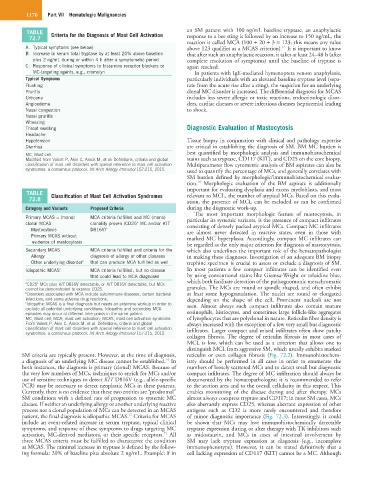
          TABLE   Criteria for the Diagnosis of Mast Cell Activation  an  SM  patient  with  100 ng/mL  baseline  tryptase,  an  anaphylactic
          72.7                                                response to a bee sting is followed by an increase to 150 ng/mL, the
                                                              reaction is called MCA (100 + 20 + 3 = 123; this means any value
          A.  Typical symptoms (see below)                    above 123 qualifies as a MCAS criterion).  It is important to know
                                                                                             15
          B.  Increase in serum total tryptase by at least 20% above baseline   that after such an anaphylactic reaction, it takes at least 24–48 h (after
            plus 2 ng/mL during or within 4 h after a symptomatic period  complete resolution of symptoms) until the baseline of tryptase is
          C.  Response of clinical symptoms to histamine receptor blockers or   again reached.
            MC-targeting agents, e.g., cromolyn                  In patients with IgE-mediated hymenoptera venom anaphylaxis,
         Typical Symptoms                                     particularly individuals with an elevated baseline tryptase level (sepa-
         Flushing                                             rate from the acute rise after a sting), the suspicion for an underlying
         Pruritis                                             clonal MC disorder is increased. The differential diagnosis for MCAS
         Urticaria                                            includes less severe allergic or toxic reactions, endocrinologic disor-
         Angioedema                                           ders, cardiac diseases or severe infectious diseases (septicemia) leading
         Nasal congestion                                     to shock.
         Nasal pruritis
         Wheezing
         Throat swelling                                      Diagnostic Evaluation of Mastocytosis
         Headache
         Hypotension                                          Tissue biopsy in conjunction with clinical and pathology expertise
         Diarrhea                                             are critical in establishing the diagnosis of SM. BM MC burden is
         MC, Mast cell.                                       best quantified by morphologic analysis and immunohistochemical
         Modified from Valent P, Akin C, Arock M, et al: Definitions, criteria and global   stains such as tryptase, CD117 (KIT), and CD25 on the core biopsy.
         classification of mast cell disorders with special reference to mast cell activation   Multiparameter flow cytometric analysis of BM aspirates can also be
         syndromes: a consensus protocol. Int Arch Allergy Immunol 157:215, 2015.  used to quantify the percentage of MCs, and generally correlates with
                                                              SM burden defined by morphologic/immunohistochemical evalua-
                                                                  16
                                                              tion.   Morphologic  evaluation  of  the  BM  aspirate  is  additionally
                                                              important for evaluating dysplasia and excess myeloblasts, and most
          TABLE   Classification of Mast Cell Activation Syndromes  relevant to MCL, the number of atypical MCs. Based on this evalu-
          72.8                                                ation, the presence of MCL can be excluded or can be confirmed
         Category and Variants  Proposed Criteria             during the diagnostic work-up.
                                                                 The  most  important  morphologic  feature  of  mastocytosis,  in
         Primary MCAS = (mono)  MCA criteria fulfilled and MC (mono)  particular its systemic variants, is the presence of compact infiltrates
                                              +
         clonal MCAS           clonality proven (CD25  MC and/or KIT   consisting of densely packed atypical MCs. Compact MC infiltrates
            Mastocytosis       D816V) a                       are  almost  never  detected  in  reactive  states,  even  in  those  with
            Primary MCAS without                              marked MC hyperplasia. Accordingly, compact MC infiltrates can
           evidence of mastocytosis
                                                              be regarded as the only major criterion for diagnosis of mastocytosis,
         Secondary MCAS        MCA criteria fulfilled and criteria for the   which also underlines the important role of the hematopathologist
            Allergy            diagnosis of allergy or other diseases   in making these diagnoses. Investigation of an adequate BM biopsy
            Other underlying disorder b  that can produce MCA fulfilled as well  trephine specimen is crucial to assess or exclude a diagnosis of SM.
         Idiopathic MCAS c     MCA criteria fulfilled, but no disease   In  most  patients  a  few  compact  infiltrates  can  be  identified  even
                               that could lead to MCA diagnosed  by using conventional stains like Giemsa-Wright or toluidine blue,
         a CD25  MCs plus KIT D816V detectable, or KIT D816V detectable, but MCs   which both facilitate detection of the pathognomonic metachromatic
             +
         cannot be demonstrated to express CD25.              granules. The MCs are round or spindle shaped, and often exhibit
         b Disorders associated with MCA include autoimmune diseases, certain bacterial   at  least  some  hypogranulation. The  nuclei  are  round  or  elongated
         infections, and some adverse drug reactions.         depending  on  the  shape  of  the  cell.  Prominent  nucleoli  are  not
         c Idiopathic MCAS is a final diagnosis but needs an extensive workup in order to   seen.  Almost  always  such  compact  infiltrates  also  contain  mature
         exclude all potential underlying conditions. Idiopathic and secondary MCA
         episodes may occur at different time points in the same patient.  eosinophils, histiocytes, and sometimes large follicle-like aggregates
         MC, Mast cell; MCA, mast cell activation; MCAS, mast cell activation syndrome.  of lymphocytes that are polyclonal in nature. Reticulin fiber density is
         From Valent P, Akin C, Arock M, et al. Definitions, criteria and global   always increased with the exception of a few very small but diagnostic
         classification of mast cell disorders with special reference to mast cell activation   infiltrates. Larger compact and mixed infiltrates often show patchy
         syndromes: a consensus protocol. Int Arch Allergy Immunol 157:215, 2012.
                                                              collagen  fibrosis. The  degree  of  reticulin  fibrosis  in  most  cases  of
                                                              MCL  is  low,  which  can  be  used  as  a  criterion  that  allows  one  to
                                                              distinguish MCL from aggressive SM, which usually exhibits marked
        SM criteria are typically present. However, at the time of diagnosis,   reticulin  or  even  collagen  fibrosis  (Fig.  72.2).  Immunohistochem-
                                                       16
        a diagnosis of an underlying MC disease cannot be established.  In   istry  should  be  performed  in  all  cases  in  order  to  enumerate  the
        both instances, the diagnosis is primary (clonal) MCAS. Because of   numbers of loosely scattered MCs and to detect small but diagnostic
        the very low numbers of MCs, techniques to enrich for MCs and/or   compact infiltrates. The degree of MC infiltration should always be
        use of sensitive techniques to detect KIT D816V (e.g., allele-specific   documented by the hematopathologist: it is recommended to refer
        PCR) may be necessary to detect neoplastic MCs in these patients.   to the section area and to the overall cellularity in this respect. This
        Currently, there is no evidence that these two entities are “prodromal”   enables  monitoring  of  the  disease  during  and  after  therapy.  MCs
        SM conditions with a defined rate of progression to systemic MC   almost always coexpress tryptase and CD117; in most SM cases, MCs
        disease. If neither an underlying allergy or another underlying reactive   also aberrantly express CD25, whereas aberrant expression of other
        process nor a clonal population of MCs can be detected in an MCAS   antigens  such  as  CD2  is  more  rarely  encountered  and  therefore
                                           15
        patient, the final diagnosis is idiopathic MCAS.  Criteria for MCAS   of  minor  diagnostic  importance  (Fig.  72.3).  Interestingly,  it  could
        include an event-related increase in serum tryptase, typical clinical   be  shown  that  MCs  may  lose  immunohistochemically  detectable
        symptoms, and response of these symptoms to drugs targeting MC   tryptase expression during or after therapy with TK inhibitors such
                                                       15
        activation,  MC-derived  mediators,  or  their  specific  receptors.   All   as  midostaurin,  and  MCs  in  cases  of  intestinal  involvement  by
        three MCAS criteria must be fulfilled to characterize the condition   SM  may  lack  tryptase  expression  at  diagnosis  (e.g.,  incomplete
        as MCAS. The minimal increase in tryptase is defined by the follow-  immunophenotype).  However,  it  can  be  stated  definitively  that  a
        ing formula: 20% of baseline plus absolute 2 ng/mL. Example: if in   cell lacking expression of CD117 (KIT) cannot be a MC. Although

