


Page 1327 - Hematology_ Basic Principles and Practice ( PDFDrive )
P. 1327
Chapter 72  Mast Cells and Mastocytosis  1173


                                                                    Diagnostic criteria for SM were initially formulated by a working
            Germline Susceptibility to Mast Cell Disorders and    group of MC disease experts at a consensus conference in Vienna in
            Familial Mastocytosis                                 2000,  and adopted by the WHO in both 2001 and 2008.  In the
                                                                                                              4
                                                                      3
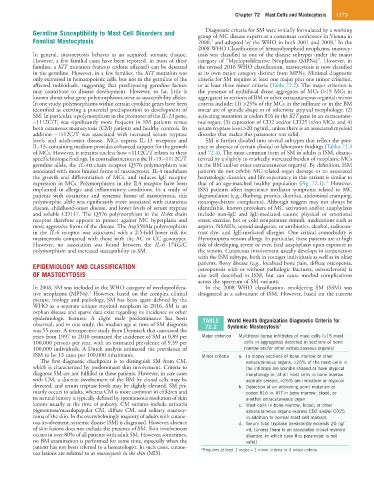
                                                                  2008 WHO Classification of hematolymphoid neoplasms, mastocy-
            In  general,  mastocytosis  behaves  as  an  acquired,  somatic  disease.   tosis was classified as one of the disease subtypes under the major
            However, a few familial cases have been reported. In most of these   category  of  “Myeloproliferative  Neoplasms  (MPNs)”.  However,  in
            families, a KIT mutation (various codons affected) can be detected   the revised 2016 WHO classification, mastocytosis is now classified
            in the germline. However, in a few families, the KIT mutation was   as its own major category distinct from MPNs. Minimal diagnostic
            only expressed in hematopoietic cells, but not in the germline of the   criteria for SM requires at least one major plus one minor criterion,
            affected  individuals,  suggesting  that  predisposing  germline  factors   or at least three minor criteria (Table 72.2). The major criterion is
            may  contribute  to  disease  development.  However,  so  far,  little  is   the presence of  multifocal  dense aggregates of  MCs  (>15 MCs in
            known about what gene polymorphisms serve as susceptibility alleles.   aggregates) in sections of BM or other extracutaneous organ(s); minor
            In one study, polymorphisms within certain cytokine genes have been   criteria include: (1) >25% of the MCs in the infiltrate or in the BM
            identified as exerting a potential predisposition to development of   smear are of spindle shape or of otherwise atypical morphology; (2)
            SM. In particular, a polymorphism in the promoter of the IL-13 gene,   activating mutation at codon 816 in the KIT gene in an extracutane-
            −1112C/T,  was  significantly  more  frequent  in  SM  patients  versus   ous organ; (3) expression of CD2 and/or CD25 in/on MCs; and 4)
            both cutaneous mastocytosis (CM) patients and healthy controls. In   serum tryptase level >20 ng/mL, unless there is an associated myeloid
            addition  −1112C/T  was  associated  with  increased  serum  tryptase   disorder that makes this parameter not valid.
            levels  and  adult-onset  disease.  MCs  express  IL-13  receptors  and   SM is further divided into several subtypes that reflect the pres-
            IL-13–containing medium provides enhanced support for the growth   ence or absence of certain clinical or laboratory findings (Tables 72.3
            of MCs. However, it remains unclear how −1112C/T relates to these   and 72.4). The most common form of SM in adults is ISM, charac-
            specific biologic findings. In contradistinction to the IL-13 −1112C/T   terized by a slightly to markedly increased burden of neoplastic MCs
            germline allele, the IL-4α chain receptor Q576 polymorphism was   in the BM and/or other extracutaneous organ(s). By definition, ISM
            associated with more limited forms of mastocytosis. IL-4 modulates   patients do not exhibit MC-related organ damage or an associated
            the  growth  and  differentiation  of  MCs,  and  induces  IgE  receptor   hematologic disorder, and life expectancy in this variant is similar to
                                                                                                           11
            expression in MCs. Polymorphisms in the IL4 receptor have been   that of an age-matched healthy population (Fig. 72.1).  However,
            implicated  in  allergic  and  inflammatory  conditions.  In  a  study  of   ISM  patients  often  experience  mediator  symptoms  related  to  MC
            patients  with  cutaneous  and  systemic  forms  of  mastocytosis,  this   degranulation (e.g., flushing, pruritis, diarrhea, abdominal cramping,
            polymorphic allele was significantly more associated with cutaneous   neuropsychiatric complaints). Although triggers may not always be
            disease, childhood-onset disease, and lower levels of serum tryptase   identifiable, known provokers of MC activation and/or anaphylaxis
            and soluble CD117. The Q576 polymorphism in the IL4α chain   include  non-IgE  and  IgE-mediated  causes:  physical  or  emotional
            receptor  therefore  appears  to  protect  against  MC  hyperplasia  and   stress, exercise, hot or cold temperature stimuli, medications such as
            more aggressive forms of the disease. The Asp358Ala polymorphism   aspirin, NSAIDs, opioid analgesics, or antibiotics, alcohol, radiocon-
            in  the  IL-6  receptor  was  associated  with  a  2.5-fold  lower  risk  for   trast  dye,  and  IgE-mediated  allergies.  One  critical  comorbidity  is
            mastocytosis compared with those with the AC or CC genotypes.   Hymenoptera venom allergy. In particular, these patients are at high
            However,  no  association  was  found  between  the  IL-6  174G/C   risk of developing severe or even fatal anaphylaxis upon exposure to
            polymorphism and increased susceptibility to SM.      the venom. Cutaneous involvement usually develops in conjunction
                                                                  with the ISM subtype, both in younger individuals as well as in older
            EPIDEMIOLOGY AND CLASSIFICATION                       patients. Bony disease (e.g., localized bone pain, diffuse osteopenia,
                                                                  osteoporosis with or without pathologic fractures, osteosclerosis) is
            OF MASTOCYTOSIS                                       also  well  described  in  ISM,  but  can  cause  morbid  complications
                                                                  across the spectrum of SM variants.
            In 2008, SM was included in the WHO category of myeloprolifera-  In  the  2008  WHO  classification,  smoldering  SM  (SSM)  was
                              4
            tive  neoplasms  (MPNs).   However,  based  on  the  complex  clinical   designated as a subvariant of ISM. However, based on the current
            picture, biology and pathology, SM has been again defined by the
            WHO as a separate unique myeloid neoplasm in 2016. SM is an
            orphan disease and sparse data exist regarding its incidence or other
            epidemiologic  features.  A  slight  male  predominance  has  been   TABLE   World Health Organization Diagnostic Criteria for
            observed, and in one study, the median age at time of SM diagnosis   72.2  Systemic Mastocytosis a
            was 55 years. A retrospective study from Denmark that canvassed the
            years from 1997 to 2010 estimated the incidence of SM at 0.89 per   Major criterion  Multifocal dense infiltrates of mast cells (>15 mast
            100,000 persons per year, with an estimated prevalence of 9.59 per   cells in aggregates) detected in sections of bone
            100,000 individuals. A Dutch analysis estimated the prevalence of    marrow and/or other extracutaneous organ(s)
            ISM to be 13 cases per 100,000 inhabitants.            Minor criteria   a.  In biopsy sections of bone marrow or other
              The  first  diagnostic  checkpoint  is  to  distinguish  SM  from  CM,   extracutaneous organs, >25% of the mast cells in
            which is characterized by predominant skin involvement. Criteria to   the infiltrate are spindle shaped or have atypical
            diagnose SM are not fulfilled in these patients. However, in rare cases   morphology or, of all mast cells in bone marrow
            with CM, a discrete involvement of the BM by clonal cells may be     aspirate smears, >25% are immature or atypical
            detected, and serum tryptase levels may be slightly elevated. SM pri-   b.  Detection of an activating point mutation at
            marily occurs in adults, whereas CM is more common in children and   codon 816 in KIT in bone marrow, blood, or
            its natural history is typically defined by spontaneous resolution of skin   another extracutaneous organ
            lesions usually at the time of puberty. CM variants include urticaria    c.  Mast cells in bone marrow, blood, or other
            pigmentosa/maculopapular  CM,  diffuse  CM,  and  solitary  mastocy-  extracutaneous organs express CD2 and/or CD25
            toma of the skin. In the overwhelmingly majority of adults with cutane-  in addition to normal mast cell markers
            ous involvement, systemic disease (SM) is diagnosed. However, absence    d.  Serum total tryptase persistently exceeds 20 ng/
            of skin lesions does not exclude the presence of SM. Skin involvement   mL (unless there is an associated clonal myeloid
            occurs in over 80% of all patients with adult SM. However, sometimes,   disorder, in which case this parameter is not
            no BM examination is performed for some time, especially when the    valid)
            patient has not been referred to a hematologist. In such cases, cutane-  a Requires at least 1 major + 1 minor criteria or 3 minor criteria.
            ous lesions are referred to as mastocytosis in the skin (MIS).

