


Page 1329 - Hematology_ Basic Principles and Practice ( PDFDrive )
P. 1329
Chapter 72  Mast Cells and Mastocytosis  1175


             Expected US survival compared to all systemic mastocytosis patients  TABLE   “C” Findings: Indication of Organ Damage Attributable
              100                                                   72.6   to Neoplastic Mast Cell Infiltration
                                         Observed survival
                                         Expected US survival      1.  Cytopenia(s): Absolute neutrophil count <1000/µL or hemoglobin
               80                                                    <10 g/dL or platelets <100,000/µL
                                                                   2.  Hepatomegaly with ascites and/or impaired liver function
                                                                   3.  Palpable splenomegaly with hypersplenism
               60
             Survival  40                                          4.  Malabsorption with hypoalbuminemia and weight loss
                                                                   5.  Skeletal lesions: large-sized osteolyses or severe osteoporosis
                                                                     causing pathologic fractures
                                                                   6.  Life-threatening organopathy in other organ systems that is
               20                                                    definitively caused by an infiltration of the tissue by neoplastic mast
                                                                     cells
                0
                  0          10        20         30
            A                    Years from Dx                    nuclei, metachromatic blasts, and mitotic figures. In MCL, circulat-
                                                                  ing  MCs  (≥10%  of  nucleated  cells)  may  be  found;  however,  the
                                                                  aleukemic MCL variant (<10% MCs in the peripheral blood) is more
                                                                  common. MCL may arise de novo or progress from less advanced
                                                                  forms of SM, such as ASM with elevated MC counts on the BM
              Expected US Survival compared to WHO classification       13
                                                                  aspirate.  MCL typically has a dismal prognosis with a life expectancy
              100                         ISM, (n=159)            of 6 months or less in most patients (see Fig. 72.1). 11,13,14  However,
                                          ASM, (n=41)             a chronic form of MCL has also been described, wherein patients
                                          SM-AHN, (n=138)         meet histopathologic criteria for the disease, but without C findings
               80                         MCL, (n=4)              (see later).  In these cases, MCs tend to show a more mature mor-
                                                                         13
                                          Expected US survival    phology. However, even those with the initially more indolent form
               60
             Survival                                             of (chronic) MCL are expected to show progression over time with
                                                                  development of organ damage (transformation to acute MCL) and
                                                                  limited survival.
               40
                                                                    MC sarcoma (MCS) is a rare MC tumor that can invade local
                                                                  tissues and has a high potential to develop advanced systemic disease
               20
                                                                  with a fulminant course. In particular, most if not all patients with
                                                                  MCS progress to MCL within a relatively short time period. Extra-
                0                                                 cutaneous  mastocytoma  is  another  rare  SM  variant  that  typically
                                                                  follows a benign course.
                  0         10         20         30
                                                                    Well-differentiated  SM  (WDSM)  is  a  more  recently  described,
            B                    Years from Dx                    rare variant of SM that is not yet formally recognized by the WHO
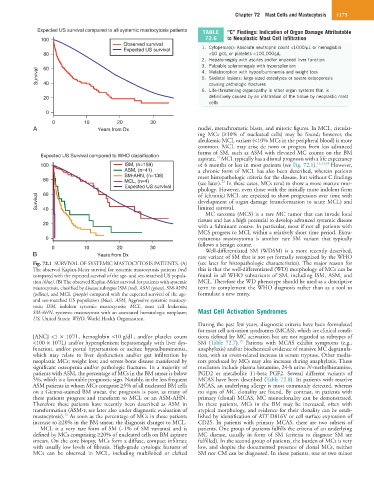
            Fig. 72.1  SURVIVAL OF SYSTEMIC MASTOCYTOSIS PATIENTS. (A)   (see later for histopathologic characteristics). The major reason for
            The observed Kaplan-Meier survival for systemic mastocytosis patients (red)   this is that the well-differentiated (WD) morphology of MCs can be
            compared with the expected survival of the age- and sex-matched US popula-  found in all WHO subvariants of SM, including ISM, ASM, and
            tion (blue). (B) The observed Kaplan-Meier survival for patients with systemic   MCL. Therefore the WD phenotype should be used as a descriptive
            mastocytosis, classified by disease subtypes ISM (red), ASM (green), SM-AHN   term to complement the WHO diagnosis rather than as a tool to
            (yellow), and MCL (purple) compared with the expected survival of the age-   formulate a new entity.
            and sex-matched US population (blue). ASM, Aggressive systemic mastocy-
            tosis;  ISM,  indolent  systemic  mastocytosis;  MCL,  mast  cell  leukemia;
            SM-AHN, systemic mastocytosis with an associated hematologic neoplasm;   Mast Cell Activation Syndromes
            US, United States; WHO, World Health Organization.
                                                                  During the past few years, diagnostic criteria have been formulated
                                                                  for mast cell activation syndromes (MCAS), which are clinical condi-
                        9
            [ANC]  <1  ×  10 /L,  hemoglobin  <10 g/dL,  and/or  platelet  count   tions defined by MC activation but are not regarded as subtypes of
                                                                               15
                    9
            <100 × 10 /L) and/or hypersplenism; hepatomegaly with liver dys-  SM  (Table  72.7).   Patients  with  MCAS  exhibit  symptoms  (e.g.,
            function, and/or portal hypertension or ascites; hypoalbuminemia,   anaphylaxis) and/or biochemical evidence of massive MC degranula-
            which  may  relate  to  liver  dysfunction  and/or  gut  infiltration  by   tion, with an event-related increase in serum tryptase. Other media-
            neoplastic MCs; weight loss; and severe bone disease manifested by   tors produced by MCs may also increase during anaphylaxis. These
            significant osteopenia and/or pathologic fractures. In a majority of   mediators include plasma histamine, 24-h urine N-methylhistamine,
            patients with ASM, the percentage of MCs in the BM smear is below   PGD2  or  metabolite  11-beta  PGF2.  Several  different  variants  of
            5%, which is a favorable prognostic sign. Notably, in the less frequent   MCAS have been described (Table 72.8). In patients with reactive
            ASM patients in whom MCs comprise ≥5% of all nucleated BM cells   MCAS, an underlying allergy is most commonly detected, whereas
            on a Giemsa-stained BM smear, the prognosis is poor, as many of   no signs of MC clonality are found. By contrast, in patients with
            these  patients  progress  and  transform  to  MCL  or  an  ASM-AHN.   primary (clonal) MCAS, MC monoclonality can be demonstrated.
            Therefore  these  patients  have  recently  been  described  as  ASM  in   In  these  patients,  MCs  in  the  BM  may  be  increased,  often  with
            transformation (ASM-t; see later also under diagnostic evaluation of   atypical morphology, and evidence for their clonality can be estab-
                      13
            mastocytosis).  As soon as the percentage of MCs in these patients   lished by identification of KIT D816V or cell surface expression of
            increase to ≥20% in the BM smear, the diagnosis changes to MCL.  CD25.  In  patients  with  primary  MCAS,  there  are  two  subsets  of
              MCL  is  a  very  rare  form  of  SM  (~1%  of  SM  variants)  and  is   patients. One group of patients fulfills the criteria of an underlying
            defined by MCs comprising ≥20% of nucleated cells on BM aspirate   MC  disease,  usually  in  form  of  SM  (criteria  to  diagnose  SM  are
            smears. On the core biopsy, MCs form a diffuse, compact infiltrate   fulfilled). In the second group of patients, the burden of MCs is very
            with usually low levels of fibrosis. High-grade cytologic features of   low, and despite the documented presence of clonal MCs, neither
            MCs  can  be  observed  in  MCL,  including  multilobed  or  clefted   SM nor CM can be diagnosed. In these patients, one or two minor

