


Page 1328 - Hematology_ Basic Principles and Practice ( PDFDrive )
P. 1328
1174   Part VII  Hematologic Malignancies


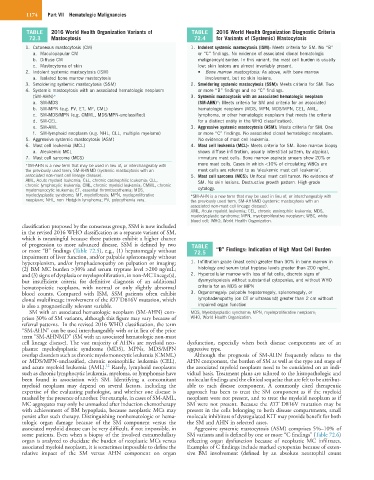
          TABLE   2016 World Health Organization Variants of    TABLE   2016 World Health Organization Diagnostic Criteria
          72.3    Mastocytosis                                  72.4    for Variants of (Systemic) Mastocytosis
         1.  Cutaneous mastocytosis (CM)                       1.  Indolent systemic mastocytosis (ISM): Meets criteria for SM. No “B”
             a.  Maculopapular CM                                 or “C” findings. No evidence of associated clonal hematologic
             b.  Diffuse CM                                       malignancy/disorder. In this variant, the mast cell burden is usually
             c.  Mastocytoma of skin                              low; skin lesions are almost invariably present.
         2.  Indolent systemic mastocytosis (ISM)                 •  Bone marrow mastocytosis: As above, with bone marrow
             a.  Isolated bone marrow mastocytosis                  involvement, but no skin lesions.
         3.  Smoldering systemic mastocytosis (SSM)            2.  Smoldering systemic mastocytosis (SSM): Meets criteria for SM. Two
         4.  Systemic mastocytosis with an associated hematologic neoplasm   or more “B” findings and no “C” findings.
            (SM-AHN)*                                          3.  Systemic mastocytosis with an associated hematologic neoplasm
             a.  SM-MDS                                           (SM-AHN)*: Meets criteria for SM and criteria for an associated
             b.  SM-MPN (e.g. PV, ET, MF, CML)                    hematologic neoplasm (MDS, MPN, MDS/MPN, CEL, AML,
             c.  SM-MDS/MPN (e.g. CMML, MDS/MPN-unclassified)     lymphoma, or other hematologic neoplasm that meets the criteria
             d.  SM-CEL                                           for a distinct entity in the WHO classification).
             e.  SM-AML                                        3.  Aggressive systemic mastocytosis (ASM): Meets criteria for SM. One
             f.  SM-lymphoid neoplasm (e.g. NHL, CLL, multiple myeloma)  or more “C” findings. No associated clonal hematologic neoplasm.
         5.  Aggressive systemic mastocytosis (ASM)               No evidence of mast cell leukemia.
         6.  Mast cell leukemia (MCL)                          4.  Mast cell leukemia (MCL): Meets criteria for SM. Bone marrow biopsy
             a.  Aleukemic MCL                                    shows diffuse infiltration, usually interstitial pattern, by atypical,
         7.  Mast cell sarcoma (MCS)                              immature mast cells. Bone marrow aspirate smears show 20% or
         *SM-AHN is a new term that may be used in lieu of, or interchangeably with   more mast cells. Cases in which <10% of circulating WBCs are
         the previously used term, SM-AHNMD (systemic mastocytosis with an   mast cells are referred to as ‘aleukemic mast cell leukemia’.
         associated non-mast cell lineage disease).            5.  Mast cell sarcoma (MCS): Unifocal mast cell tumor. No evidence of
         AML, Acute myeloid leukemia; CEL, chronic eosinophilic leukemia; CLL,   SM. No skin lesions. Destructive growth pattern. High-grade
         chronic lymphocytic leukemia; CML, chronic myeloid leukemia; CMML, chronic
         myelomonocytic leukemia; ET, essential thrombocythemia; MDS,   cytology.
         myelodysplastic syndrome; MF, myelofibrosis; MPN, myeloproliferative   *SM-AHN is a new term that may be used in lieu of, or interchangeably with
         neoplasm; NHL, non–Hodgkin lymphoma; PV, polycythemia vera.  the previously used term, SM-AHNMD (systemic mastocytosis with an
                                                               associated non-mast cell lineage disease).
                                                               AML, Acute myeloid leukemia; CEL, chronic eosinophiic leukemia; MDS,
                                                               myelodysplastic syndrome; MPN, myeloproliferative neoplasm; WBC, white
                                                               blood cell; WHO, World Health Organization.
        classification proposed by the consensus group, SSM is now included
        in the revised 2016 WHO classification as a separate variant of SM,
        which is meaningful because these patients exhibit a higher chance
        of  progression  to  more  advanced  disease.  SSM  is  defined  by  two     TABLE
        or more “B” findings (Table 72.5), e.g., (1) hepatomegaly without   72.5  “B” Findings: Indication of High Mast Cell Burden
        impairment of liver function, and/or palpable splenomegaly without
        hypersplenism, and/or lymphadenopathy on palpation or imaging;   1.  Infiltration grade (mast cells) greater than 30% in bone marrow in
        (2) BM MC burden >30% and serum tryptase level >200 ng/mL;   histology and serum total tryptase levels greater than 200 ng/mL
        and (3) signs of dysplasia or myeloproliferation, in non-MC lineage(s),   2.  Hypercellular marrow with loss of fat cells, discrete signs of
        but  insufficient  criteria  for  definitive  diagnosis  of  an  additional   dysmyelopoiesis without substantial cytopenias, and without WHO
        hematopoietic  neoplasm,  with  normal  or  only  slightly  abnormal   criteria for an MDS or MPN
        blood  counts.  Compared  with  ISM,  SSM  patients  often  exhibit   3.  Organomegaly: palpable hepatomegaly, splenomegaly, or
        clonal multilineage involvement of the KIT D816V mutation, which   lymphadenopathy (on CT or ultrasound) greater than 2 cm without
        is also a prognostically relevant variable.               impaired organ function
           SM with an associated hematologic neoplasm (SM-AHN) com-  MDS, Myelodysplastic syndrome; MPN, myeloproliferative neoplasm;
        prises 30% of SM variants, although this figure may vary because of   WHO, World Health Organization.
        referral patterns.  In the revised 2016 WHO classification, the term
        “SM-AHN” can be used interchangeably with or in lieu of the prior
        term “SM-AHNMD” (SM with an associated hematologic non-mast
        cell lineage disease). The vast majority of AHNs are myeloid neo-  dysfunction,  especially  when  both  disease  components  are  of  an
        plasms:  myelodysplastic  syndrome  (MDS),  MPNs,  MDS/MPN   aggressive type.
        overlap disorders such as chronic myelomonocytic leukemia (CMML)   Although  the  prognosis  of  SM-AHN  frequently  relates  to  the
        or  MDS/MPN-unclassified,  chronic  eosinophilic  leukemia  (CEL),   AHN component, the burden of SM as well as the type and stage of
                                    12
        and acute myeloid leukemia (AML).  Rarely, lymphoid neoplasms   the associated myeloid neoplasm need to be considered on an indi-
        such as chronic lymphocytic leukemia, myeloma, or lymphomas have   vidual basis. Treatment plans are tailored to the histopathologic and
        been  found  in  association  with  SM.  Identifying  a  concomitant   molecular findings and the clinical sequelae that are felt to be attribut-
        myeloid  neoplasm  may  depend  on  several  factors,  including  the   able  to  each  disease  component.  A  commonly  cited  therapeutic
        expertise of the evaluating pathologist, and whether one disease is   approach  has  been  to  treat  the  SM  component  as  if  the  myeloid
        masked by the presence of another. For example, in cases of SM-AML,   neoplasm were not present, and to treat the myeloid neoplasm as if
        MC aggregates may only be unmasked after induction chemotherapy   SM  were  not  present.  Because  the  KIT  D816V  mutation  may  be
        with achievement of BM hypoplasia, because neoplastic MCs may   present in the cells belonging to both disease compartments, small
        persist after such therapy. Distinguishing nonhematologic or hema-  molecule inhibitors of dysregulated KIT may provide benefit for both
        tologic  organ  damage  because  of  the  SM  component  versus  the   the SM and AHN in selected cases.
        associated myeloid disease can be very difficult, if not impossible, in   Aggressive systemic mastocytosis (ASM) comprises 5%–10% of
        some patients. Even when a biopsy of the involved extramedullary   SM variants and is defined by one or more “C findings” (Table 72.6)
        organ is analyzed to elucidate the burden of neoplastic MCs versus   reflecting  organ  dysfunction  because  of  neoplastic  MC  infiltrates.
        associated myeloid neoplasm, it is sometimes impossible to define the   Examples of C findings include marked cytopenias because of exten-
        relative  impact  of  the  SM  versus  AHN  component  on  organ   sive  BM  involvement  (defined  by  an  absolute  neutrophil  count

