


Page 1402 - Hematology_ Basic Principles and Practice ( PDFDrive )
P. 1402
1248   Part VII  Hematologic Malignancies


                                      C


                                      D


          A          B                E                                      F                  G
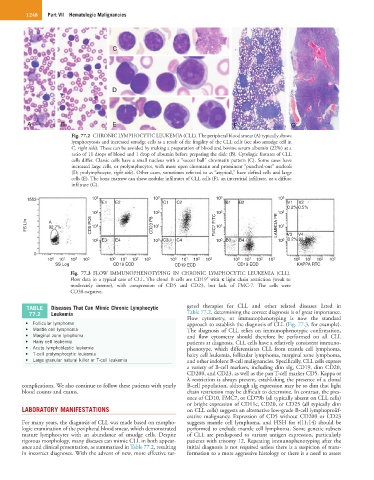
                        Fig. 77.2  CHRONIC LYMPHOCYTIC LEUKEMIA (CLL). The peripheral blood smear (A) typically shows
                        lymphocytosis and increased smudge cells as a result of the fragility of the CLL cells (see also smudge cell in
                        C, right side). These can be avoided by making a preparation of blood and bovine serum albumin (22%) at a
                        ratio of 11 drops of blood and 1 drop of albumin before preparing the slide (B). Cytologic features of CLL
                        cells differ. Classic cells have a small nucleus with a “soccer ball” chromatin pattern (C). Some cases have
                        increased large cells, or prolymphocytes, with more open chromatin and prominent “punched-out” nucleoli
                        (D; prolymphocyte, right side). Other cases, sometimes referred to as “atypical,” have clefted cells and large
                        cells (E). The bone marrow can show nodular infiltrates of CLL cells (F), an interstitial infiltrate, or a diffuse
                        infiltrate (G).

          1553                 10 3                10 3                 10 3                10 3
                                  E1   E2             C1   C2              B1  B2              V1     V2
                                                                                               0.2% 0.5%
                               10 2                10 2                  2                   2
          FS LIn  A            CD5 PC6  10 1       CD23 P8  10 1       FMC7 FITC 10 1       LAMBDA PE 10 1
                                                                                            10
                                                                        10
                 92.7%
                                                                                               V3     V4
                               10 0     E3  E4     10 0     C3  C4      10 0     B3  B4     10 0    0.2% 99.2%
            0
                 10 0       10 1  10 2        10 3  10 0       10 1       10 2        10 3  10 0       10 1  10 2        10 3  10 0       10 1       10 2        10 3  10 0       10 1       10 2        10 3
                   SS Log             CD19 ECD            CD19 ECD             CD19 ECD           KAPPA RTC
                        Fig.  77.3  FLOW  IMMUNOPHENOTYPING  IN  CHRONIC  LYMPHOCYTIC  LEUKEMIA  (CLL).
                                                                     +
                        Flow data in a typical case of CLL. The clonal B cells are CD19  with κ light chain restriction (weak to
                        moderately  intense),  with  coexpression  of  CD5  and  CD23,  but  lack  of  FMC-7.  The  cells  were
                        CD38-negative.

          TABLE   Diseases That Can Mimic Chronic Lymphocytic   geted  therapies  for  CLL  and  other  related  diseases  listed  in
          77.2    Leukemia                                    Table 77.2, determining the correct diagnosis is of great importance.
                                                              Flow  cytometry,  or  immunophenotyping  is  now  the  standard
         •  Follicular lymphoma                               approach to establish the diagnosis of CLL (Fig. 77.3, for example).
         •  Mantle cell lymphoma                              The  diagnosis  of  CLL  relies  on  immunophenotypic  confirmation,
         •  Marginal zone lymphoma                            and  flow  cytometry  should  therefore  be  performed  on  all  CLL
         •  Hairy cell leukemia                               patients at diagnosis. CLL cells have a relatively consistent immuno-
         •  Acute lymphoblastic leukemia                      phenotype,  which  differentiates  CLL  from  mantle  cell  lymphoma,
         •  T-cell prolymphocytic leukemia                    hairy cell leukemia, follicular lymphoma, marginal zone lymphoma,
         •  Large granular natural killer or T-cell leukemia  and other indolent B-cell malignancies. Specifically, CLL cells express
                                                              a variety of B-cell markers, including dim sIg, CD19, dim CD20,
                                                              CD200, and CD23, as well as the pan T-cell marker CD5. Kappa or
                                                              λ restriction is always present, establishing the presence of a clonal
        complications. We also continue to follow these patients with yearly   B-cell population, although sIg expression may be so dim that light
        blood counts and exams.                               chain restriction may be difficult to determine. In contrast, the pres-
                                                              ence of CD10, FMC7, or CD79b (all typically absent on CLL cells)
                                                              or bright expression of CD11c, CD20, or CD25 (all typically dim
        LABORATORY MANIFESTATIONS                             on CLL cells) suggests an alternative low-grade B-cell lymphoprolif-
                                                              erative malignancy. Expression of CD5 without CD200 or CD23
        For many years, the diagnosis of CLL was made based on morpho-  suggests  mantle  cell  lymphoma,  and  FISH  for  t(11;14)  should  be
        logic examination of the peripheral blood smear, which demonstrated   performed to exclude mantle cell lymphoma. Some genetic subsets
        mature  lymphocytes  with  an  abundance  of  smudge  cells.  Despite   of  CLL  are  predisposed  to  variant  antigen  expression,  particularly
        rigorous morphology, many diseases can mimic CLL in both appear-  patients with trisomy 12. Repeating immunophenotyping after the
        ance and clinical presentation, as summarized in Table 77.2, resulting   initial diagnosis is not required unless there is a suspicion of trans-
        in incorrect diagnoses. With the advent of new, more effective tar-  formation to a more aggressive histology or there is a need to assess

