


Page 1399 - Hematology_ Basic Principles and Practice ( PDFDrive )
P. 1399
Chapter 77  Chronic Lymphocytic Leukemia  1245


                30                                                inhibitor idelalisib and syk inhibitors have been shown to antagonize
                                             27.6
                                                  26.4            these  survival  signals  and  result  in  clinically  meaningful  disease
                                                                  responses.
               Percent of new cases 25  9.2            13.6       IGHV Mutational Status
                                         21.2
                20
                15
                                                                  Two seminal manuscripts in 1999 demonstrated that the IGHV gene
                                                                  had undergone somatic mutation, indicating that the patient’s CLL
                10
                                                                  at diagnosis. Detailed epigenetic studies examining the methylation
                 5                                                arose after this point in B-cell maturation, in 60% of CLL patients
                               1.7                                changes occurring in normal B cells during development have subse-
                     0.0  0.2                                     quently  suggested  that  immunoglobulin  mutational  analysis  may
                 0                                                indicate simply where in normal B-cell development transformation
                     <20  20–34  35–44  45–54  55–64  65–74  75–84  >84  occurred. In an attempt to identify surrogate genes associated with
                                                                  IGHV-unmutated  disease,  ZAP-70  overexpression  was  identified.
                                     Age (y)                      The majority of IGHV-unmutated CLL cells have ZAP-70 expres-
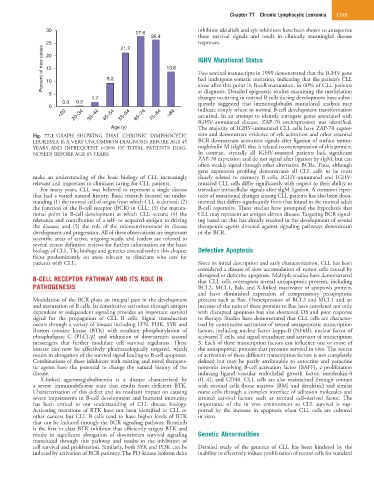
            Fig.  77.1  GRAPH  SHOWING  THAT  CHRONIC  LYMPHOCYTIC   sion and demonstrate evidence of syk activation and other essential
            LEUKEMIA IS A VERY UNCOMMON DIAGNOSIS BEFORE AGE 45   BCR downstream activation signals after ligation of surface immu-
            YEARS  AND  INFREQUENT  (<30%  OF  TOTAL  PATIENTS  DIAG-  noglobulin M (sIgM) that is related to overexpression of this protein.
            NOSED) BEFORE AGE 65 YEARS.                           In  contrast,  virtually  all  IGHV-mutated  patients  lack  significant
                                                                  ZAP-70 expression and do not signal after ligation by sIgM, but can
                                                                  often weakly signal through other alternative BCRs. Thus, although
                                                                  gene  expression  profiling  demonstrates  all  CLL  cells  to  be  most
            make  an  understanding  of  the  basic  biology  of  CLL  increasingly   closely  related  to  memory  B  cells,  IGHV-unmutated  and  IGHV-
            relevant and important to clinicians caring for CLL patients.  mutated CLL cells differ significantly with respect to their ability to
              For many years, CLL was believed to represent a single disease   transduce intracellular signals after sIgM ligation. A common reper-
            that had a varied natural history. Basic research focused on under-  toire of mutational changes among CLL patients has also been docu-
            standing (1) the normal cell of origin from which CLL is derived; (2)   mented that differs significantly from that found in the normal adult
            the function of the B-cell receptor (BCR) in CLL; (3) the matura-  B-cell repertoire. These studies have prompted the hypothesis that
            tional  point  in  B-cell  development  at  which  CLL  occurs;  (4)  the   CLL may represent an antigen-driven disease. Targeting BCR signal-
            relevance and contribution of a self- or acquired-antigen to driving   ing based on this has already resulted in the development of several
            the  disease;  and  (5)  the  role  of  the  microenvironment  in  disease   therapeutic agents directed against signaling pathways downstream
            development and progression. All of these observations are important   of the BCR.
            scientific areas of active, ongoing study, and readers are referred to
            several recent definitive reviews for further information on the basic
            biology of CLL. The biology and genetics covered within this chapter   Defective Apoptosis
            focus  predominantly  on  areas  relevant  to  clinicians  who  care  for
            patients with CLL.                                    Since its initial description and early characterization, CLL has been
                                                                  considered a disease of slow accumulation of tumor cells caused by
            B-CELL RECEPTOR PATHWAY AND ITS ROLE IN               disrupted or defective apoptosis. Multiple studies have demonstrated
                                                                  that CLL cells overexpress several antiapoptotic proteins, including
            PATHOGENESIS                                          BCL2, MCL1, Bak, and X-linked inactivator of apoptosis protein,
                                                                  and  have  diminished  expression  of  compensatory  proapoptotic
            Modulation of the BCR plays an integral part in the development   proteins such as Bax. Overexpression of BCL2 and MCL1 and an
            and maturation of B cells. Its constitutive activation through antigen   increase of the ratio of these proteins to Bax have correlated not only
            dependent or independent signaling provides an important survival   with disrupted apoptosis but also shortened OS and poor response
            signal  for  the  propagation  of  CLL  B  cells.  Signal  transduction   to therapy. Studies have demonstrated that CLL cells are character-
            occurs through a variety of kinases including LYN, PI3K, SYK and   ized by constitutive activation of several antiapoptotic transcription
            Bruton  tyrosine  kinase  (BTK)  with  resultant  phosphorylation  of   factors, including nuclear factor kappa-B (NFκB), nuclear factor of
            phospholipase  C  (PLC)-γ2  and  induction  of  downstream  second   activated T cells, and signal transducer and activator of transcription
            messengers  that  further  modulate  cell  survival  regulators.  These   3. Each of these transcription factors can influence one or more of
            kinases  can  now  be  effectively  pharmacologically  targeted,  which   the antiapoptotic proteins that promote survival in vivo. The source
            results in abrogation of the survival signal leading to B-cell apoptosis.   of activation of these different transcription factors is not completely
            Combinations of these inhibitors with existing and novel therapeu-  defined  but  may  be  partly  attributable  to  autocrine  and  paracrine
            tic  agents  have  the  potential  to  change  the  natural  history  of  the    networks involving B-cell activation factor (BAFF), a proliferation
            disease.                                              inducing  ligand  vascular  endothelial  growth  factor,  interleukin-4
              X-linked  agammaglobulinemia  is  a  disease  characterized  by   (IL-4), and CD40. CLL cells are also maintained through contact
            a  severe  immunodeficient  state  that  results  from  deficient  BTK.   with  stromal  cells  (bone  marrow  [BM]  and  dendritic)  and  similar
            Characterization of this defect and its resultant impact on causing   nurse cells through a complex interface of adhesion molecules and
            severe  impairments  in  B-cell  development  and  humoral  immunity   stromal  survival  factors  such  as  stromal  cell–derived  factor.  The
            has  been  critical  to  our  understanding  of  CLL  disease  biology.   importance  of  the  in  vivo  environment  to  CLL  survival  is  sup-
            Activating  mutations  of  BTK  have  not  been  identified  in  CLL  or   ported  by  the  increase  in  apoptosis  when  CLL  cells  are  cultured
            other  cancers  but  CLL  B  cells  tend  to  have  higher  levels  of  BTK   in vitro.
            that can be induced through the BCR signaling pathway. Ibrutinib
            is the first in class BTK inhibitor that efficiently targets BTK and
            results  in  significant  abrogation  of  downstream  survival  signaling   Genetic Abnormalities
            transduced  through  this  pathway  and  results  in  the  inhibition  of
            cell survival and proliferation. Similarly, both SYK and PI3K can be   Detailed  study  of  the  genetics  of  CLL  has  been  hindered  by  the
            induced by activation of BCR pathway. The PI3-kinase isoform delta   inability to effectively induce proliferation of tumor cells for standard

