


Page 1400 - Hematology_ Basic Principles and Practice ( PDFDrive )
P. 1400
1246   Part VII  Hematologic Malignancies


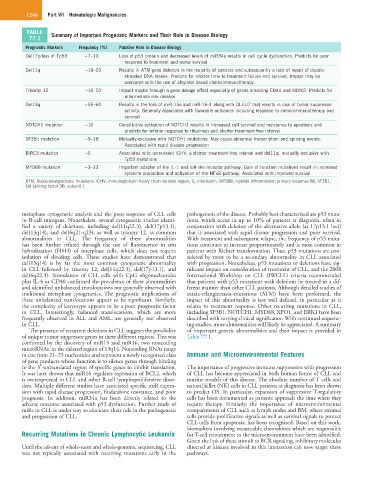
          TABLE   Summary of Important Prognostic Markers and Their Role in Disease Biology
          77.1
         Prognostic Markers  Frequency (%)  Putative Role in Disease Biology
         Del17p/loss of Tp53  ~7–10     Loss of p53 protein and decreased levels of miR34a results in cell cycle dysfunction. Predicts for poor
                                          response to treatment and worse survival
         Del11q              ~18–20     Results in ATM gene deletion in the majority of patients and subsequently a lack of repair of double-
                                          stranded DNA breaks. Predicts for shorter time to treatment failure and survival. Impact may be
                                          overcome with the use of alkylator based chemoimmunotherapy.
         Trisomy 12          ~16–20     Impact maybe through a gene dosage effect especially of genes encoding CDK4 and MDM2. Predicts for
                                          intermediate risk disease
         Del13q              ~55–60     Results in the loss of miR-15a and miR-16-1 along with DLEU7 that results in loss of tumor suppressor
                                          activity. Generally associated with favorable outcomes including response to chemoimmunotherapy and
                                          survival
         NOTCH1 mutation     ~10        Constitutive activation of NOTCH1 results in increased cell survival and resistance to apoptosis and
                                          predicts for inferior response to rituximab and shorter treatment-free interval
         SF3B1 mutation      ~9–18      Mutually exclusive with NOTCH1 mutations. May cause abnormal transcription and splicing events.
                                          Associated with rapid disease progression
         BIRC3 mutation      ~5         Associated with unmutated IGHV, a shorter treatment-free interval and del11q. mutually exclusive with
                                          Tp53 mutations
         MYD88 mutation      ~3–13      Important adapter of the IL-1 and toll-like receptor pathway. Gain of function mutations result in increased
                                          cytokine production and activation of the NFκB pathway. Associated with improved survival
         ATM, Ataxia-telangiectasia–mutations; IGHV, immunoglobulin heavy chain variable region; IL, interleukin; MYD88, myeloid differentiation primary response 88; SF3B1,
         NA splicing factor 3B, subunit 1


        metaphase cytogenetic analysis and the poor response of CLL cells   pathogenesis of the disease. Probably best characterized are p53 muta-
        to B-cell mitogens. Nonetheless, several cytogenetic studies identi-  tions, which occur in up to 10% of patients at diagnosis, often in
        fied  a  variety  of  deletions,  including  del(11q22.3),  del(17p13.1),   conjunction with deletion of the alternative allele (at 17p13.1 loci)
        del(13q14), and del(6q21-q23), as well as trisomy 12, as common   that is associated with rapid disease progression and poor survival.
        abnormalities  in  CLL.  The  frequency  of  these  abnormalities   With treatment and subsequent relapse, the frequency of p53 muta-
        has  been  further  refined  through  the  use  of  fluorescence  in  situ   tions continues to increase proportionately and is most common in
        hybridization  (FISH)  of  interphase  cells,  which  does  not  require   patients with Richter transformation. Thus, p53 mutations are con-
        isolation  of  dividing  cells.  These  studies  have  demonstrated  that   sidered by most to be a secondary abnormality in CLL associated
        del(13q14)  is  by  far  the  most  common  cytogenetic  abnormality   with progression. Nonetheless, p53 mutations or deletions have sig-
        in  CLL  followed  by  trisomy  12,  del(11q22.3),  del(17p13.1),  and   nificant impact on consideration of treatment of CLL, and the 2008
        del(6q22.3).  Stimulation  of  CLL  cells  with  CpG  oligonucleotides   International  Workshop  on  CLL  (IWCLL)  criteria  recommended
        plus IL-4 or CD40 confirmed the prevalence of these abnormalities   that patients with p53 mutations with deletions be treated in a dif-
        and identified unbalanced translocations not generally observed with   ferent manner than other CLL patients. Although detailed studies of
        traditional metaphase cytogenetics. The prognostic  implications  of   ataxia-telangiectasia–mutations  (ATM)  have  been  performed,  the
        these unbalanced translocations appear to be significant. Similarly,   impact  of  this  abnormality  is  less  well  defined,  in  particular  as  it
        the complexity of karyotype appears to be a poor prognostic factor   relates  to  treatment  response.  Other  recurring  mutations  in  CLL,
        in  CLL.  Interestingly,  balanced  translocations,  which  are  more   including SF3B1, NOTCH1, MYD88, XPO1, and ERK1 have been
        frequently  observed  in  ALL  and  AML,  are  generally  not  observed    described with varying clinical significance. With continued sequenc-
        in CLL.                                               ing studies, more abnormalities will likely be appreciated. A summary
           The presence of recurrent deletions in CLL suggests the possibility   of important genetic abnormalities and their impact is provided in
        of unique tumor suppressor genes in these different regions. This was   Table 77.1.
        confirmed by the discovery of miR15 and miR16, two noncoding
        microRNAs, in the deleted region of 13q14. Noncoding RNAs range
        in size from 21–25 nucleotides and represent a newly recognized class   Immune and Microenvironmental Features
        of gene products whose function is to silence genes through binding
        to the 3′-untranslated region of specific genes to inhibit translation.   The importance of progressive immune suppression with progression
        It was later shown that miR16 regulates expression of BCL2, which   of CLL has become appreciated in both human forms of CLL and
        is overexpressed in CLL and other B-cell lymphoproliferative disor-  murine models of this disease. The absolute number of T cells and
        ders. Multiple different studies have associated specific miR expres-  natural killer (NK) cells in CLL patients at diagnosis has been shown
        sion with rapid disease progression, fludarabine resistance, and poor   to predict OS. In particular, expansion of suppressive T-regulatory
        prognosis.  In  addition,  miR34a  has  been  directly  related  to  the   cells has been documented as patients approach the time when they
        adverse outcome associated with p53 dysfunction. Further study of   require  therapy.  Similarly,  the  importance  of  microenvironmental
        miRs in CLL is under way to elucidate their role in the pathogenesis   compartments of CLL such as lymph nodes and BM, where stromal
        and progression of CLL.                               cells provide proliferative signals as well as survival signals to protect
                                                              CLL cells from apoptosis, has been recognized. Based on this work,
                                                              biomarkers involving measurable chemokines which are responsible
        Recurring Mutations in Chronic Lymphocytic Leukemia   for T-cell recruitment to the microenvironment have been identified.
                                                              Given the link of these stimuli to BCR signaling, inhibitory molecules
        Until the advent of whole-exon and whole-genomic sequencing, CLL   directed at kinases involved in this interaction can now target these
        was  not  typically  associated  with  recurring  mutations  early  in  the   pathways.

