


Page 1403 - Hematology_ Basic Principles and Practice ( PDFDrive )
P. 1403
Chapter 77  Chronic Lymphocytic Leukemia  1249


             A            B                        C                            D                             E
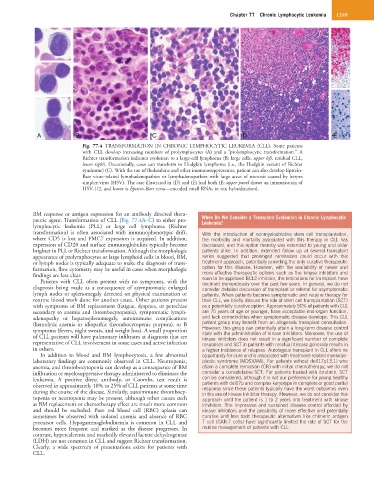
                            Fig.  77.4  TRANSFORMATION  IN  CHRONIC  LYMPHOCYTIC  LEUKEMIA  (CLL).  Some  patients
                            with  CLL  develop  increasing  numbers  of  prolymphocytes  (A)  and  a  “prolymphocytic  transformation.”  A
                            Richter transformation indicates evolution to a large-cell lymphoma (B; large cells, upper left, residual CLL,
                            lower right). Occasionally, cases can transform to Hodgkin lymphoma (i.e., the Hodgkin variant of Richter
                            syndrome) (C). With the use of fludarabine and other immunosuppressants, patient can also develop Epstein-
                            Barr virus–related lymphadenopathies or lymphadenopathies with large areas of necrosis caused by herpes
                            simplex virus (HSV). The case illustrated in (D) and (E) had both (E; upper panel shows an immunostain of
                            HSV-1/2, and lower is Epstein-Barr virus—encoded small RNAs in situ hybridization).


            BM response or antigen expression for an antibody directed thera-
            peutic agent. Transformation of CLL (Fig. 77.4A–C) to either pro-  When Do We Consider a Transplant Evaluation in Chronic Lymphocytic
                                                                   Leukemia?
            lymphocytic  leukemia  (PLL)  or  large  cell  lymphoma  (Richter
            transformation)  is  often  associated  with  immunophenotypic  drift,   With  the  introduction  of  nonmyeloablative  stem  cell  transplantation,
            where CD5 is lost and FMC7 expression is acquired. In addition,   the  morbidity  and  mortality  associated  with  this  therapy  in  CLL  has
            expression of CD20 and surface immunoglobulins typically become   decreased, and this option thereby was extended to young and older
            brighter in PLL or Richter transformation. Although the morphologic   patients  alike.  In  addition,  extended  follow  up  at  several  transplant
            appearance of prolymphocytes or large lymphoid cells in blood, BM,   series  suggested  that  prolonged  remissions  could  occur  with  this
            or lymph nodes is typically adequate to make the diagnosis of trans-  treatment approach, potentially providing the only curative therapeutic
            formation, flow cytometry may be useful in cases when morphologic   option  for  this  disease.  However,  with  the  availability  of  newer  and
            findings are less clear.                               more effective therapeutic options such as the kinase inhibitors and
                                                                   soon to be approved BCL2 inhibitor, the indications for transplant have
              Patients  with  CLL  often  present  with  no  symptoms,  with  the   declined tremendously over the past few years. In general, we do not
            diagnosis  being  made  as  a  consequence  of  asymptomatic  enlarged   consider detailed discussion of transplant or referral for asymptomatic
            lymph nodes or splenomegaly detected on physical examination or   patients. When patients become symptomatic and require therapy for
            routine blood work done for another cause. Other patients present   their CLL, we briefly discuss the role of stem cell transplantation (SCT)
            with symptoms of BM replacement (fatigue, dyspnea, or petechiae   as a potentially curative option. Approximately 50% of patients with CLL
            secondary to anemia and thrombocytopenia), symptomatic lymph-  are 75 years of age or younger, have acceptable end-organ function,
            adenopathy  or  hepatosplenomegaly,  autoimmune  complications   and lack comorbidities when symptomatic disease develops. This CLL
            (hemolytic anemia or idiopathic thrombocytopenic purpura), or B   patient group may benefit from an allogeneic transplant consultation.
            symptoms (fevers, night sweats, and weight loss). A small proportion   However, this group can potentially attain a long-term disease control
                                                                   state with the administration of kinase inhibitors. Moreover, the use of
            of CLL patients will have pulmonary infiltrates at diagnosis that are   kinase inhibitors does not result in a significant number of complete
            representative of CLL involvement in some cases and active infection   responses and SCT in patients with residual disease generally results in
            in others.                                             a higher incidence of relapses. Autologous transplant in CLL offers no
              In  addition  to  blood  and  BM  lymphocytosis,  a  few  abnormal   opportunity for cure and is associated with treatment-related myelodys-
            laboratory  findings  are  commonly  observed  in  CLL.  Neutropenia,   plastic syndrome (MDS)/AML. For patients without del(17p13.1) who
            anemia, and thrombocytopenia can develop as a consequence of BM   attain a complete remission (CR) with initial chemotherapy, we do not
            infiltration or myelosuppressive therapy administered to eliminate the   consider a consolidative SCT. For patients treated with ibrutinib, SCT
            leukemia.  A  positive  direct  antibody,  or  Coombs,  test  result  is   can be considered, although it is not our preference for young healthy
            observed in approximately 10% to 25% of CLL patients at some time   patients with del17p and complex karyotype in complete or good partial
                                                                   response since these patients typically have the worst outcomes even
            during the course of the disease. Similarly, autoimmune thrombocy-  in the era of kinase inhibitor therapy. However, we do not consider this
            topenia or neutropenia may be present, although other causes such   approach until the patient is 1 to 2 years into treatment with kinase
            as BM replacement or chemotherapy effect are much more common   inhibitors. The impressive and sustained disease control afforded by
            and  should  be  excluded.  Pure  red  blood  cell  (RBC)  aplasia  can   kinase inhibitors and the possibility of more effective and potentially
            sometimes  be  observed  with  isolated  anemia  and  absence  of  RBC   curative  and  less  toxic  therapeutic  alternatives  like  chimeric  antigen
            precursor  cells.  Hypogammaglobulinemia  is  common  in  CLL  and   T cell (CAR-T cells) have significantly limited the role of SCT for the
            becomes  more  frequent  and  marked  as  the  disease  progresses.  In   routine management of patients with CLL.
            contrast, hypercalcemia and markedly elevated lactate dehydrogenase
            (LDH) are not common in CLL and suggest Richter transformation.
            Clearly,  a  wide  spectrum  of  presentations  exists  for  patients  with
            CLL.

