


Page 1432 - Hematology_ Basic Principles and Practice ( PDFDrive )
P. 1432
1278   Part VII  Hematologic Malignancies


                                *

                                                                                                   *

                                                                      *


           A                               B                                      C

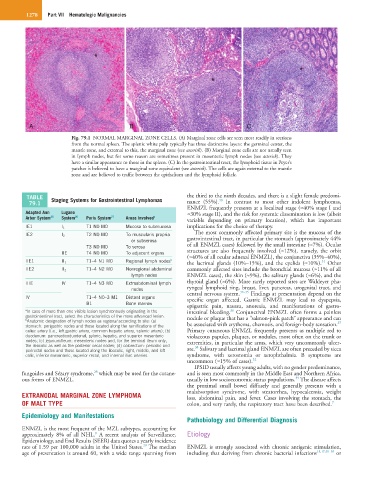
                        Fig. 79.1  NORMAL MARGINAL ZONE CELLS. (A) Marginal zone cells are seen most readily in sections
                        from the normal spleen. The splenic white pulp typically has three distinctive layers: the germinal center, the
                        mantle zone, and external to this, the marginal zone (see asterisk). (B) Marginal zone cells are not usually seen
                        in lymph nodes, but for some reason are sometimes present in mesenteric lymph nodes (see asterisk). They
                        have a similar appearance to those in the spleen. (C) In the gastrointestinal tract, the lymphoid tissue in Peyer’s
                        patches is believed to have a marginal zone equivalent (see asterisk). The cells are again external to the mantle
                        zone and are believed to traffic between the epithelium and the lymphoid follicle.


          TABLE   Staging Systems for Gastrointestinal Lymphomas  the third to the ninth decades, and there is a slight female predomi-
                                                                         30
          79.1                                                nance  (55%).   In  contrast  to  most  other  indolent  lymphomas,
                                                              ENMZL frequently presents at a localized stage (≈40% stage I and
         Adapted Ann   Lugano                                 ≈30% stage II), and the risk for systemic dissemination is low (albeit
         Arbor System 25  System 26  Paris System 27  Areas Involved a  variable  depending  on  primary  location),  which  has  important
         IE1         I 1     T1 N0 M0     Mucosa to submucosa  implications for the choice of therapy.
         IE2         I 2     T2 N0 M0     To muscularis propria   The most commonly affected primary site is the mucosa of the
                                            or subserosa      gastrointestinal tract, in particular the stomach (approximately 44%
                             T3 N0 M0     To serosa           of all ENMZL cases) followed by the small intestine (≈7%). Ocular
                     IIE     T4 N0 M0     To adjacent organs  structures  are  also  frequently  involved  (≈12%),  namely,  the  orbit
                                                              (≈40% of all ocular adnexal ENMZL), the conjunctiva (35%–40%),
         IIE1        II 1    T1–4 N1 M0   Regional lymph nodes b  the  lacrimal  glands  (10%–15%),  and  the  eyelids  (≈10%).   Other
                                                                                                          31
         IIE2        II 2    T1–4 N2 M0   Nonregional abdominal   commonly affected sites include the bronchial mucosa (≈11% of all
                                            lymph nodes       ENMZL cases), the skin (≈9%), the salivary glands (≈6%), and the
         IIIE        IV      T1–4 N3 M0   Extraabdominal lymph   thyroid gland (≈6%). More rarely reported sites are Waldeyer pha-
                                            nodes             ryngeal lymphoid ring, breast, liver, pancreas, urogenital tract, and
                                                              central nervous system. 32–35  Findings at presentation depend on the
         IV                  T1–4 N0–3 M1  Distant organs     specific  organ  affected.  Gastric  ENMZL  may  lead  to  dyspepsia,
                             B1           Bone marrow         epigastric  pain,  nausea,  anorexia,  and  manifestations  of  gastro-
         a In case of more than one visible lesion synchronously originating in the   intestinal bleeding.  Conjunctival ENMZL often forms a painless
                                                                            36
         gastrointestinal tract, select the characteristics of the more advanced lesion.  nodule or plaque that has a “salmon-pink patch” appearance and can
         b Anatomic designation of lymph nodes as regional according to site: (a)                              37
         stomach: perigastric nodes and those located along the ramifications of the   be associated with erythema, chemosis, and foreign-body sensation.
         celiac artery (i.e., left gastric artery, common hepatic artery, splenic artery); (b)   Primary cutaneous ENMZL frequently presents as multiple red to
         duodenum: pancreaticoduodenal, pyloric, hepatic, and superior mesenteric   violaceous papules, plaques, or nodules, most often on the trunk or
         nodes; (c) jejunum/ileum: mesenteric nodes and, for the terminal ileum only,   extremities, in particular the arms, which very uncommonly ulcer-
         the ileocolic as well as the posterior cecal nodes; (d) colorectum: pericolic and   38
         perirectal nodes and those located along the ileocolic, right, middle, and left   ate.  Salivary and lacrimal gland ENMZL are often preceded by sicca
         colic, inferior mesenteric, superior rectal, and internal iliac arteries.  syndrome,  with  xerostomia  or  xerophthalmia.  B  symptoms  are
                                                              uncommon (≈15% of cases). 32
                                                                 IPSID usually affects young adults, with no gender predominance,
                                28
        fungoides and Sézary syndrome,  which may be used for the cutane-  and is seen most commonly in the Middle East and Northern Africa,
                                                                                                  39
        ous forms of ENMZL.                                   usually in low socioeconomic status populations.  The disease affects
                                                              the  proximal  small  bowel  diffusely  and  generally  presents  with  a
        EXTRANODAL MARGINAL ZONE LYMPHOMA                     malabsorption  syndrome,  with  steatorrhea,  hypocalcemia,  weight
                                                              loss,  abdominal  pain,  and  fever.  Cases  involving  the  stomach,  the
        OF MALT TYPE                                          colon, and very rarely, the respiratory tract have been described. 7
        Epidemiology and Manifestations
                                                              Pathobiology and Differential Diagnosis
        ENMZL is the most frequent of the MZL subtypes, accounting for
                                8
        approximately  8%  of  all  NHL.   A  recent  analysis  of  Surveillance,   Etiology
        Epidemiology, and End Results (SEER) data quotes a yearly incidence
                                                29
        rate of 1.59 per 100,000 adults in the United States.  The median   ENMZL is strongly associated with chronic antigenic stimulation,
        age of presentation is around 60, with a wide range spanning from   including that deriving from chronic bacterial infections 15,17,40–59  or

