


Page 1518 - Hematology_ Basic Principles and Practice ( PDFDrive )
P. 1518
Chapter 85  T-Cell Lymphomas  1345


                                              Non-Hodgkin lymphoma
                                                    (NHL)


                          B-cell neoplasms     T/NK-cell neoplasms


                    NHL neoplasm  grouping  Precursor lymphoid        Mature T/NK-cell
                                                                         neoplasms
                             neoplasms


                                               Cutaneous       Extranodal         Nodal           Leukemic


                           T-lymphoblastic  Mycosis fungoides    NKTCL          Peripheral        Adult T-cell
                         leukemia/lymphoma                                                        leukemia/
                                                 (MF)           nasal type      TCL-NOS
                                                                                                  lymphoma
                                                                              Anaplastic large    Aggressive
                    2008 WHO classification  of major subtypes  syndrome  Hepatosplenic  Angioimmunoblastic  prolymphocytic
                                              Transformed
                                                               Enteropathy-
                                                                                                   NK-cell
                                                                               cell lymphoma
                                                              associated TCL
                                                  MF
                                                                                                   leukemia
                                                                                 (ALK+/–)
                                                                                                    T-cell
                                                 Sézary
                                                                                  TCL
                                                                  TCL
                                                                                                   leukemia
                                                              Subcutaneous
                                            Primary cutaneous
                                                   +
                                                                                                  lymphocytic
                                              CD30  T-cell
                                                                                                   leukemia
                                                                  TCL
                                                disorders     panniculitis-like                T-cell large granular
                                            Primary cutaneous                    Aggressive
                                                γ/δ TCL                          Indolent
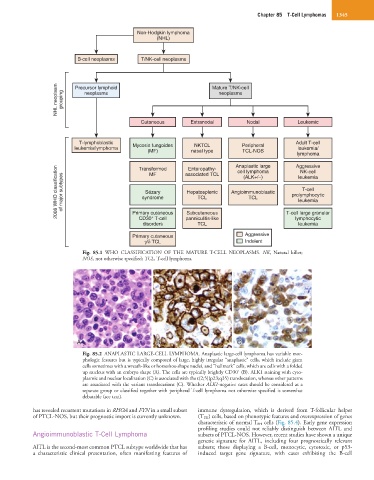
                            Fig.  85.1  WHO  CLASSIFICATION  OF  THE  MATURE  T-CELL  NEOPLASMS.  NK,  Natural  killer;
                            NOS, not otherwise specified; TCL, T-cell lymphoma.


                          A A                       B B                        C C

                            Fig. 85.2  ANAPLASTIC LARGE-CELL LYMPHOMA. Anaplastic large-cell lymphoma has variable mor-
                            phologic features but is typically composed of large, highly irregular “anaplastic” cells, which include giant
                            cells sometimes with a wreath-like or horseshoe-shape nuclei, and “hallmark” cells, which are cells with a folded
                                                                               +
                            up nucleus with an embryo shape (A). The cells are typically brightly CD30  (B). ALK1 staining with cyto-
                            plasmic and nuclear localization (C) is associated with the t(2;5)(p23;q35) translocation, whereas other patterns
                            are associated with the variant translocations (C). Whether ALK1-negative cases should be considered as a
                            separate group or classified together with peripheral T-cell lymphoma not otherwise specified is somewhat
                            debatable (see text).

            has revealed recurrent mutations in RHOA and FYN in a small subset   immune  dysregulation,  which  is  derived  from  T-follicular  helper
            of PTCL-NOS, but their prognostic import is currently unknown.  (T FH) cells, based on phenotypic features and overexpression of genes
                                                                  characteristic of normal T FH  cells (Fig. 85.4). Early gene expression
                                                                  profiling  studies  could  not  reliably  distinguish  between  AITL  and
            Angioimmunoblastic T-Cell Lymphoma                    subsets of PTCL-NOS. However, recent studies have shown a unique
                                                                  genetic  signature  for  AITL,  including  four  prognostically  relevant
            AITL is the second-most common PTCL subtype worldwide that has   subsets;  those  displaying  a  B-cell,  monocytic,  cytotoxic,  or  p53-
            a  characteristic  clinical  presentation,  often  manifesting  features  of   induced  target  gene  signature,  with  cases  exhibiting  the  B-cell

