


Page 1520 - Hematology_ Basic Principles and Practice ( PDFDrive )
P. 1520
Chapter 85  T-Cell Lymphomas  1347


            PTCL. While it shares morphologic and immunophenotypic features   classification,  EATL  types  I  and  II,  recent  studies  have  suggested
            with ALCL, ALK+, including CD30 expression, it characteristically   distinct differences between these entities and proposed to designate
            lacks ALK translocations, occurs in older individuals, and has a poorer   EATL  type  II  as  “monomorphic  epitheliotropic  intestinal  T-cell
            prognosis. Additionally, a subset of PTCL-NOS can express CD30   lymphoma” (MEITL). EATL type I, now simply referred to as EATL,
            and distinguishing ALCL, ALK− from these lesions can be challeng-  occurs in individuals with celiac disease and is associated with the
            ing. Refined, supervised gene expression analysis could reliably dif-  HLA DQ2 or DQ8 haplotypes. Homozygosity for HLA-DQ2 has
            ferentiate ALCL, ALK− from PTCL-NOS and metaanalysis of the   been shown to increase the risk of developing EATL. Refractory celiac
            transcriptional profiles of a large series of PTCLs revealed a three-gene   disease (RCD), especially RCD type II, is considered a precursor of
            model,  comprising  TNFRSF8,  BATF3,  and  TMOD1,  that  could   at least a subset of EATL. Cytogenetic analysis of RCD II has shown
            accurately  separate  ALCL,  ALK−  from  PTCL-NOS.  Recently,  an   recurrent  gains  of  chromosome  1q22–q44,  a  feature  shared  with
            enrichment of MYC, IRF4 targets, mTOR and PI3K pathway gene   EATL, indicating early acquisition of chromosome 1q abnormalities
            signatures were described in ALCL, ALK−, while hypoxia-inducible   in the pathogenesis of EATL.
            factor 1-α targets, interleukin (IL)-10-induced genes and H/K-ras–  Genomic  analyses  of  EATL  have  revealed  additional  recurrent
            induced genes appear enriched in ALCL, ALK+.          chromosome abnormalities. Gains or amplifications of chromosome
              Array  comparative  genomic  hybridization  (CGH)  analysis  of   9q34 are the most frequent (40%–58%), but recurrent gains at 5q
            ALCL, ALK+ and ALCL, ALK− has highlighted differences in sec-  and 7q and losses of 8p, 9p, and 13q have also been reported. The
            ondary genetic aberrations between the two subtypes, and differential   pattern of aberrations suggests at least two subtypes of EATL. Seg-
            expression of microRNAs. Genome-wide single-nucleotide polymor-  mental  amplifications  of  the  chromosome  9q31.3-qter  region,
            phism profiling has shown recurrent losses of 17p13.3–p12 (TP53)   encompassing known protooncogenes (e.g. NOTCH1, ABL1, VAV),
            and  6q21  (PRDM1)  at  a  significantly  higher  frequency  in  ALCL,   or, alternatively, deletions at 16q12.1 have been reported in greater
            ALK− compared with ALCL, ALK+. In addition to loss, PRDM1   than 80% of EATLs, while a small subset exhibit allelic imbalances
            mutations were also detected in a subset of ALCL, ALK− cases, and   at 3q27.
            loss of either PRDM1 and/or TP53 conferred a worse prognosis.  MEITL has a wider geographic distribution than EATL and it
              Next-generation  sequencing  analysis  has  identified  a  recurrent   appears  to  be  more  common  in  Asians  and  Hispanics.  Serologic
            balanced translocation t(6;7)(p25.3;q32.3) in 10% of ALCL, ALK−,   evidence of celiac disease is lacking in the vast majority of cases and
            leading to juxtaposition of the DUSP22 phosphatase gene (6p25.3)   the morphology is distinct from EATL. Recent studies from Asia have
            with the fragile site FRA7H (7q32.3) locus, resulting in the down-  reported 23%–78% of MEITLs to manifest the TCRγδ phenotype,
            regulation of DUSP22 and upregulation of MIR29 microRNAs on   and a lack of TCR expression has been described in up to a third of
            7q32.3. Mutually exclusive and recurrent rearrangements of DUSP22   cases. On comparing genomic profiles of EATL and MEITL, mutu-
            and TP63 have been identified in 30% and 8% of ALCL, ALK−,   ally exclusive segmental amplifications of 9q31.3-qter and deletions
            respectively, and differences in morphology and phenotype have been   of 16q12.1 have been detected in both disease types, with gains of
            reported  for  the  different  subsets.  Cases  with  DUSP22  rearrange-  1q and 5q occurring more frequently in EATL and gains of the MYC
            ments have a significantly better prognosis compared with those with   locus (8q24) more often observed in MEITL. These data suggest the
            TP63  rearrangements.  Recent  whole-exome  sequencing  analysis  of   possibility of common as well as distinct genetic alterations associated
            ALCL, ALK− identified recurrent and concurrent mutations in JAK1   with  the  pathogenesis  of  the  two  subtypes  of  intestinal  T-cell
            and STAT3. Interestingly, a subset of cases lacking mutations in either   lymphomas.
            JAK1 or STAT3 harbored chimeric fusion proteins involving NF-κB2
            and tyrosine kinases ROS1 and TYK2, which result in constitutive
            STAT3  activation.  Hence,  activation  of  the  STAT3  pathway  may   Hepatosplenic T-Cell Lymphoma
            represent a common and critical event in the pathogenesis of ALCL,
            ALK− and possibly a therapeutic target.               HSTL  is  a  rare  subtype  of  PTCL  that  has  been  associated  with
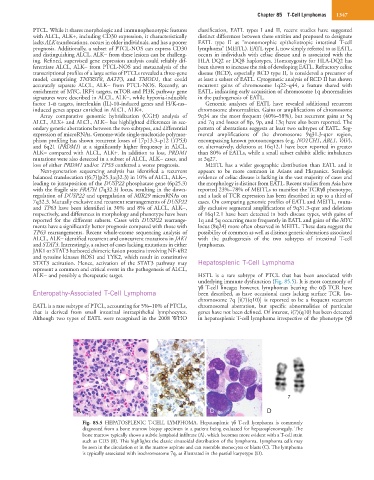
                                                                  underlying immune dysfunction (Fig. 85.5). It is most commonly of
                                                                  γδ T-cell  lineage;  however,  lymphomas  bearing  the  αβ TCR  have
            Enteropathy-Associated T-Cell Lymphoma                been described, as have occasional cases lacking surface TCR. Iso-
                                                                  chromosome  7q  [i(7)(q10)]  is  reported  to  be  a  frequent  recurrent
            EATL is a rare subtype of PTCL, accounting for 5%–10% of PTCLs,   chromosomal  aberration,  but  specific  abnormalities  of  particular
            that  is  derived  from  small  intestinal  intraepithelial  lymphocytes.   genes have not been defined. Of interest, i(7)(q10) has been detected
            Although two types of EATL were recognized in the 2008 WHO   in hepatosplenic T-cell lymphoma irrespective of the phenotype (γδ


                                                                                               7

                          A                        B                  C                 D

                            Fig.  85.5  HEPATOSPLENIC T-CELL  LYMPHOMA.  Hepatosplenic  γδ T-cell  lymphoma  is  commonly
                            diagnosed from a bone marrow biopsy specimen in a patient being evaluated for hepatosplenomegaly. The
                            bone marrow typically shows a subtle lymphoid infiltrate (A), which becomes more evident with a T-cell stain
                            such as CD3 (B). This highlights the classic sinusoidal distribution of the lymphoma. Lymphoma cells may
                            be seen in the circulation or in the marrow aspirate and can resemble monocytes or blasts (C). The lymphoma
                            is typically associated with isochromosome 7q, as illustrated in the partial karyotype (D).

