


Page 1523 - Hematology_ Basic Principles and Practice ( PDFDrive )
P. 1523
1350   Part VII  Hematologic Malignancies


                               100
                                                                       Overall survival
                                90                                     Failure-free survival
                                80
                                70
                              Survival (%)  50
                                60
                                40
                                30
                                20
                                10
                                 0
                                    0  1  2  3  4  5  6  7  8  9  10 11 12 13 14 15 16 17 18
                                                          Time (years)
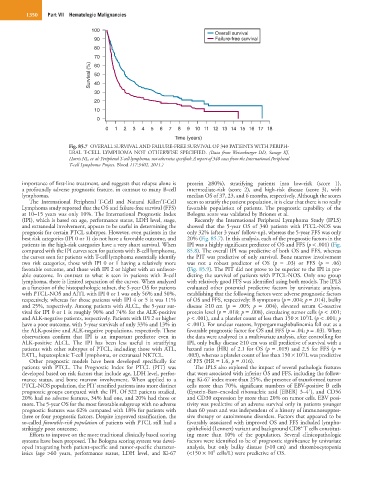
                        Fig. 85.7  OVERALL SURVIVAL AND FAILURE-FREE SURVIVAL OF 340 PATIENTS WITH PERIPH-
                        ERAL T-CELL  LYMPHOMA  NOT  OTHERWISE  SPECIFIED.  (Data  from Weisenburger  DD,  Savage  KJ,
                        Harris NL, et al: Peripheral T-cell lymphoma, not otherwise specified: A report of 340 cases from the International Peripheral
                        T-cell Lymphoma Project. Blood 117:3402, 2011.)


        importance of first-line treatment, and suggests that relapse alone is   protein  ≥80%),  stratifying  patients  into  low-risk  (score  1),
        a profoundly adverse prognostic feature, in contrast to many B-cell   intermediate-risk  (score  2),  and  high-risk  disease  (score  3),  with
        lymphomas.                                            median OS of 37, 23, and 6 months, respectively. Although the scores
           The  International  Peripheral  T-Cell  and  Natural  Killer/T-Cell   seem to stratify the patient population, it is clear that there is no really
        Lymphoma study reported that the OS and failure-free survival (FFS)   favorable  population  of  patients. The  prognostic  capability  of  the
        at 10−15 years was only 10%. The International Prognostic Index   Bologna score was validated by Briones et al.
        (IPI), which is based on age, performance status, LDH level, stage,   Recently  the  International  Peripheral  Lymphoma  Study  (IPLS)
        and extranodal involvement, appears to be useful in determining the   showed that the 5-year OS of 340 patients with PTCL-NOS was
        prognosis for certain PTCL subtypes. However, even patients in the   only 32% (after 3 years’ follow-up), whereas the 5-year FFS was only
        best risk categories (IPI 0 or 1) do not have a favorable outcome, and   20% (Fig. 85.7). In this analysis, each of the prognostic factors in the
        patients in the high-risk categories have a very short survival. When   IPI was a highly significant predictor of OS and FFS (p < .001) (Fig.
        compared with the IPI curves seen for patients with B-cell lymphoma,   85.8). The overall IPI was predictive of both OS and FFS, whereas
        the curves seen for patients with T-cell lymphoma essentially identify   the PIT was predictive of only survival. Bone marrow involvement
        two risk categories, those with IPI 0 or 1 having a relatively more   was  not  a  robust  predictor  of  OS  (p  =  .03)  or  FFS  (p  =  .06)
        favorable outcome, and those with IPI 2 or higher with an unfavor-  (Fig. 85.9). The PIT did not prove to be superior to the IPI in pre-
        able  outcome.  In  contrast  to  what  is  seen  in  patients  with  B-cell   dicting the survival of patients with PTCL-NOS. Only one group
        lymphoma, there is limited separation of the curves. When analyzed   with relatively good FFS was identified using both models. The IPLS
        as a function of the histopathologic subset, the 5-year OS for patients   evaluated  other  potential  predictive  factors  by  univariate  analysis,
        with PTCL-NOS and AITL with IPI 0 or 1 was only 56% and 50%,   establishing that the following factors were adverse prognostic factors
        respectively, whereas for those patients with IPI 4 or 5 it was 11%   of OS and FFS, respectively: B symptoms (p = .004; p = .014), bulky
        and 25%, respectively. Among patients with ALCL, the 5-year sur-  disease  ≥10 cm  (p  =  .005;  p  =  .004),  elevated  serum  C-reactive
        vival for IPI 0 or 1 is roughly 90% and 74% for the ALK-positive   protein level (p = .018; p = .008), circulating tumor cells (p < .001;
                                                                                                     9
        and ALK-negative patients, respectively. Patients with IPI 2 or higher   p < .001), and a platelet count of less than 150 × 10 /L (p < .001; p
        have a poor outcome, with 5-year survivals of only 33% and 13% in   < .001). For unclear reasons, hypergammaglobulinemia fell out as a
        the ALK-positive and ALK-negative populations, respectively. These   favorable prognostic factor for OS and FFS (p = .04; p = .03). When
        observations  confirm  that  IPI  is  an  important  predictor  even  in   the data were analyzed in a multivariate analysis, after controlling for
        ALK-positive  ALCL.  The  IPI  has  been  less  useful  in  stratifying   IPI, only bulky disease ≥10 cm was still predictive of survival with a
        patients with other subtypes of PTCL, including those with ATL,   hazard ratio (HR) of 2.1 for OS (p = .019) and 2.5 for FFS (p =
                                                                                                    9
        EATL, hepatosplenic T-cell lymphoma, or extranasal NKTCL.  .003), whereas a platelet count of less than 150 × 10 /L was predictive
           Other  prognostic  models  have  been  developed  specifically  for   of FFS (HR = 1.6, p = .016).
        patients  with  PTCL.  The  Prognostic  Index  for  PTCL  (PIT)  was   The IPLS also explored the impact of several pathologic features
        developed based on risk factors that include age, LDH level, perfor-  that were associated with inferior OS and FFS, including the follow-
        mance  status,  and  bone  marrow  involvement.  When  applied  to  a   ing: Ki-67 index more than 25%, the presence of transformed tumor
        PTCL-NOS population, the PIT stratified patients into more distinct   cells  more  than  70%,  significant  numbers  of  EBV-positive  B  cells
                                                                                                      +
        prognostic groups compared with the IPI. Of 322 patients studied,   (Epstein-Barr–encoded ribonucleic acid [EBER] 3–4 ), and CD56
        20% had no adverse features, 34% had one, and 20% had three or   and CD30 expression by more than 20% on tumor cells. EBV posi-
        more. The 5-year OS for the most favorable subgroup with no adverse   tivity was predictive of an adverse survival only in patients younger
        prognostic features was 62% compared with 18% for patients with   than 60 years and was independent of a history of immunosuppres-
        three or four prognostic factors. Despite improved stratification, the   sive therapy or autoimmune disorders. Factors that appeared to be
        so-called favorable-risk population of patients with PTCL still had a   favorably associated with improved OS and FFS included lympho-
                                                                                                   +
        strikingly poor outcome.                              epithelioid (Lennert) variant and background CD8  T cells constitut-
           Efforts to improve on the more traditional clinically based scoring   ing  more  than  10%  of  the  population.  Several  clinicopathologic
        systems have been proposed. The Bologna scoring system was devel-  factors were identified to be of prognostic significance by univariate
        oped integrating both patient-specific and tumor-specific character-  analysis,  but  only  bulky  disease  (>10 cm)  and  thrombocytopenia
                                                                       9
        istics  (age  >60  years,  performance  status,  LDH  level,  and  Ki-67   (<150 × 10  cells/L) were predictive of OS.

