


Page 1524 - Hematology_ Basic Principles and Practice ( PDFDrive )
P. 1524
Chapter 85  T-Cell Lymphomas  1351


                                       100
                                                    p < .001      International Prognostic Index
                                        90
                                        80                                   0/1
                                                                             2
                                       Overall survival (%)  60              4/5
                                        70
                                                                             3
                                        50
                                        40
                                        30
                                        20
                                        10
                                         0
                                            0  1  2  3  4  5  6  7  8  9 10 11 12 13 14 15 16 17 18
                                     A                         Time (years)

                                       100
                                        90
                                                    p < .001       International Prognostic Index
                                       Failure-free survival (%)  60         2
                                        80
                                                                             0/1
                                        70
                                                                             3
                                        50
                                                                             4/5
                                        40
                                        30
                                        20
                                        10
                                         0
                                            0  1  2  3  4  5  6  7  8  9 10 11 12 13 14 15 16 17 18
                                     B                         Time (years)
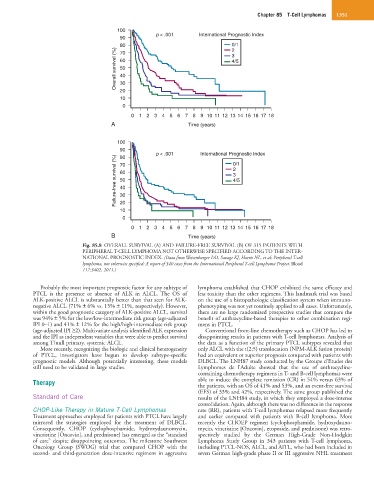
                            Fig. 85.8  OVERALL SURVIVAL (A) AND FAILURE-FREE SURVIVAL (B) OF 315 PATIENTS WITH
                            PERIPHERAL T-CELL LYMPHOMA NOT OTHERWISE SPECIFIED ACCORDING TO THE INTER-
                            NATIONAL PROGNOSTIC INDEX. (Data from Weisenburger DD, Savage KJ, Harris NL, et al: Peripheral T-cell
                            lymphoma, not otherwise specified: A report of 340 cases from the International Peripheral T-cell Lymphoma Project. Blood
                            117:3402, 2011.)


              Probably the most important prognostic factor for any subtype of   lymphoma established that CHOP exhibited the same efficacy and
            PTCL  is  the  presence  or  absence  of  ALK  in  ALCL.  The  OS  of   less toxicity than the other regimens. This landmark trial was based
            ALK-positive ALCL is substantially better than that seen for ALK-  on the use of a histopathologic classification system when immuno-
            negative ALCL (71% ± 6% vs. 15% ± 11%, respectively). However,   phenotyping was not yet routinely applied to all cases. Unfortunately,
            within the good prognostic category of ALK-positive ALCL, survival   there are no large randomized prospective studies that compare the
            was 94% ± 5% for the low/low-intermediate risk group (age-adjusted   benefit of anthracycline-based therapies to other combination regi-
            IPI 0–1) and 41% ± 12% for the high/high-intermediate risk group   mens in PTCL.
            (age-adjusted IPI ≥2). Multivariate analysis identified ALK expression   Conventional front-line chemotherapy such as CHOP has led to
            and the IPI as independent variables that were able to predict survival   disappointing results in patients with T-cell lymphomas. Analysis of
            among T/null primary, systemic ALCL.                  the data as a function of the primary PTCL subtypes revealed that
              More recently, recognizing the biologic and clinical heterogeneity   only ALCL with the t(2;5) translocation (NPM-ALK fusion protein)
            of  PTCL,  investigators  have  begun  to  develop  subtype-specific   had an equivalent or superior prognosis compared with patients with
            prognostic  models.  Although  potentially  interesting,  these  models   DLBCL. The LNH87 study conducted by the Groupe d’Etudes des
            still need to be validated in large studies.          Lymphomes  de  l’Adulte  showed  that  the  use  of  anthracycline-
                                                                  containing chemotherapy regimens in T- and B-cell lymphomas were
            Therapy                                               able to induce the complete remission (CR) in 54% versus 63% of
                                                                  the patients, with an OS of 41% and 53%, and an event-free survival
                                                                  (EFS) of 33% and 42%, respectively. The same group published the
            Standard of Care                                      results of the LNH84 study, in which they employed a dose-intense
                                                                  consolidation. Again, although there was no difference in the response
            CHOP-Like Therapy in Mature T-Cell Lymphomas          rate (RR), patients with T-cell lymphomas relapsed more frequently
            Treatment approaches employed for patients with PTCL have largely   and  earlier  compared  with  patients  with  B-cell  lymphoma.  More
            mirrored  the  strategies  employed  for  the  treatment  of  DLBCL.   recently  the  CHOEP  regimen  (cyclophosphamide,  hydroxydauno-
            Consequently,  CHOP  (cyclophosphamide,  hydroxydaunomycin,   mycin, vincristine [Oncovin], etoposide, and prednisone) was retro-
            vincristine [Oncovin], and prednisone) has emerged as the “standard   spectively  studied  by  the  German  High-Grade  Non-Hodgkin
            of care” despite disappointing outcomes. The milestone Southwest   Lymphoma  Study  Group  in  343  patients  with  T-cell  lymphoma,
            Oncology  Group  (SWOG)  trial  that  compared  CHOP  with  the   including PTCL-NOS, ALCL, and AITL, who had been included in
            second-  and  third-generation  dose-intensive  regimens  in  aggressive   seven German high-grade phase II or III aggressive NHL treatment

