


Page 155 - Hematology_ Basic Principles and Practice ( PDFDrive )
P. 155
Chapter 10  Stem Cell Model of Hematologic Diseases  113


             Functional Evaluation of Cell-of-Origin in Vivo
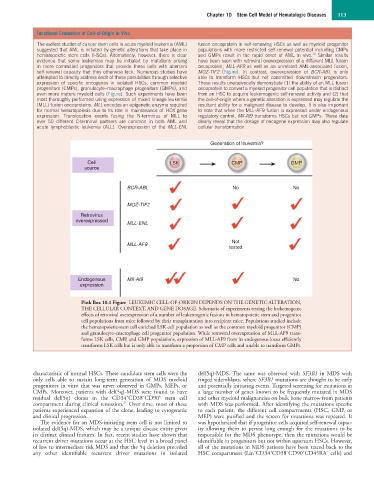
             The earliest studies of cancer stem cells in acute myeloid leukemia (AML)   fusion oncoprotein in self-renewing HSCs as well as myeloid progenitor
             suggested that AML is initiated by genetic alterations that take place in   populations with more restricted self-renewal potential including CMPs
                                                                                                       10
             hematopoietic  stem  cells  (HSCs).  Alternatively,  however,  there  is  clear   and  GMPs  result  in  the  rapid  onset  of  AML  in  vivo.   Similar  results
             evidence  that  some  leukemias  may  be  initiated  by  mutations  arising   have been seen with retroviral overexpression of a different MLL fusion
             in  more  committed  progenitors  that  provide  these  cells  with  aberrant   oncoprotein, MLL-AF9 as well as an unrelated AML-associated fusion,
             self-renewal capacity that they otherwise lack. Numerous studies have   MOZ-TIF2  (Figure).  In  contrast,  overexpression  of  BCR-ABL  is  only
             attempted to directly address each of these possibilities through selective   able  to  transform  HSCs  but  not  committed  downstream  progenitors.
             expression  of  specific  oncogenes  in  isolated  HSCs,  common  myeloid   These results unequivocally demonstrate (1) the ability of an MLL fusion
             progenitors (CMPs), granulocyte–macrophage progenitors (GMPs), and   oncoprotein to convert a myeloid progenitor cell population that is distinct
             even more mature myeloid cells (Figure). Such experiments have been   from an HSC to acquire leukemogenic self-renewal activity and (2) that
             most thoroughly performed using expression of mixed lineage leukemia   the cell-of-origin where a genetic alteration is expressed may regulate the
             (MLL) fusion oncoproteins. MLL encodes an epigenetic enzyme required   resultant ability for a malignant disease to develop. It is also important
             for normal hematopoiesis due to its role in maintenance of HOX gene   to note that when the MLL-AF9 fusion is expressed under endogenous
             expression.  Translocation  events  fusing  the  N-terminus  of  MLL  to   regulatory control, Mll-Af9 transforms HSCs but not GMPs. These data
             over  50  different  C-terminal  partners  are  common  in  both  AML  and   clearly reveal that the dosage of oncogene expression may also regulate
             acute  lymphoblastic  leukemia  (ALL).  Overexpression  of  the  MLL-ENL   cellular transformation.


                                                                      Generation of leukemia?

                              Cell                       LSK                 CMP                GMP
                             source


                                           BCR-ABL                           No                  No

                                           MOZ-TIF2
                           Retrovirus
                          overexpressed    MLL-ENL


                                                                             Not
                                           MLL-AF9
                                                                            tested


                           Endogenous      MII-Af9                                               No
                           expression

                            Pink Box 10.1 Figure  LEUKEMIC CELL-OF-ORIGIN DEPENDS ON THE GENETIC ALTERATION,
                            THE CELLULAR CONTEXT, AND GENE DOSAGE. Schematic of experiments testing the leukemogenic
                            effects of retroviral overexpression of a number of leukemogenic fusions in hematopoietic stem and progenitor
                            cell populations from mice followed by their transplantation into recipient mice. Populations studied include
                            the hematopoietic-stem cell enriched LSK cell population as well as the common myeloid progenitor (CMP)
                            and granulocyte–macrophage cell progenitor population. While retroviral overexpression of MLL-AF9 trans-
                            forms LSK cells, CMP, and GMP populations, expression of MLL-AF9 from its endogenous locus efficiently
                            transforms LSK cells but is only able to transform a proportion of CMP cells and unable to transform GMPs.


            characteristic of normal HSCs. These candidate stem cells were the   del(5q)-MDS. The  same  was  observed  with  SF3B1  in  MDS  with
            only  cells  able  to  sustain  long-term  generation  of  MDS  myeloid   ringed sideroblasts, where SF3B1 mutations are thought to be early
            progenitors  in  vitro  that  was  never  observed  in  GMPs,  MEPs,  or   and potentially initiating events. Targeted screening for mutations in
            CMPs.  Moreover,  patients  with  del(5q)-MDS  were  found  to  have   a large number of genes known to be frequently mutated in MDS
                                          +
                                                −
                                                     +
            residual  del(5q)  clones  in  the  CD34 CD38 CD90   stem  cell   and other myeloid malignancies on bulk bone marrow from patients
                                         21
            compartment during clinical remission.  Over time, most of these   with MDS was performed. After identifying the mutations specific
            patients experienced expansion of the clone, leading to cytogenetic   to  each  patient,  the  different  cell  compartments  (HSC,  GMP,  or
            and clinical progression.                             MEP) were purified and the screen for mutations was repeated. It
              The evidence for an MDS-initiating stem cell is not limited to   was hypothesized that if progenitor cells acquired self-renewal capac-
            isolated del(5q)-MDS, which may be a unique disease entity given   ity  allowing  them  to  persist  long  enough  for  the  mutations  to  be
            its distinct clinical features. In fact, recent studies have shown that   responsible for the MDS phenotype, then the mutations would be
            recurrent driver mutations occur at the HSC level in a broad panel   identifiable in progenitors but not within upstream HSCs. However,
            of low to intermediate risk MDS and that the 5q deletion preceded   all of the mutations in MDS patients have been traced back to the
                                                                                                    +
                                                                                                            −
                                                                                               −
                                                                                    −
                                                                                         +
            any  other  identifiable  recurrent  driver  mutations  in  isolated   HSC compartment (Lin CD34 CD38 CD90 CD45RA  cells) and

