


Page 154 - Hematology_ Basic Principles and Practice ( PDFDrive )
P. 154
112    Part II  Cellular Basis of Hematology


                            A          BCR-ABL  B                   C                    D          TET2
                                       AML1-ETO                                                     DNMT3A
                                       JAK2V617F                                                    ASXL1
                                                                                                    IDH1/2
                  HSC                                                          LSC              Preleukemic
             (CD34+ CD38−)         LSC                                      population          stem cells
                                                                               #1                   FLT3
                                                          PML-RARA                                  N/KRAS
                Progenitors
             (CD34+ CD38+)                             LSC                      LSC
                                                                              population
                                                                                 #2


                                      Mature              Acute
                                      blood             promyelocytic           Frank             Frank
                                       cells             leukemia              leukemia          leukemia
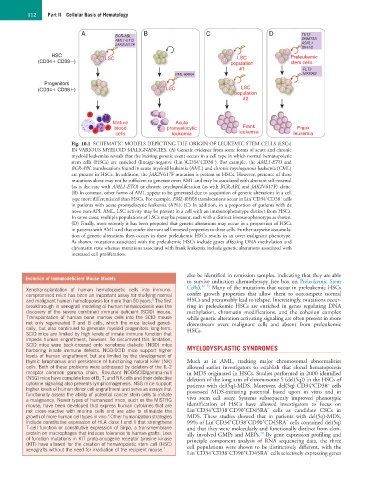
                        Fig. 10.1  SCHEMATIC MODELS DEPICTING THE ORIGIN OF LEUKEMIC STEM CELLS (LSCs)
                        IN VARIOUS MYELOID MALIGNANCIES. (A) Genetic evidence from some forms of acute and chronic
                        myeloid leukemias reveals that the inciting genetic event occurs in a cell type in which normal hematopoietic
                                                                  +
                                                                       −
                                                             −
                        stem  cells  (HSCs)  are  enriched  (lineage-negative  (Lin )CD34 CD38 ).  For  example,  the  AML1-ETO  and
                        BCR-ABL translocations found in acute myeloid leukemia (AML) and chronic myelogenous leukemia (CML)
                        are present in HSCs. In addition, the JAK2V617F mutation is present in HSCs. However, presence of these
                        mutations alone may not be sufficient to generate overt AML and may be associated with aberrant self-renewal
                        (as is the case with AML1-ETO) or chronic myeloproliferation (as with BCR-ABL and JAK2V617F) alone.
                        (B) In contrast, other forms of AML appear to be generated due to acquisition of genetic alterations in a cell
                                                                                        +
                                                                                   −
                                                                                             +
                        type more differentiated than HSCs. For example, PML-RARA translocations occur in Lin CD34 CD38  cells
                        in patients with acute promyelocytic leukemia (APL). (C) In addition, in a proportion of patients with de
                        novo non-APL AML, LSC activity may be present in a cell with an immunophenotype distinct from HSCs.
                        In some cases, multiple populations of LSCs may be present, each with a distinct immunophenotype as shown.
                        (D) Finally, most recently it has been proposed that genetic alterations may occur in a proportion of HSCs
                        in patients with AML and that confer aberrant self-renewal properties to these cells. Further stepwise accumula-
                        tion of genetic alterations then occurs in these preleukemic HSCs results in an overt malignant phenotype.
                        As shown, mutations associated with the preleukemic HSCs include genes affecting DNA methylation and
                        chromatin state whereas mutations associated with frank leukemia include genetic alterations associated with
                        increased cell proliferation.

                                                              also be identified in remission samples, indicating that they are able
         Evolution of Immunodeficient Mouse Models
                                                              to  survive  induction  chemotherapy  (see  box  on  Preleukemic  Stem
          Xenotransplantation  of  human  hematopoietic  cells  into  immuno-  Cells). 11–13  Many of the mutations that occur in preleukemic HSCs
          compromised mice has been an important assay for studying normal   confer  growth  properties  that  allow  them  to  outcompete  normal
                                                   5
          and malignant human hematopoiesis for more than 50 years.  The first   HSCs and presumably lead to relapse. Interestingly, mutations occur-
          breakthrough in xenograft modeling of human hematopoiesis was the   ring  in  preleukemic  HSCs  are  enriched  in  genes  regulating  DNA
          discovery  of  the  severe  combined  immune  deficient  (SCID)  mouse.   methylation,  chromatin  modifications,  and  the  cohesion  complex
          Transplantation  of  human  bone  marrow  cells  into  the  SCID  mouse   while genetic alteration activating signaling are often present in more
          not  only  regenerated  T  and  B  cells,  which  the  mice  lacked  geneti-  downstream  overt  malignant  cells  and  absent  from  preleukemic
          cally,  but  also  continued  to  generate  myeloid  progenitors  long-term.   HSCs.
          SCID mice are limited by high levels of innate immune function that
          impede  human  engraftment,  however.  To  circumvent  this  limitation,
          SCID  mice  were  back-crossed  onto  nonobese  diabetic  (NOD)  mice
          harboring  innate  immune  defects.  NOD-SCID  mice  support  higher   MYELODYSPLASTIC SYNDROMES
          levels  of  human  engraftment  but  are  limited  by  the  development  of
          thymic lymphomas and persistence of functioning natural killer (NK)   Much  as  in  AML,  tracking  major  chromosomal  abnormalities
          cells. Both of these problems were addressed by deletion of the IL-2   allowed  earlier  investigators  to  establish  that  clonal  hematopoiesis
          receptor  common  gamma  chain.  Resultant  NOD/SCID/gamma-null   in MDS originated in HSCs. Studies performed in 2000 identified
          (NSG) mice have complete loss of B, T, and NK cells and their defective   deletion of the long arm of chromosome 5 (del(5q)) in the HSCs of
          cytokine signaling also prevents lymphomagenesis. NSG mice support   patients with del(5q)-MDS. Moreover, del(5q) CD34 CD38  cells
                                                                                                            −
                                                                                                       +
          higher levels of human donor cell engraftment and serve as assays that   possessed  MDS-initiating  potential  based  upon  in  vitro  and  in
          functionally assess the ability of potential cancer stem cells to initiate
          a malignancy. Newer types of humanized mice, such as the MISTRG   vivo  stem  cell  assay.  Systems  subsequently  improved  phenotypic
          mouse, have been developed that express human cytokines that are   identification  of  HSCs  have  allowed  investigators  to  focus  on
                                                                                        −
                                                                           −
                                                                                 +
                                                                 −
                                                                      +
          not  cross-reactive  with  murine  cells  and  are  able  to  stimulate  the   Lin CD34 CD38 CD90 CD45RA   cells  as  candidate  CSCs  in
                                    6
          growth of more human cell types in vivo.  Other humanization strategies   MDS.  These  studies  showed  that  in  patients  with  del(5q)-MDS,
                                                                                               −
                                                                                       +
                                                                                  −
                                                                            +
                                                                       −
          include constitutive expression of HLA class I and II that strengthens   99% of Lin CD34 CD38 CD90 CD45RA  cells contained del(5q)
          T-cell function or constitutive expression of Sirpa, a transmembrane   and that they were molecularly and functionally distinct from clon-
          protein on macrophages that induces tolerance to human grafts. Loss   ally involved GMPs and MEPs.  By gene expression profiling and
                                                                                      20
          of function mutations in KIT proto-oncogene receptor tyrosine kinase   principle  component  analysis  of  RNA  sequencing  data,  the  three
          (KIT) have allowed for the creation of hematopoietic stem cell (HSC)   cell populations were shown to be distinctively different, with the
          xenografts without the need for irradiation of the recipient mouse. 7  −  +  −  +  −
                                                              Lin CD34 CD38 CD90 CD45RA  cells selectively expressing genes

