


Page 1555 - Hematology_ Basic Principles and Practice ( PDFDrive )
P. 1555
1382   Part VII  Hematologic Malignancies


                  Diagnostic Criteria for Multiple Myeloma, Myeloma   TABLE
          TABLE   Variants, and Monoclonal Gammopathy of Unknown   86.2  Recurrent Cytogenetic Changes in Myeloma
          86.1    Significance
                                                                          Common Cytogenetic Alterations
         Monoclonal Gammopathy of Undetermined Significance (MGUS) or   Chromosomal Abnormality  Patients (%)  Genes Involved
         Monoclonal Gammopathy, Unattributed/Unassociated (MG[u])
         M protein in serum <30 g/L                            Hyperdiploidy            50–60        Unclear
                                                                                                     Unclear
                                                                                         20
                                                                  Hypodiploid
         Bone marrow clonal plasma cells <10%                     Pseudodiploid          15          Unclear
         No evidence of other B-cell proliferative disorders
         No myeloma-related organ or tissue impairment (no end-organ damage,   del(17p)  8           p53
            including bone lesions)                            t(4:14)                   15          FGFR3, MMSET
         Asymptomatic Myeloma (Smoldering Myeloma)             t(11;14)                  20          Cyclin D1
         M protein in serum >30 g/L and/or
         Bone marrow clonal plasma cell ≥10% to 60%            t(14;16)                  3           c-MAF
         No related organ or tissue impairment (no end-organ damage, including   t(14;20)  1         MAFB
            bone lesions) or symptoms                          t(6p25 or 6p21;14)        1           IRF4 or CCND3
         Symptomatic Multiple Myeloma (MM)                     t(8;14)                   5           c-Myc
         M protein in serum and/or urine a
         Bone marrow (clonal) plasma cells  or plasmacytoma    t(9;14)                   <1%         PAX5
                                a
         Related organ or tissue impairment (end-organ damage, including bone   del(13 or 13q)  50%  Unclear
            lesions)                                           Recently Identified Alterations
         Solitary Plasmacytoma of Bone                         1q+                       35%
         No M protein in serum and/or urine b                  1p−                       30%
         Single area of bone destruction caused by clonal plasma cells  5q+              50%
         Bone marrow not consistent with MM
         Normal skeletal survey (and MRI of spine and pelvis if done)  12p−              10%
         No related organ or tissue impairment (no end-organ damage other than
            solitary bone lesion) b
         Nonsecretory Myeloma
         No M protein in serum and/or urine with immunofixation  identified.  Importantly,  using  fluorescence  in  situ  hybridization
         Bone marrow clonal plasmacytosis ≥10% or plasmacytoma  (FISH) as well as flow cytometry–based DNA aneuploidy analysis,
         Related organ or tissue impairment (end-organ damage, including bone   genomic alterations are observed in over 90% of the patients with
            lesions)                                          MM. These results suggest that the normal cytogenetics observed in
         Extramedullary Plasmacytoma                          the majority of the patients is derived from normal cellular compo-
         No M protein in serum and/or urine c                 nents of the bone marrow and not from the cells belonging to the
         Extramedullary tumor of clonal plasma cells          myeloma clone. Although detection of karyotypic changes in MGUS
         Normal bone marrow                                   and SMM is extremely low, again owing to very low frequency of
         Normal skeletal survey                               proliferating cells in these indolent conditions, with the use of FISH,
         No related organ or tissue impairment (end-organ damage including   up  to  50%  of  the  patients  with  MGUS  and  SMM  have  genomic
            bone lesions)                                     alterations.
         Multiple Solitary Plasmacytomas (Recurrent or Not)      The most prominent cytogenetic abnormality identified is hyper-
         No M protein in serum and/or urine d                 diploidy and recurrent translocations involving 14q32 region, which
         More than one localized area of bone destruction or extramedullary   contains the IgH gene, the λ light chain region on chromosome 22,
            tumor of clonal plasma cells that may be recurrent  or the κ light-chain genes on chromosome 2, suggesting that these
         Normal bone marrow                                   abnormalities may be an early important event in the development
         Normal skeletal survey and MRI of spine and pelvis if done  of plasma cell disorders. IgH translocation has been confirmed using
         No related organ or tissue impairment (no end-organ damage other than   FISH analysis in approximately 47% of patients with MGUS and
            the localized bone lesions)                       over 70% of patients with MM, the λ light chain region in 17% of
         Myeloma-Related Organ or Tissue Impairment (End-Organ Damage)  patients  with  MM,  and  the  κ  light-chain  genes  in  a  very  small
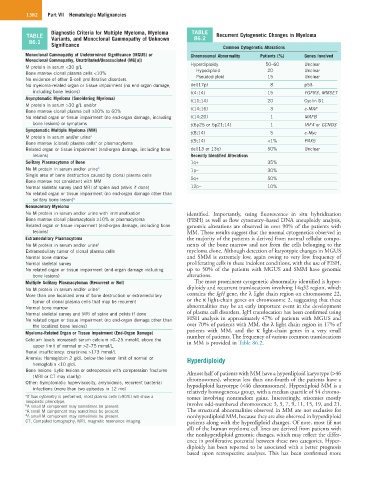
                                                              number of patients. The frequency of various common translocations
         Calcium levels increased: serum calcium >0–25 mmol/L above the   in MM is provided in Table 86.2.
            upper limit of normal or >2–75 mmol/L
         Renal insufficiency: creatinine >173 mmol/L
         Anemia: Hemoglobin 2 g/dL below the lower limit of normal or   Hyperdiploidy
            hemoglobin <10 g/dL
         Bone lesions: Lytic lesions or osteoporosis with compression fractures   Almost half of patients with MM have a hyperdiploid karyotype (>46
            (MRI or CT may clarify)                           chromosomes), whereas less than one-fourth of the patients have a
         Other: Symptomatic hyperviscosity, amyloidosis, recurrent bacterial   hypodiploid karyotype (<46 chromosomes). Hyperdiploid MM is a
            infections (more than two episodes in 12 mo)      relatively homogeneous group, with a median quartile of 54 chromo-
         a If flow cytometry is performed, most plasma cells (>90%) will show a   somes  involving  nonrandom  gains.  Interestingly,  trisomies  mostly
         neoplastic phenotype.
         b A small M component may sometimes be present.      involve odd-numbered chromosomes: 3, 5, 7, 9, 11, 15, 19, and 21.
         c A small M component may sometimes be present.      The structural abnormalities observed in MM are not exclusive for
         d A small M component may sometimes be present.      nonhyperdiploid MM, because they are also observed in hyperdiploid
         CT, Computed tomography; MRI, magnetic resonance imaging.  patients along with the hyperdiploid changes. Of note, most (if not
                                                              all) of the human myeloma cell lines are derived from patients with
                                                              the nonhyperdiploid genomic changes, which may reflect the differ-
                                                              ence in proliferative potential between these two categories. Hyper-
                                                              diploidy has been reported to be associated with a better prognosis
                                                              based  upon  retrospective  analyses. This  has  been  confirmed  more

