


Page 1556 - Hematology_ Basic Principles and Practice ( PDFDrive )
P. 1556
Chapter 86  Plasma Cell Neoplasms  1383


                                  60
                                             Both sexes
                                  50         Male
                                             Female
                                 Incidence per 100,000  30
                                  40


                                  20

                                  10

                                   0
                                      25-29  30-34  35-39  40-44  45-49  50-54  55-59  60-64  65-69  70-74  75-79  80-84  85+

                                A                               Age (yr)


                                  20
                                           Male incidence
                                           Male mortality
                                           Female incidence
                                 Incidence per 100,000  10
                                  15
                                           Female mortality


                                   5


                                   0
                                        All races  White   African  Asian and  American  Hispanic
                                                          American Pacific Islander  Indian
                               B                                 Race
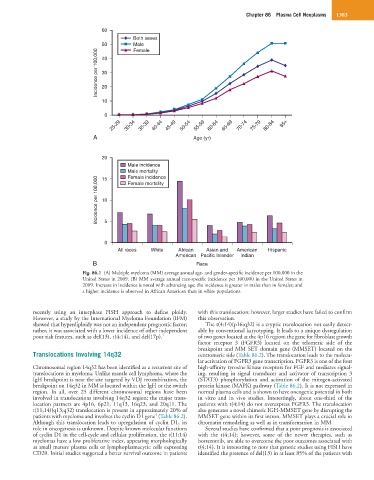
                            Fig. 86.1  (A) Multiple myeloma (MM) average annual age- and gender-specific incidence per 100,000 in the
                            United States in 2009. (B) MM average annual race-specific incidence per 100,000 in the United States in
                            2009. Increase in incidence is noted with advancing age; the incidence is greater in males than in females; and
                            a higher incidence is observed in African American than in white populations.


            recently  using  an  interphase  FISH  approach  to  define  ploidy.   with this translocation; however, larger studies have failed to confirm
            However, a study by the International Myeloma Foundation (IFM)   this observation.
            showed that hyperdiploidy was not an independent prognostic factor;   The t(4;14)(p16;q32) is a cryptic translocation not easily detect-
            rather, it was associated with a lower incidence of other independent   able by conventional karyotyping. It leads to a unique dysregulation
            poor risk features, such as del(13), t(4;14), and del(17p). 3  of two genes located at the 4p16 region; the gene for fibroblast growth
                                                                  factor  receptor  3  (FGFR3)  located  on  the  telomeric  side  of  the
                                                                  breakpoint and MM SET domain gene (MMSET) located on the
            Translocations Involving 14q32                        centromeric side (Table 86.2). The translocation leads to the molecu-
                                                                  lar activation of FGFR3 gene transcription. FGFR3 is one of the four
            Chromosomal region 14q32 has been identified as a recurrent site of   high-affinity tyrosine kinase receptors for FGF and mediates signal-
            translocations in myeloma. Unlike mantle cell lymphoma, where the   ing,  resulting  in  signal  transducer  and  activator  of  transcription  3
            IgH breakpoint is near the site targeted by VDJ recombination, the   (STAT3)  phosphorylation  and  activation  of  the  mitogen-activated
            breakpoint on 14q32 in MM is located within the IgH or the switch   protein kinase (MAPK) pathway (Table 86.2). It is not expressed in
            region.  In  all,  over  25  different  chromosomal  regions  have  been   normal plasma cells and is shown to have oncogenic potential in both
            involved in translocations involving 14q32 region; the major trans-  in  vitro  and  in  vivo  studies.  Interestingly,  about  one-third  of  the
            location partners are 4p16, 6p21, 11q13, 16q23, and 20q11. The   patients with t(4;14) do not overexpress FGFR3. The translocation
            t(11;14)(q13;q32) translocation is present in approximately 20% of   also generates a novel chimeric IGH-MMSET gene by disrupting the
                                                    4
            patients with myeloma and involves the cyclin D1 gene  (Table 86.2).   MMSET gene within its first intron. MMSET plays a crucial role in
            Although this translocation leads to upregulation of cyclin D1, its   chromatin remodeling as well as in transformation in MM.
            role in oncogenesis is unknown. Despite known molecular functions   Several studies have confirmed that a poor prognosis is associated
            of cyclin D1 in the cell-cycle and cellular proliferation, the t(11;14)   with  the  t(4;14);  however,  some  of  the  newer  therapies,  such  as
            myelomas have a low proliferative index, appearing morphologically   bortezomib, are able to overcome the poor outcomes associated with
            as small mature plasma cells or lymphoplasmacytic cells expressing   t(4;14). It is interesting to note that genetic studies using FISH have
            CD20. Initial studies suggested a better survival outcome in patients   identified the presence of del(13) in at least 85% of the patients with

