


Page 1558 - Hematology_ Basic Principles and Practice ( PDFDrive )
P. 1558
Chapter 86  Plasma Cell Neoplasms  1385


                                                                  plasma cells, and these changes have been correlated with an effect
                                                                  on overall clinical outcome.
                                                                    MicroRNAs (miRNAs or miRs) are a class of small noncoding
                1        2         3         4        5           RNAs that cleave specific targeted transcripts inhibiting translational
                                                                  of specific genes. Differences in the expression patterns of miRNAs
                                                                  have been observed between MM and MGUS. For example, miR-32,
                                                                  and  miR-17-92,  are  overexpressed  only  in  MM,  whereas  miR-21,
              6          7      8     9      10   11    12        miR-106b-25, and miR-181a/b show similar expression patterns in
                                                                  both  MM  and  MGUS  but  are  highly  expressed  compared  with
                                                                  normal plasma cells, providing a possible clue to events underlying
               13     14      15       16     17      18          progression  from  MGUS  to  MM.  miRs  15a/16  are  present  on
                                                                  chromosome 13, and their downregulation is described in a subset
                                                                  of MM. Although this does not strictly correlate with chromosome
                                                                  13 deletion, which is observed in almost half of the patients with
                19        20      21      22      X    Y          MM, a potential effect of these miRs on MM cell proliferation has
                                                                  been described. A similar attempt at correlating observed cytogenetic
                                12                                changes and their effects on miR expression has identified overexpres-
                                                                  sion  of  miR-let-7e,  miR-125-5p,  and  miR-99b  in  patients  with
                                                                  t(4;14)  translocation  and  miR-1  and  miR-133a  in  patients  with
               1      2      3                     4      5       t(14;16) MM. A causal relationship between changes in these miR

                                          17                 1    expression  patterns  and  their  effects  on  target  genes  and  eventual
                                                                                                           8
                                                                  phenotypic changes in MM still needs to be established.  As in gene
                                                             7
                                                                  expression  profiling,  miRNA  expression  profiling  also  identifies
               6        7       8      9      10     11    12     subgroups with different clinical outcomes, highlighting a significant
                                                                  role of miRNAs in determining MM biology and its possible role as
                                                                  a therapeutic target. An integrated analysis of mRNA and miR profil-
              13    14     15                 16   17     18      ing  has  been  used  to  identify  regulatory  networks  that  combine
                                        1     1                   miRNA-mRNA pairs that may drive the behavior of tumor cells. One
                  1                                               such network combines p53-MDM2 expression with the downregu-
              19     20             21     22           X   Y     lation of miR-192, miR-194, and miR-215 in a subset of patients
                                                                  with MM. Such analyses might explain some of the observed genomic
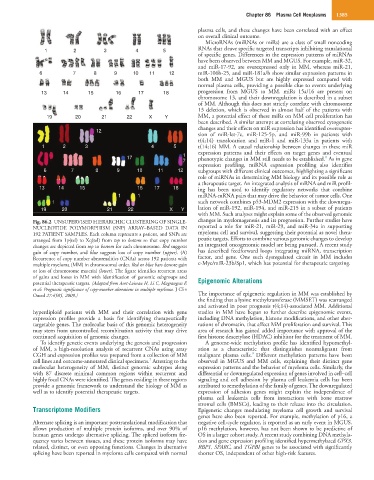
            Fig. 86.2  UNSUPERVISED HIERARCHIC CLUSTERING OF SINGLE-  changes in myelomagenesis and its progression. Further studies have
            NUCLEOTIDE  POLYMORPHISM  (SNP)  ARRAY–BASED  DATA  IN   reported  a  role  for  miR-21,  miR-29,  and  miR-34a  in  supporting
            192 PATIENT SAMPLES. Each column represents a patient, and SNPs are   myeloma cell and survival, suggesting their potential as novel thera-
            arranged from 1p(tel) to Xq(tel) from top to bottom so that copy number   peutic targets. Efforts to combine various genomic changes to develop
            changes are depicted from top to bottom for each chromosome. Red suggests   an integrated oncogenomic model are being pursued. A recent study
            gain  of  copy  number,  and  blue  suggests  loss  of  copy  number  (upper).  (A)   has  described  feedforward  loops  integrating  miRNA,  transcription
            Recurrence of copy number abnormalities (CNAs) across 192 patients with   factor,  and  gene.  One  such  dysregulated  circuit  in  MM  includes
            multiple myeloma (MM) in chromosomal order. Red or blue bars denote gain   c-Myc/miR-23b/Sp1, which has potential for therapeutic targeting.
            or loss of chromosome material (lower). The figure identifies recurrent areas
            of  gains  and  losses  in  MM  with  identification  of  genomic  subgroups  and
            potential therapeutic targets. (Adapted from Avet-Loiseau H, Li C, Magrangeas F,   Epigenomic Alterations
            et al: Prognostic significance of copy-number alterations in multiple myeloma. J Clin
            Oncol 27:4585, 2009.)                                 The importance of epigenetic regulation in MM was established by
                                                                  the finding that a lysine methyltransferase (MMSET) was rearranged
                                                                  and activated in poor prognosis t(4;14)-associated MM. Additional
            hyperdiploid  patients  with  MM  and  their  correlation  with  gene   studies in MM have begun to further describe epigenomic events,
            expression  profiles  provide  a  basis  for  identifying  therapeutically   including DNA methylation, histone modifications, and other aber-
            targetable genes. The molecular basis of this genomic heterogeneity   rations of chromatin, that affect MM proliferation and survival. This
            may stem from uncontrolled recombination activity that may drive   area of research has gained added importance with approval of the
            continued acquisition of genomic changes.             first histone deacetylase (HDAC) inhibitor for the treatment of MM.
              To identify genetic events underlying the genesis and progression   A  genome-wide  methylation  profile  has  identified  hypomethyl-
            of  MM,  a  high-resolution  analysis  of  recurrent  CNAs  using  array   ation  as  a  characteristic  that  distinguishes  nonmalignant  from
                                                                                   9
            CGH and expression profiles was prepared from a collection of MM   malignant  plasma  cells.   Different  methylation  patterns  have  been
                                                  7
            cell lines and outcome-annotated clinical specimens.  Attesting to the   observed  in  MGUS  and  MM  cells,  explaining  their  distinct  gene
            molecular  heterogeneity  of  MM,  distinct  genomic  subtypes  along   expression patterns and the behavior of myeloma cells. Similarly, the
            with  87  discrete  minimal  common  regions  within  recurrent  and   differential or downregulated expression of genes involved in cell–cell
            highly focal CNAs were identified. The genes residing in these regions   signaling and cell adhesion by plasma cell leukemia cells has been
            provide a genomic framework to understand the biology of MM as   attributed to remethylation of the family of genes. The downregulated
            well as to identify potential therapeutic targets.    expression  of  adhesion  genes  might  explain  the  independence  of
                                                                  plasma  cell  leukemia  cells  from  interactions  with  bone  marrow
                                                                  stromal cells (BMSCs), leading to their release into the circulation.
            Transcriptome Modifiers                               Epigenetic  changes  modulating  myeloma  cell  growth  and  survival
                                                                  genes have also been reported. For example, methylation of p16, a
            Alternate splicing is an important posttranslational modification that   negative cell-cycle regulator, is reported as an early event in MGUS.
            allows  production  of  multiple  protein  isoforms,  and  over  90%  of   p16 methylation, however, has not been shown to be predictive of
            human genes undergo alternative splicing. The spliced isoform fre-  OS in a larger cohort study. A recent study combining DNA methyla-
            quency varies between tissues, and these protein isoforms may have   tion and gene expression profiling identified hypermethylated GPX3,
            related, distinct, or even opposing functions. Changes in alternative   RBP1, SPARC, and TGFBI genes to be associated with significantly
            splicing have been reported in myeloma cells compared with normal   shorter OS, independent of other high-risk features.

