


Page 1561 - Hematology_ Basic Principles and Practice ( PDFDrive )
P. 1561
1388   Part VII  Hematologic Malignancies


                                                                                      MM
                                                                   GSK-3β
                                                          Migration
                                                                   FKHR
                                         CD40       PKC            Caspase-9  Survival
                                                                             Antiapoptosis
                                                                   NF-κB
                            Cell surface                    Akt    mTOR      Cell cycle
                              targets  FGFR3        PI3K           Bad
                                       CS1                       Bcl-xL   Survival
                                                   JAK/STAT3
                                                                 Mcl-1    Antiapoptosis
                                    BAFF-R
                                                             Bcl-xL     Survival
                                     VEGFR          NFκB     IAP        Anti-apoptosis
                                                             Cyclin-D   Cell cycle
                           Cytokines               Ras/Raf
                          IL-6, VEGF
                          IGF-1, SDF-1α,    TNF-α           MEK/ERK     Proliferation
                                                               Kip1
                          BAFF, APRIL,      TGFβ            p27         Antiapoptosis
                          BSF-3             VEGF


                                                                    Adhesion
                                           Smad, ERK
                               Cytokines↑ NF-κB            Adhesion
                                                           molecules↑
                                                                                         LFA-1
                                                                           ICAM-1
                                                                                         MUC-1
                            BMSC
                                                                           VCAM-1        VLA-4
                                                                           Fibronectin
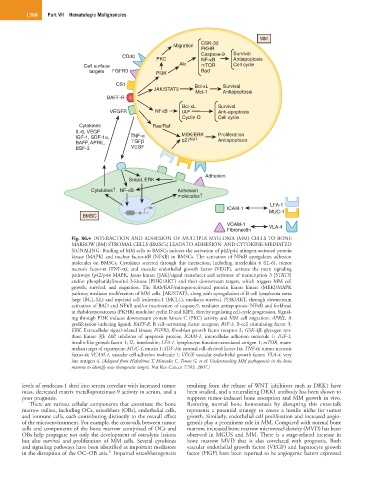
                        Fig. 86.4  INTERACTION AND ADHESION OF MULTIPLE MYELOMA (MM) CELLS TO BONE
                        MARROW (BM) STROMAL CELLS (BMSCs) LEADS TO ADHESION- AND CYTOKINE-MEDIATED
                        SIGNALING. Binding of MM cells to BMSCs induces the activation of p42/p44 mitogen-activated protein
                        kinase (MAPK) and nuclear factor-κB (NFκB) in BMSCs. The activation of NFκB upregulates adhesion
                        molecules  on  BMSCs.  Cytokines  secreted  through  this  interaction,  including  interleukin  6  (IL-6),  tumor
                        necrosis  factor-α  (TNF-α),  and  vascular  endothelial  growth  factor  (VEGF),  activate  the  main  signaling
                        pathways (p42/p44 MAPK, Janus kinase [JAK]/signal transducer and activator of transcription 3 [STAT3]
                        and/or phosphatidylinositol 3-kinase [PI3K]/AKT) and their downstream targets, which triggers MM cell
                        growth,  survival,  and  migration.  The  RAS/RAF/mitogen-activated  protein  kinase  kinase  (MEK)/MAPK
                        pathway mediates proliferation of MM cells. JAK/STAT3, along with upregulation of B cell lymphoma extra
                        large (BCL-XL) and myeloid cell leukemia-1 (MCL1), mediates survival. PI3K/AKT, through downstream
                        activation of BAD and NFκB and/or inactivation of caspase-9, mediates antiapoptosis. NFκB and forkhead
                        in rhabdomyosarcoma (FKHR) modulate cyclin D and KIP1, thereby regulating cell-cycle progression. Signal-
                        ing through PI3K induces downstream protein kinase C (PKC) activity and MM cell migration. APRIL, A
                        proliferation-inducing ligand; BAFF-R, B cell–activating factor receptor; BSF-3, B-cell stimulating factor 3;
                        ERK, Extracellular signal-related kinase; FGFR3, fibroblast growth factor receptor 3; GSK-3β, glycogen syn-
                        thase  kinase  3β;  IAP,  inhibitor  of  apoptosis  protein;  ICAM-1,  intercellular  adhesion  molecule  1;  IGF-1,
                        insulin-like growth factor 1; IL, interleukin; LFA-1, lymphocyte function-associated antigen 1; mTOR, mam-
                        malian target of rapamycin; MUC-1, mucin 1; SDF-1α, stromal cell–derived factor 1α; TNF-α, tumor-necrosis
                        factor-α; VCAM-1, vascular cell adhesion molecule 1; VEGF, vascular endothelial growth factor; VLA-4, very
                        late antigen 4. (Adapted from Hideshima T, Mitsiades C, Tonon G, et al: Understanding MM pathogenesis in the bone
                        marrow to identify new therapeutic targets. Nat Rev Cancer 7:585, 2007.)


        levels of syndecan-1 shed into serum correlate with increased tumor   resulting from the release of WNT inhibitors such as DKK1 have
        mass, decreased matrix metalloproteinase-9 activity in serum, and a   been studied, and a neutralizing DKK1 antibody has been shown to
        poor prognosis.                                       suppress tumor-induced bone resorption and MM growth in vivo.
           There are various cellular components that constitute the bone   Restoring  normal  bone  homeostasis  by  disrupting  this  cross-talk
        marrow milieu, including OCs, osteoblasts (OBs), endothelial cells,   represents  a  potential  strategy  to  create  a  hostile  niche  for  tumor
        and immune cells, each contributing distinctly to the overall effect   growth. Similarly, endothelial cell proliferation and increased angio-
        of the microenvironment. For example, the cross-talk between tumor   genesis play a prominent role in MM. Compared with normal bone
        cells and components of the bone marrow comprised of OCs and   marrow, increased bone marrow microvessel density (MVD) has been
        OBs help propagate not only the development of osteolytic lesions   observed  in  MGUS  and  MM. There  is  a  stage-related  increase  in
        but  also  survival  and  proliferation  of  MM  cells.  Several  cytokines   bone  marrow  MVD  that  is  also  correlated  with  prognosis.  Both
        and signaling pathways have been identified as important mediators   vascular endothelial growth factor (VEGF) and hepatocyte growth
                                    11
        in the disruption of the OC–OB axis.  Impaired osteoblastogenesis   factor (HGF) have been reported to be angiogenic factors expressed

