


Page 1596 - Hematology_ Basic Principles and Practice ( PDFDrive )
P. 1596
1422   Part VII  Hematologic Malignancies


        suggesting  that  WM  cells  require  a  microenvironmental  support   Unlike most indolent lymphomas, splenomegaly and lymphadenopa-
                                    60
        system for their growth and survival.  High levels of CXCR4 and   thy are uncommon (≤15%). Purpura is frequently associated with
                                                 59
        very late antigen-4 (VLA-4) are expressed by WM cells.  In blocking   cryoglobulinemia  and  in  rare  circumstances  with  light-chain  (AL)
        experiment studies, CXCR4 was shown to support migration of WM   amyloidosis.  Hemorrhagic  and  neuropathic  manifestations  are
        cells, whereas VLA-4 contributed to adhesion of WM cells to BM   multifactorial  (see  “IgM-Related  Neuropathy”  section  below). The
        stromal cells. 59                                     morbidity associated with WM is caused by the co-occurrence of two
                                                              main components: tissue infiltration by neoplastic cells and, impor-
                                                              tantly,  the  physicochemical  and  immunologic  properties  of  the
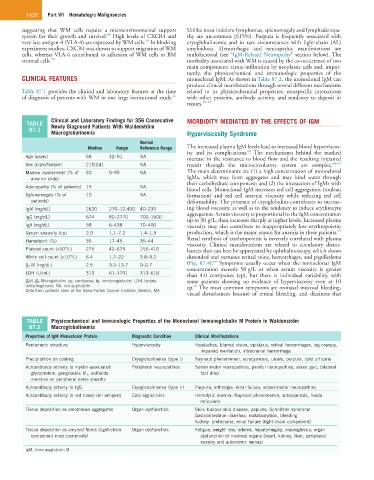
        CLINICAL FEATURES                                     monoclonal IgM. As shown in Table 87.2, the monoclonal IgM can
                                                              produce clinical manifestations through several different mechanisms
        Table 87.1 provides the clinical and laboratory features at the time   related  to  its  physicochemical  properties,  nonspecific  interactions
                                                         16
        of diagnosis of patients with WM in one large institutional study.    with  other  proteins,  antibody  activity,  and  tendency  to  deposit  in
                                                              tissues. 61–63

                  Clinical and Laboratory Findings for 356 Consecutive   MORBIDITY MEDIATED BY THE EFFECTS OF IGM
          TABLE   Newly Diagnosed Patients With Waldenström
          87.1
                  Macroglobulinemia                           Hyperviscosity Syndrome
                                               Normal
                              Median   Range   Reference Range  The increased plasma IgM levels lead to increased blood hyperviscos-
                                                                                  64
                                                              ity  and  its  complications.   The  mechanisms  behind  the  marked
         Age (years)         58      32–91     NA             increase in the resistance to blood flow and the resulting impaired
         Sex (male/female)   215/141           NA             transit  through  the  microcirculatory  system  are  complex. 64–67
         Marrow involvement (% of   30  5–95   NA             The main determinants are (1) a high concentration of monoclonal
           area on slide)                                     IgMs,  which  may  form  aggregates  and  may  bind  water  through
                                                              their carbohydrate component; and (2) the interaction of IgMs with
         Adenopathy (% of patients)  15        NA
                                                              blood cells. Monoclonal IgM increases red cell aggregation (rouleau
         Splenomegaly (% of   10               NA             formation)  and  red  cell  internal  viscosity  while  reducing  red  cell
           patients)                                          deformability. The presence of cryoglobulins contributes to increas-
         IgM (mg/dL)         2620    270–12,400  40–230       ing blood viscosity, as well as to the tendency to induce erythrocyte
                                                              aggregation. Serum viscosity is proportional to the IgM concentration
         IgG (mg/dL)         674     80–2770   700–1600
                                                              up to 30 g/L, then increases sharply at higher levels. Increased plasma
         IgA (mg/dL)         58      6–438     70–400         viscosity may also contribute to inappropriately low erythropoietin
                                                                                                               67
         Serum viscosity (cp)  2.0   1.1–7.2   1.4–1.9        production, which is the major reason for anemia in these patients.
         Hematocrit (%)      35      17–45     35–44          Renal synthesis of erythropoietin is inversely correlated with plasma
                                                              viscosity.  Clinical  manifestations  are  related  to  circulatory  distur-
                      9
         Platelet count (×10 /L)  275  42–675  155–410        bances that can best be appreciated by ophthalmoscopy, which shows
                        9
         White cell count (×10 /L)  6.4  1.7–22  3.8–9.2      distended and tortuous retinal veins, hemorrhages, and papilledema
                                                                       68
         β 2 -M (mg/dL)      2.5     0.9–13.7  0–2.7          (Fig.  87.4).   Symptoms  usually  occur  when  the  monoclonal  IgM
                                                              concentration  exceeds  50 g/L  or  when  serum  viscosity  is  greater
         LDH (U/mL)          313     61–1701   313–618        than  4.0  centipoises  (cp),  but  there  is  individual  variability,  with
         β 2 M, β 2 -Microglobulin; cp, centipoise; Ig, immunoglobulin; LDH, lactate   some  patients  showing  no  evidence  of  hyperviscosity  even  at  10
         dehydrogenase; NA, not applicable.                   cp.  The most common symptoms are oronasal mucosal bleeding,
                                                                64
         Data from patients seen at the Dana-Farber Cancer Institute, Boston, MA.
                                                              visual  disturbances  because  of  retinal  bleeding,  and  dizziness  that
          TABLE   Physicochemical and Immunologic Properties of the Monoclonal Immunoglobulin M Protein in Waldenström
          87.2    Macroglobulinemia
         Properties of IgM Monoclonal Protein  Diagnostic Condition  Clinical Manifestations
         Pentameric structure               Hyperviscosity       Headaches, blurred vision, epistaxis, retinal hemorrhages, leg cramps,
                                                                   impaired mentation, intracranial hemorrhage
         Precipitation on cooling           Cryoglobulinemia (type I)  Raynaud phenomenon, acrocyanosis, ulcers, purpura, cold urticaria
         Autoantibody activity to myelin-associated   Peripheral neuropathies  Sensorimotor neuropathies, painful neuropathies, ataxic gait, bilateral
           glycoprotein, ganglioside M 1 , sulfatide               foot drop
           moieties on peripheral nerve sheaths
         Autoantibody activity to IgG       Cryoglobulinemia (type II)  Purpura, arthralgia, renal failure, sensorimotor neuropathies
         Autoantibody activity to red blood cell antigens  Cold agglutinins  Hemolytic anemia, Raynaud phenomenon, acrocyanosis, livedo
                                                                   reticularis
         Tissue deposition as amorphous aggregates  Organ dysfunction  Skin: bullous skin disease, papules, Schnitzler syndrome
                                                                 Gastrointestinal: diarrhea, malabsorption, bleeding
                                                                 Kidney: proteinuria, renal failure (light-chain component)
         Tissue deposition as amyloid fibrils (light-chain   Organ dysfunction  Fatigue, weight loss, edema, hepatomegaly, macroglossia, organ
           component most commonly)                                dysfunction of involved organs (heart, kidney, liver, peripheral
                                                                   sensory and autonomic nerves)
         IgM, Immunoglobulin M.

