


Page 1594 - Hematology_ Basic Principles and Practice ( PDFDrive )
P. 1594
1420   Part VII  Hematologic Malignancies

                                                              MUTATION IN MYD88

                                                              A highly recurrent somatic mutation (MYD88 L265P ) was first identi-
                                                              fied in patients with WM by whole genome sequencing (WGS) and
                                                              confirmed  by  multiple  studies  through  Sanger  sequencing  and/or
                                                              allele-specific polymerase chain reaction (PCR) assays. 35–40  MYD88 L265P
                                                              is  expressed  in  90%  to  95%  of  WM  cases  when  more  sensitive
                                                              allele-specific PCR is employed using both CD19-sorted and unsorted
                                                              BM cells. 36–40  By comparison, MYD88 L265P  was absent in myeloma
                                                              samples, including IgM myeloma, and was expressed in a small subset
                                                              (6% to 10%) of patients with marginal zone lymphoma, who surpris-
                                                              ingly have WM-related features. 36–38,41  By PCR assays, 50% to 80%
                                                              of patients with IgM MGUS also express MYD88 L265P , and expression
                                                              of  this  mutation  was  associated  with  increased  risk  for  malignant
                                                              progression. 36–38,42  The presence of MYD88 L265P  in patients with IgM
                                                              MGUS suggests a role for this mutation as an early oncogenic driver,
                                                              and  other  mutations  and/or  copy  number  alterations  leading
                                                              to  abnormal  gene  expression  are  likely  to  promote  disease
        Fig.  87.1  MARROW  FILM  FROM  A  PATIENT  WITH  WALDEN-  progression. 29
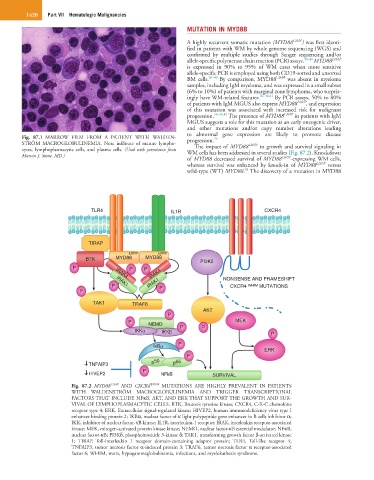
        STRÖM  MACROGLOBULINEMIA.  Note  infiltrate  of  mature  lympho-  The impact of MYD88 L265P  to growth and survival signaling in
        cytes, lymphoplasmacytic cells, and plasma cells. (Used with permission from   WM cells has been addressed in several studies (Fig. 87.2). Knockdown
        Marvin J. Stone, MD.)                                                                L265P
                                                              of MYD88 decreased survival of MYD88  -expressing WM cells,
                                                              whereas  survival  was  enhanced  by  knock-in  of  MYD88 L265P   versus
                                                                                 43
                                                              wild-type (WT) MYD88.  The discovery of a mutation in MYD88


                               TLR4                      IL1R                           CXCR4


                              TIRAP
                                           L265P     L265P
                             BTK       MYD88     MYD88             PI3Kδ
                         P             IRAK4 P  P  IRAK4
                                                  IRAK1                   NONSENSE AND FRAMESHIFT
                                       IRAK1
                                      P              P                      CXCR4  WHIM  MUTATIONS
                           P
                               TAK1         TRAF6
                                                                   AKT
                                                        P
                                           P      NEMO                        MEK
                                             IKKα     IKKβ  P      P                      P

                                                   IKBα    P
                                                                                        ERK
                                                              P
                              TNFAIP3              p 50   p 65
                                                P
                              HIVEP2                  NFkB             SURVIVAL
                        Fig.  87.2  MYD88 L265P   AND  CXCR4 WHIM   MUTATIONS  ARE  HIGHLY  PREVALENT  IN  PATIENTS
                        WITH  WALDENSTRÖM  MACROGLOBULINEMIA  AND  TRIGGER  TRANSCRIPTIONAL
                        FACTORS THAT INCLUDE NFκB, AKT, AND ERK THAT SUPPORT THE GROWTH AND SUR-
                        VIVAL OF LYMPHOPLASMACYTIC CELLS. BTK, Bruton’s tyrosine kinase; CXCR4, C-X-C chemokine
                        receptor type 4; ERK, Extracellular signal-regulated kinase; HIVEP2, human immunodeficiency virus type I
                        enhancer binding protein 2; IKBα, nuclear factor of κ light polypeptide gene enhancer in B cells inhibitor α;
                        IKK, inhibitor of nuclear factor-κB kinase; IL1R, interleukin-1 receptor; IRAK, interleukin receptor-associated
                        kinase; MEK, mitogen-activated protein kinase kinase; NEMO, nuclear factor-κB essential modulator; NFκB,
                        nuclear factor-κB; PI3Kδ, phosphoinositide 3-kinase δ; TAK1, transforming growth factor β-activated kinase
                        1;  TIRAP,  Toll-interleukin  1  receptor  domain-containing  adaptor  protein;  TLR4,  Toll-like  receptor  4;
                        TNFAIP3, tumor necrosis factor α-induced protein 3; TRAF6, tumor necrosis factor α receptor-associated
                        factor 6; WHIM, warts, hypogammaglobulinemia, infections, and myelokathexis syndrome.

