


Page 1597 - Hematology_ Basic Principles and Practice ( PDFDrive )
P. 1597
Chapter 87  Waldenström Macroglobulinemia/Lymphoplasmacytic Lymphoma  1423


               A


               B

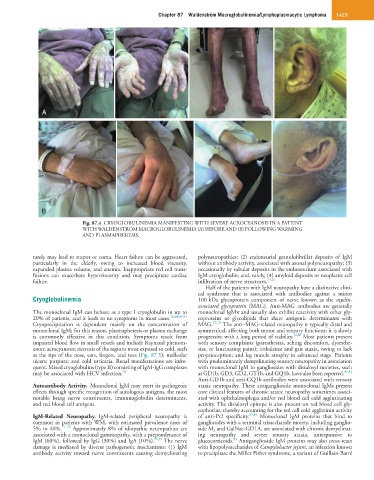
                            Fig. 87.4  CRYOGLOBULINEMIA MANIFESTING WITH SEVERE ACROCYANOSIS IN A PATIENT
                            WITH WALDENSTRÖM MACROGLOBULINEMIA (A) BEFORE AND (B) FOLLOWING WARMING
                            AND PLASMAPHERESIS.


            rarely may lead to stupor or coma. Heart failure can be aggravated,   polyneuropathies;  (2)  endoneurial  granulofibrillar  deposits  of  IgM
            particularly  in  the  elderly,  owing  to  increased  blood  viscosity,   without antibody activity, associated with axonal polyneuropathy; (3)
            expanded plasma volume, and anemia. Inappropriate red cell trans-  occasionally by tubular deposits in the endoneurium associated with
            fusions  can  exacerbate  hyperviscosity  and  may  precipitate  cardiac     IgM cryoglobulin; and, rarely, (4) amyloid deposits or neoplastic cell
            failure.                                              infiltration of nerve structures. 73,76
                                                                    Half of the patients with IgM neuropathy have a distinctive clini-
                                                                  cal  syndrome  that  is  associated  with  antibodies  against  a  minor
            Cryoglobulinemia                                      100 kDa  glycoprotein  component  of  nerve  known  as  the  myelin-
                                                                  associated  glycoprotein  (MAG).  Anti-MAG  antibodies  are  generally
            The monoclonal IgM can behave as a type I cryoglobulin in up to   monoclonal IgMκ and usually also exhibit reactivity with other gly-
            20% of patients, and it leads to no symptoms in most cases. 16,64,69,70    coproteins  or  glycolipids  that  share  antigenic  determinants  with
            Cryoprecipitation  is  dependent  mainly  on  the  concentration  of   MAG. 77–79  The anti–MAG-related neuropathy is typically distal and
            monoclonal IgM; for this reason, plasmapheresis or plasma exchange   symmetrical, affecting both motor and sensory functions; it is slowly
            is  commonly  effective  in  this  condition.  Symptoms  result  from   progressive with a long period of stability. 72,80  Most patients present
            impaired blood flow in small vessels and include Raynaud phenom-  with sensory complaints (paresthesias, aching discomfort, dysesthe-
            enon; acrocyanosis; necrosis of the regions most exposed to cold, such   sias, or lancinating pains); imbalance and gait ataxia, owing to lack
            as the tips of the nose, ears, fingers, and toes (Fig. 87.5); malleolar   proprioception; and leg muscle atrophy in advanced stage. Patients
            ulcers; purpura; and cold urticaria. Renal manifestations are infre-  with predominantly demyelinating sensory neuropathy in association
            quent. Mixed cryoglobulins (type II) consisting of IgM-IgG complexes   with monoclonal IgM to gangliosides with disialosyl moieties, such
            may be associated with HCV infection. 70              as GD1b, GD3, GD2, GT1b, and GQ1b, have also been reported. 81,82
                                                                  Anti-GD1b and anti-GQ1b antibodies were associated with sensory
            Autoantibody Activity.  Monoclonal IgM may exert its pathogenic   ataxic neuropathy. These antiganglioside monoclonal IgMs present
            effects through specific recognition of autologous antigens, the most   core clinical features of chronic ataxic neuropathy sometimes associ-
            notable  being  nerve  constituents,  immunoglobulin  determinants,   ated with ophthalmoplegia and/or red blood cell cold agglutinating
            and red blood cell antigens.                          activity. The disialosyl epitope is also present on red blood cell gly-
                                                                  cophorins, thereby accounting for the red cell cold agglutinin activity
            IgM-Related  Neuropathy.  IgM-related  peripheral  neuropathy  is   of  anti-Pr2  specificity. 83,84   Monoclonal  IgM  proteins  that  bind  to
            common in patients with WM, with estimated prevalence rates of   gangliosides with a terminal trisaccharide moiety, including ganglio-
            5% to 40%. 71–73  Approximately 8% of idiopathic neuropathies are   side M 2 and GalNac-GD1A, are associated with chronic demyelinat-
            associated with a monoclonal gammopathy, with a preponderance of   ing  neuropathy  and  severe  sensory  ataxia,  unresponsive  to
                                                                             85
            IgM (60%), followed by IgG (30%) and IgA (10%). 74,75  The nerve   glucocorticoids.  Antiganglioside IgM proteins may also cross-react
            damage is mediated by diverse pathogenetic mechanisms: (1) IgM   with lipopolysaccharides of Campylobacter jejuni, an infection known
            antibody  activity  toward  nerve  constituents  causing  demyelinating   to precipitate the Miller Fisher syndrome, a variant of Guillain-Barré

