


Page 1595 - Hematology_ Basic Principles and Practice ( PDFDrive )
P. 1595
Chapter 87  Waldenström Macroglobulinemia/Lymphoplasmacytic Lymphoma  1421


            is of significance, given its role as an adaptor molecule in Toll-like
                                                          44
            receptor  (TLR)  and  interleukin-1  receptor  (IL-1R)  signaling.   All   IMPACT OF WM GENOMICS ON
            TLRs  except  for  TLR3  use  MYD88  to  facilitate  their  signaling.   CLINICAL PRESENTATION
            Following TLR  or  IL-1R  stimulation,  MYD88  is  recruited  to  the
            activated receptor complex as a homodimer, which then complexes   The importance of MYD88 and CXCR4 mutations in the clinical
            with interleukin receptor-associated kinase 4 (IRAK4) and activates   presentation of patients with WM was recently reported. Significantly
            IRAK1  and  IRAK2. 45–47  Tumor  necrosis  factor  receptor-associated   higher BM involvement, serum IgM levels, and symptomatic disease
            factor 6 is then activated by IRAK1, leading to NFκB activation via   requiring therapy, including hyperviscosity syndrome, were observed
                                                                                                                   50
                             48
            IκBα phosphorylation.  Use of inhibitors of the MYD88 pathway   in  those  patients  with  MYD88 L265P CXCR4 WHIM/NS   mutations.
                                                                                                                  WT
            led  to  decreased  IRAK1  and  IκBα  phosphorylation,  as  well  as  to   Patients  with  MYD88 L265P CXCR4 WHIM/FS   or  MYD88 L265P CXCR4
            survival of MYD88 L265P -expressing WM cells. These observations are   had  intermediate  BM  and  serum  IgM  levels;  those  with  MYD-
                                                                    WT
                                                                           WT
            of particular relevance to WM because NFκB signaling is important   88 CXCR4  showed the lowest BM disease burden. Fewer patients
                                 49
            for WM growth and survival.  Bruton’s tyrosine kinase (BTK) is also   with MYD88 L265P  and CXCR4 WHIM/FS or NS  than with MYD88 L265P CX-
                                                                     WT
                               .   Activated  BTK  coimmunoprecipitates
            activated  by  MYD88 L265P 43                         CR4  presented with adenopathy, further delineating differences in
            with MYD88, which could be abrogated by use of a BTK inhibitor,   disease tropism based on CXCR4 status. Despite the more aggressive
            and  overexpression  of  MYD88 L265P   but  not  WT  MYD88  triggers   presentation associated with CXCR4 WHIM/NS  genotype, risk of death
            BTK activation. Knockdown of MYD88 by lentiviral transfection or   was  not  impacted  by  CXCR4  mutation  status.  Risk  of  death  was
                                                                                                           WT
            use of a MYD88 homodimerization inhibitor also abrogated BTK   found to be 10-fold higher in patients with the MYD88  versus the
            activation in MYD88 L265P -mutated WM cells.          MYD88 L265P  genotype. 50
            CXCR4 WHIM MUTATIONS                                  MARROW MICROENVIRONMENT
            The  second  most  common  somatic  mutation  after  MYD88 L265P    In patients with WM, increased numbers of mast cells are found in
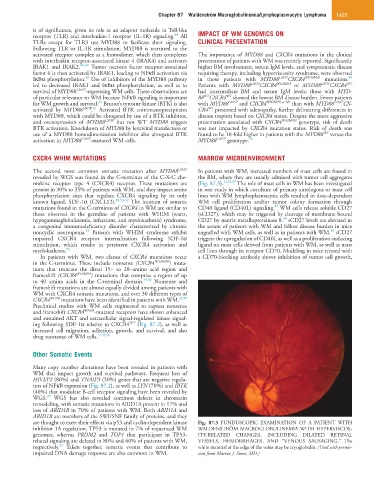
            revealed by WGS was found in the C-terminus of the C-X-C che-  the BM, where they are usually admixed with tumor cell aggregates
            mokine  receptor  type  4  (CXCR4)  receptor.  These  mutations  are   (Fig. 87.3). 14,18,57  The role of mast cells in WM has been investigated
            present in 30% to 35% of patients with WM, and they impact serine   in one study in which coculture of primary autologous or mast cell
            phosphorylation  sites  that  regulate  CXCR4  signaling  by  its  only   lines with WM lymphoplasmacytic cells resulted in dose-dependent
            known  ligand,  SDF-1α  (CXCL12). 29,50–52  The  location  of  somatic   WM  cell  proliferation  and/or  tumor  colony  formation  through
                                                                                           57
            mutations found in the C-terminus of CXCR4 in WM are similar to   CD40 ligand (CD40L) signaling.  WM cells release soluble CD27
            those  observed  in  the  germline  of  patients  with  WHIM  (warts,   (sCD27), which may be triggered by cleavage of membrane bound
                                                                                              58
            hypogammaglobulinemia, infections, and myelokathexis) syndrome,   CD27 by matrix metalloproteinase 8.  sCD27 levels are elevated in
            a  congenital  immunodeficiency  disorder  characterized  by  chronic   the serum of patients with WM and follow disease burden in mice
                             53
                                                                                                             59
            noncyclic  neutropenia.   Patients  with  WHIM  syndrome  exhibit   engrafted with WM cells, as well as in patients with WM.  sCD27
            impaired  CXCR4  receptor  internalization  following  SDF-1α   triggers the upregulation of CD40L as well as a proliferation-inducing
            stimulation,  which  results  in  persistent  CXCR4  activation  and   ligand on mast cells derived from patients with WM, as well as mast
            myelokathexis. 54                                     cell lines through its receptor CD70. Modeling in mice treated with
              In  patients  with  WM,  two  classes  of  CXCR4  mutations  occur   a CD70-blocking antibody shows inhibition of tumor cell growth,
            in the C-terminus. These include nonsense (CXCR4 WHIM/NS ) muta-
            tions  that  truncate  the  distal  15–  to  20–amino  acid  region  and
            frameshift (CXCR4 WHIM/FS ) mutations that comprise a region of up
            to  40  amino  acids  in  the  C-terminal  domain. 29,50   Nonsense  and
            frameshift mutations are almost equally divided among patients with
            WM with CXCR4 somatic mutations, and over 30 different types of
            CXCR4 WHIM  mutations have been identified in patients with WM. 29,50
            Preclinical  studies  with  WM  cells  engineered  to  express  nonsense
            and frameshift CXCR4 WHIM -mutated receptors have shown enhanced
            and sustained AKT and extracellular signal-regulated kinase signal-
                                           WT
            ing following SDF-1α relative to CXCR4  (Fig. 87.2), as well as
            increased  cell  migration,  adhesion,  growth,  and  survival,  and  also
            drug resistance of WM cells. 51,55,56

            Other Somatic Events

            Many copy number alterations have been revealed in patients with
            WM  that  impact  growth  and  survival  pathways.  Frequent  loss  of
            HIVEP2 (80%) and TNAIP3 (50%) genes that are negative regula-
            tors of NFκB expression (Fig. 87.2), as well as LYN (70%) and IBTK
            (40%) that modulate B-cell receptor signaling have been revealed by
                29
            WGS.   WGS  has  also  revealed  common  defects  in  chromatin
            remodeling, with somatic mutations in ARID1A present in 17% and
            loss of ARID1B in 70% of patients with WM. Both ARID1A and
            ARID1B are members of the SWI/SNF family of proteins, and they
            are thought to exert their effects via p53 and cyclin-dependent kinase   Fig.  87.3  FUNDUSCOPIC  EXAMINATION  OF  A  PATIENT  WITH
            inhibitor 1A regulation. TP53 is mutated in 7% of sequenced WM   WALDENSTRÖM MACROGLOBULINEMIA WITH HYPERVISCOS-
            genomes,  whereas  PRDM2  and  TOP1  that  participate  in  TP53-  ITY-RELATED  CHANGES,  INCLUDING  DILATED  RETINAL
            related signaling are deleted in 80% and 60% of patients with WM,   VESSELS,  HEMORRHAGES,  AND  “VENOUS  SAUSAGING.”  The
                     29
            respectively.   Taken  together,  somatic  events  that  contribute  to   white material at the edge of the veins may be cryoglobulin. (Used with permis-
            impaired DNA damage response are also common in WM.   sion from Marvin J. Stone, MD.)

