


Page 1621 - Hematology_ Basic Principles and Practice ( PDFDrive )
P. 1621
1442   Part VII  Hematologic Malignancies


        response  without  a  significant  risk  of  recurrent  amyloid  when  the   CONCLUSIONS
        primary hematologic disorder is controlled.
           Nine  cardiac  transplants  were  reported  from  Boston,  eight  of   Amyloidosis should always be considered in the differential diagnosis
        whom  subsequently  received  a  stem  cell  transplant.  Six  of  seven   of a patient who presents with proteinuria and is nondiabetic. Any
        evaluable patients achieved a complete hematologic remission. One   patient  with  unexplained  fatigue  or  restrictive  cardiomyopathy  or
        achieved a partial remission. At a median follow-up of 56 months,   heart failure with preserved ejection fraction should be screened for
        five of seven patients were alive without recurrent amyloid, compa-  amyloidosis.  Patients  who  fulfill  criteria  for  chronic  inflammatory
        rable to patients who received heart transplants for nonamyloid heart   demyelinating peripheral neuropathy, unexplained hepatomegaly, or
        disease. At Mayo Clinic, the median survival of patients who have   atypical multiple myeloma should all be considered for the possibility
        received cardiac transplants for amyloid is approximately 50%, which   of  amyloidosis.  When  a  patient  with  one  of  these  five  compatible
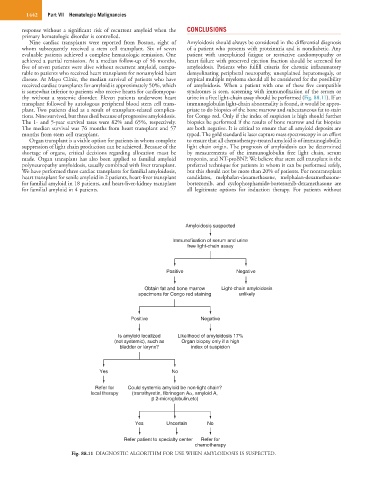
        is somewhat inferior to patients who receive hearts for cardiomyopa-  syndromes is seen, screening with immunofixation of the serum or
        thy  without  a  systemic  disorder.  Eleven  patients  underwent  heart   urine in a free light-chain assay should be performed (Fig. 88.11). If an
        transplant followed by autologous peripheral blood stem cell trans-  immunoglobulin light-chain abnormality is found, it would be appro-
        plant. Two patients died as a result of transplant-related complica-  priate to do biopsies of the bone marrow and subcutaneous fat to stain
        tions. Nine survived, but three died because of progressive amyloidosis.   for Congo red. Only if the index of suspicion is high should further
        The 1- and 5-year survival rates were 82% and 65%, respectively.   biopsies be performed if the results of bone marrow and fat biopsies
        The median survival was 76 months from heart transplant and 57   are both negative. It is critical to ensure that all amyloid deposits are
        months from stem cell transplant.                     typed. The gold standard is laser capture mass spectroscopy in an effort
           Organ transplant is a viable option for patients in whom complete   to ensure that all chemotherapy-treated amyloid is of immunoglobulin
        suppression of light chain production can be achieved. Because of the   light chain origin. The prognosis of amyloidosis can be determined
        shortage  of  organs,  critical  decisions  regarding  allocation  must  be   by  measurements  of  the  immunoglobulin  free  light  chain,  serum
        made.  Organ  transplant  has  also  been  applied  to  familial  amyloid   troponin, and NT-proBNP. We believe that stem cell transplant is the
        polyneuropathy amyloidosis, usually combined with liver transplant.   preferred technique for patients in whom it can be performed safely,
        We have performed three cardiac transplants for familial amyloidosis,   but this should not be more than 20% of patients. For nontransplant
        heart transplant for senile amyloid in 2 patients, heart-liver transplant   candidates,  melphalan-dexamethasone,  melphalan-dexamethasone-
        for familial amyloid in 18 patients, and heart-liver-kidney transplant   bortezomib,  and  cyclophosphamide-bortezomib-dexamethasone  are
        for familial amyloid in 4 patients.                   all  legitimate  options  for  induction  therapy.  For  patients  without


                                                              Amyloidosis suspected

                                                          lmmunofixation of serum and urine
                                                              free light-chain assay


                                                       Positive               Negative

                                                Obtain fat and bone marrow  Light-chain amyloidosis
                                              specimens for Congo red staining  unlikely


                                            Positive               Negative


                                        Is amyloid localized  Likelihood of amyloidosis 17%
                                      (not systemic), such as  Organ biopsy only if a high
                                        bladder or larynx?     index of suspicion


                                  Yes                    No

                                Refer for  Could systemic amyloid be non-light chain?
                               local therapy  (transthyretin, fibrinogen A , amyloid A,
                                                     2-microglobulin,etc)


                                             Yes       Uncertain     No

                                          Refer patient to specialty center  Refer for
                                                                 chemotherapy
                        Fig. 88.11  DIAGNOSTIC ALGORITHM FOR USE WHEN AMYLOIDOSIS IS SUSPECTED.

