


Page 1618 - Hematology_ Basic Principles and Practice ( PDFDrive )
P. 1618
Chapter 88  Immunoglobulin Light Chain Amyloidosis (Primary Amyloidosis)  1439


                1.0                                               orthostatic syncope but are associated with both fluid retention and
                0.9                                               supine  hypertension,  making  their  use  a  challenge.  The  diarrhea
                                                                  associated with GI amyloid is also challenging. It is common for these
                0.8                                               patients to fail imodium therapy and loperamide. We frequently will
                0.7                                               use tincture of opium to manage this. In refractory instances where
                                                                  fecal incontinence is common, the placement of a diverting sigmoid
                0.6
              Surviving  0.5                                      colostomy has no impact on the diarrhea but can provide the patient
                                                                  important improved quality of life and social relief.
                0.4
                0.3                                               Chemotherapy Treatment for Light Chain Amyloidosis
                0.2
                0.1                                               The  chemotherapy  treatment  of  light-chain  amyloidosis  requires  a
                0.0                                               determination of whether the patients are candidates for high-dose
                    0               50              100           therapy with stem cell transplant or are best served with conventional
                                                                  chemotherapy regimens.
                               Survival months                      It is now 40 years since melphalan and prednisone treatment was
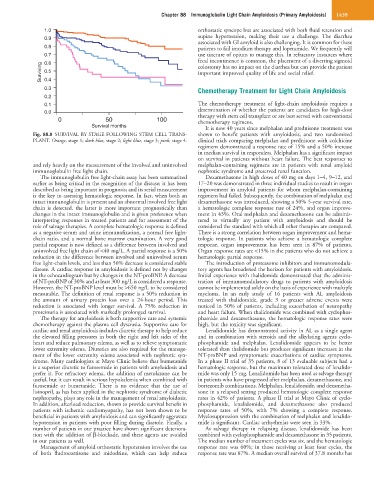
            Fig. 88.8  SURVIVAL BY STAGE FOLLOWING STEM CELL TRANS-  shown  to  benefit  patients  with  amyloidosis,  and  two  randomized
            PLANT. Orange, stage 1; dark blue, stage 2; light blue, stage 3; pink, stage 4.  clinical trials comparing melphalan and prednisone with colchicine
                                                                  regimens demonstrated a response rate of 15% and a 50% increase
                                                                  in median survival in responders. Melphalan has a significant impact
                                                                  on survival in patients without heart failure. The best responses to
            and rely heavily on the measurement of the involved and uninvolved   melphalan-containing  regimens  are  in  patients  with  renal  amyloid
            immunoglobulin free light chain.                      nephrotic syndrome and preserved renal function.
              The immunoglobulin free light-chain assay has been summarized   Dexamethasone in high doses of 40 mg on days 1–4, 9–12, and
            earlier as being critical in the recognition of the disease; it has been   17–20 was demonstrated in three individual studies to result in organ
            described as being important in prognosis; and its serial measurement   improvement in amyloid patients for whom melphalan-containing
            is the key to assessing hematologic response. In fact, when both an   regimens had failed. Subsequently, the combination of melphalan and
            intact immunoglobulin is present and an abnormal involved free light   dexamethasone was introduced, showing a 50% 5-year survival rate,
            chain is detected, the latter is more important prognostically than   a hematologic complete response rate of 24%, and organ improve-
            changes in the intact immunoglobulin and is given preference when   ment in 43%. Oral melphalan and dexamethasone can be adminis-
            interpreting responses in treated patients and for assessment of the   tered  to  virtually  any  patient  with  amyloidosis  and  should  be
            role of salvage therapies. A complete hematologic response is defined   considered the standard with which all other therapies are compared.
            as a negative serum and urine immunofixation, a normal free light-  There is a strong correlation between organ improvement and hema-
            chain ratio, and a normal bone marrow examination. A very good   tologic  response.  In  patients  who  achieve  a  hematologic  complete
            partial response is now defined as a difference between involved and   response,  organ  improvement  has  been  seen  in  87%  of  patients.
            uninvolved free light chain of <40 mg/L. A partial response is a 50%   Organ response rates are <15% in the patients who do not achieve a
            reduction in the difference between involved and uninvolved serum   hematologic partial response.
            free light-chain levels, and less than 50% decrease is considered stable   The introduction of proteasome inhibitors and immunomodula-
            disease. A cardiac response in amyloidosis is defined not by changes   tory agents has broadened the horizon for patients with amyloidosis.
            in the echocardiogram but by changes in the NT-proBNP. A decrease   Initial experience with thalidomide demonstrated that the adminis-
            of NT-proBNP of 30% and at least 300 ng/L is considered a response.   tration  of  immunomodulatory  drugs  to  patients  with  amyloidosis
            However, the NT-proBNP level must be >650 ng/L to be considered   cannot be implemented solely on the basis of experience with multiple
            measurable. The definition of renal response is a 50% reduction in   myeloma.  In  an  early  study  of  16  patients  with  AL  amyloidosis
            the  amount  of  urinary  protein  loss  over  a  24-hour  period.  This   treated  with  thalidomide,  grade  3  or  greater  adverse  events  were
            reduction  is  associated  with  longer  survival.  A  75%  reduction  in   noticed  in  50%  of  patients,  including  exacerbation  of  neuropathy
            proteinuria is associated with markedly prolonged survival.  and heart failure. When thalidomide was combined with cyclophos-
              The therapy for amyloidosis is both supportive care and systemic   phamide  and  dexamethasone,  the  hematologic  response  rates  were
            chemotherapy against the plasma cell dyscrasia. Supportive care for   high, but the toxicity was significant.
            cardiac and renal amyloidosis includes diuretic therapy to help reduce   Lenalidomide has demonstrated activity in AL as a single agent
            the elevated filling pressures in both the right and left sides of the   and  in  combination  with  steroids  and  the  alkylating  agents  cyclo-
            heart and reduce pulmonary edema, as well as to relieve symptomatic   phosphamide  and  melphalan.  Lenalidomide  appears  to  be  better
            lower extremity edema. Diuretics are also required for the manage-  tolerated than thalidomide but produces significant increases in the
            ment of the lower extremity edema associated with nephrotic syn-  NT-proBNP and symptomatic exacerbations of cardiac symptoms.
            drome. Many cardiologists at Mayo Clinic believe that bumetanide   In a phase II trial of 35 patients, 8 of 13 evaluable subjects had a
            is a superior diuretic to furosemide in patients with amyloidosis and   hematologic response, but the maximum tolerated dose of lenalido-
            prefer it. For refractory edema, the addition of metolazone can be   mide was only 15 mg. Lenalidomide has been used as salvage therapy
            useful, but it can result in serious hypokalemia when combined with   in patients who have progressed after melphalan, dexamethasone, and
            furosemide  or  bumetanide.  There  is  no  evidence  that  the  use  of   bortezomib combinations. Melphalan, lenalidomide, and dexametha-
            lisinopril, as has been applied in the nephrotic syndrome of diabetic   sone in a relapsed setting produced hematologic complete response
            nephropathy, plays any role in the management of renal amyloidosis.   rates in 42% of patients. A phase II trial at Mayo Clinic of cyclo-
            In addition, afterload reduction, shown to provide survival benefit in   phosphamide,  lenalidomide,  and  dexamethasone  also  produced
            patients with ischemic cardiomyopathy, has not been shown to be   response  rates  of  50%,  with  7%  showing  a  complete  response.
            beneficial in patients with amyloidosis and can significantly aggravate   Myelosuppression with the combination of melphalan and lenalido-
            hypotension in patients with poor filling during diastole. Finally, a   mide is significant. Cardiac arrhythmias were seen in 33%.
            number of patients in our practice have shown significant deteriora-  As  salvage  therapy  in  relapsing  disease,  lenalidomide  has  been
            tion with the addition of β-blockade, and these agents are avoided   combined with cyclophosphamide and dexamethasone in 35 patients.
            in our patients as well.                              The median number of treatment cycles was six, and the hematologic
              Management of amyloid orthostatic hypotension involves the use   response  rate  was  60%;  in  those  receiving  at  least  four  cycles,  the
            of  both  fludrocortisone  and  midodrine,  which  can  help  reduce   response rate was 87%. A median overall survival of 37.8 months has

