


Page 1620 - Hematology_ Basic Principles and Practice ( PDFDrive )
P. 1620
Chapter 88  Immunoglobulin Light Chain Amyloidosis (Primary Amyloidosis)  1441


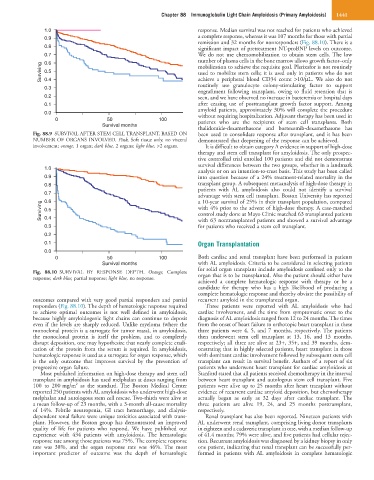
                1.0                                               response. Median survival was not reached for patients who achieved
                0.9                                               a complete response, whereas it was 107 months for those with partial
                                                                  remission and 32 months for nonresponders (Fig. 88.10). There is a
                0.8                                               significant impact of pretreatment NT-proBNP levels on outcome.
                0.7                                               We  do  not  use  chemomobilization  to  obtain  stem  cells. The  low
                                                                  number of plasma cells in the bone marrow allows growth factor–only
                0.6
              Surviving  0.5                                      mobilization to achieve the requisite goal. Plerixafor is not routinely
                                                                  used to mobilize stem cells; it is used only in patients who do not
                                                                  achieve  a  peripheral  blood  CD34  count  >10/µL.  We  also  do  not
                0.4
                0.3                                               routinely  use  granulocyte  colony-stimulating  factor  to  support
                                                                  engraftment  following  transplant,  owing  to  fluid  retention  that  is
                0.2                                               seen, and we have observed no increase in bacteremia or hospital days
                0.1                                               after  ceasing  use  of  posttransplant  growth  factor  support.  Among
                                                                  amyloid patients, approximately 30% will complete the procedure
                0.0                                               without requiring hospitalization. Adjuvant therapy has been used in
                   0                50               100          patients  who  are  the  recipients  of  stem  cell  transplants.  Both
                                  Survival months
                                                                  thalidomide-dexamethasone  and  bortezomib-dexamethasone  has
            Fig. 88.9  SURVIVAL AFTER STEM CELL TRANSPLANT, BASED ON   been used to consolidate response after transplant, and it has been
            NUMBER OF ORGANS INVOLVED. Pink, Soft tissue only, no visceral   demonstrated that deepening of the response can be achieved.
            involvement; orange, 1 organ; dark blue, 2 organs; light blue, >2 organs.  It is difficult to obtain category A evidence in support of high-dose
                                                                  therapy and stem cell transplant for amyloidosis. The only prospec-
                                                                  tive controlled trial enrolled 100 patients and did not demonstrate
                                                                  survival differences between the two groups, whether in a landmark
                1.0
                                                                  analysis or on an intention-to-treat basis. This study has been called
                0.9                                               into question because of a 24% treatment-related mortality in the
                0.8                                               transplant group. A subsequent metaanalysis of high-dose therapy in
                                                                  patients  with  AL  amyloidosis  also  could  not  identify  a  survival
                0.7                                               advantage with stem cell transplant. Boston University has reported
                                                                  a 10-year survival of 25% in their transplant population, compared
                0.6
              Surviving  0.5                                      with 4% prior to the advent of high-dose therapy. A case-matched
                                                                  control study done at Mayo Clinic matched 63 transplanted patients
                0.4
                                                                  for patients who received a stem cell transplant.
                0.3                                               with 63 nontransplanted patients and showed a survival advantage
                0.2
                0.1                                               Organ Transplantation
                0.0
                   0                50               100          Both cardiac and renal transplant have been performed in patients
                                  Survival months                 with AL amyloidosis. Criteria to be considered in selecting patients
                                                                  for solid organ transplant include amyloidosis confined only to the
            Fig.  88.10  SURVIVAL  BY  RESPONSE  DEPTH.  Orange,  Complete   organ that is to be transplanted. Also the patient should either have
            response; dark blue, partial response; light blue, no response.
                                                                  achieved  a  complete  hematologic  response  with  therapy  or  be  a
                                                                  candidate  for  therapy  who  has  a  high  likelihood  of  producing  a
                                                                  complete hematologic response and thereby obviate the possibility of
            outcomes  compared  with  very  good  partial  responders  and  partial   recurrent amyloid in the transplanted organ.
            responders (Fig. 88.10). The depth of hematologic response required   Three  patients  were  reported  with  AL  amyloidosis  who  had
            to  achieve  optimal  outcomes  is  not  well  defined  in  amyloidosis,   cardiac involvement, and the time from symptomatic onset to the
            because highly amyloidogenic light chains can continue to deposit   diagnosis of AL amyloidosis ranged from 12 to 24 months. The times
            even if the levels are sharply reduced. Unlike myeloma (where the   from the onset of heart failure to orthotopic heart transplant in these
            monoclonal protein is a surrogate for tumor mass), in amyloidosis,   three  patients  were  4,  5,  and  7  months,  respectively. The  patients
            the  monoclonal  protein  is  itself  the  problem,  and  to  completely   then  underwent  stem  cell  transplant  at  13,  16,  and  13  months,
            disrupt deposition, one may hypothesize that nearly complete eradi-  respectively; all three are alive at 23+, 35+, and 39 months, dem-
            cation  of  the  protein  from  the  serum  is  required.  In  amyloidosis,   onstrating that in highly selected patients, heart transplant in those
            hematologic response is used as a surrogate for organ response, which   with dominant cardiac involvement followed by subsequent stem cell
            is  the  only  outcome  that  improves  survival  by  the  prevention  of   transplant can result in survival benefit. Authors of a report of six
            progressive organ failure.                            patients who underwent heart transplant for cardiac amyloidosis at
              Most published information on high-dose therapy and stem cell   Stanford stated that all patients received chemotherapy in the interval
            transplant in amyloidosis has used melphalan at doses ranging from   between heart transplant and autologous stem cell transplant. Five
                          2
            100  to  200 mg/m   as  the  standard.  The  Boston  Medical  Center   patients were alive up to 25 months after heart transplant without
            reported 250 patients with AL amyloidosis who underwent high-dose   evidence of recurrent cardiac amyloid deposition, but chemotherapy
            melphalan and autologous stem cell rescue. Two-thirds were alive at   actually  began  as  early  as  32  days  after  cardiac  transplant.  The
            a mean follow-up of 23 months, with a 3-month all-cause mortality   three  patients  are  alive  19,  24,  and  25  months  posttransplant,
            of  14%.  Febrile  neutropenia,  GI  tract  hemorrhage,  and  dialysis-  respectively.
            dependent renal failure were unique toxicities associated with trans-  Renal transplant has also been reported. Nineteen patients with
            plant.  However,  the  Boston  group  has  demonstrated  an  improved   AL underwent renal transplant, comprising living donor transplants
            quality  of  life  for  patients  who  respond.  We  have  published  our   in eighteen and a cadaveric transplant in one, with a median follow-up
            experience  with  434  patients  with  amyloidosis.  The  hematologic   of 41.4 months; 79% were alive, and five patients had cellular rejec-
            response rate among those patients was 75%. The complete response   tion. Recurrent amyloidosis was diagnosed by a kidney biopsy in only
            rate  was  38%,  and  the  organ  response  rate  was  46%.  The  most   one patient, indicating that renal transplant can be successfully per-
            important  predictor  of  outcome  was  the  depth  of  hematologic   formed  in  patients  with  AL  amyloidosis  in  complete  hematologic

