


Page 1617 - Hematology_ Basic Principles and Practice ( PDFDrive )
P. 1617
1438   Part VII  Hematologic Malignancies


                              50


                              40

                             Patients, No.  30


                              20


                              10


                               0
                                   ≤35  36–40  41–45  46–50  51–55  56–60  61–65  66–70  71–75  ≥76  Unknown

                                                        Age at Diagnosis, y              age
                              Thr60Ala  Val30Met  Val122lle  Ser77Tyr  Other TTR  Non–TTR  Unknown
                                                                                     mutation
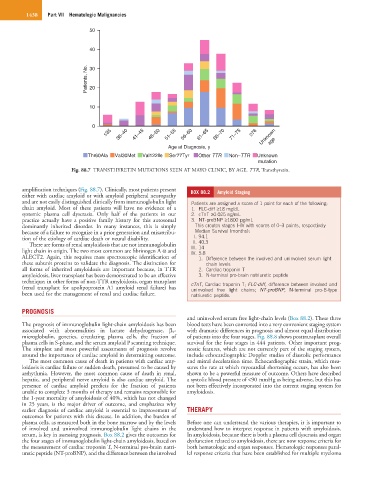
                        Fig. 88.7  TRANSTHYRETIN MUTATIONS SEEN AT MAYO CLINIC, BY AGE. TTR, Transthyretin.


        amplification techniques (Fig. 88.7). Clinically, most patients present   BOX 88.2  Amyloid Staging
        either with cardiac amyloid or with amyloid peripheral neuropathy
        and are not easily distinguished clinically from immunoglobulin light   Patients are assigned a score of 1 point for each of the following:
        chain  amyloid.  Most  of  these  patients  will  have  no  evidence  of  a   1.  FLC-diff ≥18 mg/dL
        systemic  plasma  cell  dyscrasia.  Only  half  of  the  patients  in  our   2.  cTnT ≥0.025 ng/mL
        practice  actually  have  a  positive  family  history  for  this  autosomal   3.  NT-proBNP ≥1800 pg/mL
        dominantly  inherited  disorder.  In  many  instances,  this  is  simply   This creates stages I–IV with scores of 0–3 points, respectively
        because of a failure to recognize in a prior generation and misattribu-  Median Survival (months):
        tion of the etiology of cardiac death or neural disability.    I. 94.1
           There are forms of renal amyloidosis that are not immunoglobulin    II. 40.3
        light chain in origin. The two most common are fibrinogen A α and   III. 14
                                                                IV. 5.8
        ALECT2.  Again,  this  requires  mass  spectroscopic  identification  of   1.  Difference between the involved and uninvolved serum light
        these subunit proteins to validate the diagnosis. The distinction for   chain levels
        all  forms  of  inherited  amyloidosis  are  important  because,  in TTR   2.  Cardiac troponin T
        amyloidosis, liver transplant has been demonstrated to be an effective   3.  N-terminal pro-brain natriuretic peptide
        technique; in other forms of non-TTR amyloidosis, organ transplant   cTnT, Cardiac troponin T; FLC-diff, difference between involved and
        (renal  transplant  for  apolipoprotein  A1  amyloid  renal  failure)  has   uninvolved  free  light  chains;  NT-proBNP,  N-terminal  pro-B-type
        been used for the management of renal and cardiac failure.  natriuretic peptide.


        PROGNOSIS
                                                              and uninvolved serum free light-chain levels (Box 88.2). These three
        The prognosis of immunoglobulin light-chain amyloidosis has been   blood tests have been converted into a very convenient staging system
        associated  with  abnormalities  in  lactate  dehydrogenase,  β 2 -  with dramatic differences in prognosis and almost equal distribution
        microglobulin,  genetics,  circulating  plasma  cells,  the  fraction  of   of patients into the four stages. Fig. 88.8 shows posttransplant overall
        plasma cells in S-phase, and the serum amyloid P scanning technique.   survival for the four stages in 444 patients. Other important prog-
        The  simplest  and  most  powerful  assessments  of  prognosis  revolve   nostic features, which are not currently part of the staging system,
        around the importance of cardiac amyloid in determining outcome.  include echocardiographic Doppler studies of diastolic performance
           The most common cause of death in patients with cardiac amy-  and mitral deceleration time. Echocardiographic strain, which mea-
        loidosis is cardiac failure or sudden death, presumed to be caused by   sures the rate at which myocardial shortening occurs, has also been
        arrhythmia.  However,  the  most  common  cause  of  death  in  renal,   shown to be a powerful measure of outcome. Others have described
        hepatic, and peripheral nerve amyloid is also cardiac amyloid. The   a systolic blood pressure of <90 mmHg as being adverse, but this has
        presence  of  cardiac  amyloid  predicts  for  the  fraction  of  patients   not been effectively incorporated into the current staging system for
        unable to complete 3 months of therapy and remains responsible for   amyloidosis.
        the 1-year mortality of amyloidosis of 40%, which has not changed
        in  25  years,  is  the  major  driver  of  outcome,  and  emphasizes  why
        earlier diagnosis of cardiac amyloid is essential to improvement of   THERAPY
        outcomes for patients with this disease. In addition, the burden of
        plasma cells, as measured both in the bone marrow and by the levels   Before one can understand the various therapies, it is important to
        of  involved  and  uninvolved  immunoglobulin  light  chains  in  the   understand how to interpret response in patients with amyloidosis.
        serum, is key in assessing prognosis. Box 88.2 gives the outcomes for   In amyloidosis, because there is both a plasma cell dyscrasia and organ
        the four stages of immunoglobulin light-chain amyloidosis, based on   dysfunction related to amyloidosis, there are now response criteria for
        the measurement of cardiac troponin T, N-terminal pro-brain natri-  both hematologic and organ responses. Hematologic responses paral-
        uretic peptide (NT-proBNP), and the difference between the involved   lel response criteria that have been established for multiple myeloma

