


Page 1628 - Hematology_ Basic Principles and Practice ( PDFDrive )
P. 1628
Chapter 89  Clinical Approach to Infections in the Compromised Host  1449


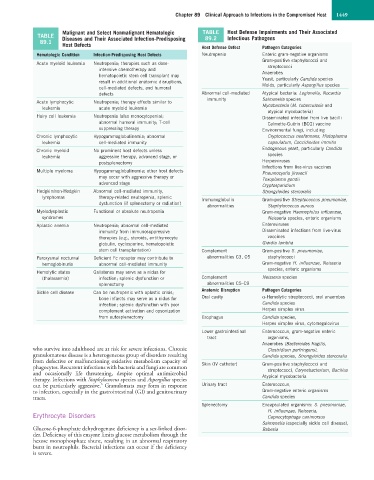
                     Malignant and Select Nonmalignant Hematologic   TABLE   Host Defense Impairments and Their Associated
             TABLE   Diseases and Their Associated Infection-Predisposing   89.2  Infectious Pathogens
              89.1   Host Defects
                                                                   Host Defense Defect  Pathogen Categories
             Hematologic Condition  Infection-Predisposing Host Defects  Neutropenia   Enteric gram-negative organisms
                                                                                       Gram-positive staphylococci and
             Acute myeloid leukemia  Neutropenia; therapies such as dose-                streptococci
                                 intensive chemotherapy and                            Anaerobes
                                 hematopoietic stem cell transplant may                Yeast, particularly Candida species
                                 result in additional anatomic disruptions,            Molds, particularly Aspergillus species
                                 cell-mediated defects, and humoral
                                 defects                           Abnormal cell-mediated   Atypical bacteria: Legionella, Nocardia
                                                                     immunity          Salmonella species
             Acute lymphocytic   Neutropenia; therapy effects similar to               Mycobacteria (M. tuberculosis and
               leukemia          acute myeloid leukemia
                                                                                         atypical mycobacteria)
             Hairy cell leukemia  Neutropenia (also monocytopenia);                    Disseminated infection from live bacilli
                                 abnormal humoral immunity; T-cell                       Calmette-Guérin (BCG) vaccine
                                 suppressing therapy                                   Environmental fungi, including
             Chronic lymphocytic   Hypogammaglobulinemia; abnormal                       Cryptococcus neoformans, Histoplasma
               leukemia          cell-mediated immunity                                  capsulatum, Coccidioides immitis
             Chronic myeloid    No prominent host defects unless                       Endogenous yeast, particularly Candida
               leukemia          aggressive therapy, advanced stage, or                  species
                                 postsplenectomy                                       Herpesviruses
                                                                                       Infections from live-virus vaccines
             Multiple myeloma   Hypogammaglobulinemia; other host defects              Pneumocystis jirovecii
                                 may occur with aggressive therapy or                  Toxoplasma gondii
                                 advanced stage
                                                                                       Cryptosporidium
             Hodgkin/non-Hodgkin   Abnormal cell-mediated immunity,                    Strongyloides stercoralis
               lymphomas         therapy-related neutropenia, splenic   Immunoglobulin   Gram-positive Streptococcus pneumoniae,
                                 dysfunction (if splenectomy or radiation)
                                                                     abnormalities       Staphylococcus aureus
             Myelodysplastic    Functional or absolute neutropenia                     Gram-negative Haemophilus influenzae,
               syndromes                                                                 Neisseria species, enteric organisms
             Aplastic anemia    Neutropenia; abnormal cell-mediated                    Enteroviruses
                                 immunity from immunosuppressive                       Disseminated infections from live-virus
                                 therapies (e.g., steroids, antithymocyte                vaccines
                                 globulin, cyclosporine, hematopoietic                 Giardia lamblia
                                 stem cell transplantation)        Complement          Gram-positive S. pneumoniae,
             Paroxysmal nocturnal   Deficient Fc receptor may contribute to   abnormalities C3, C5  staphylococci
               hemoglobinuria    abnormal cell-mediated immunity                       Gram-negative H. influenzae, Neisseria
                                                                                         species, enteric organisms
             Hemolytic states   Gallstones may serve as a nidus for
               (thalassemia)     infection; splenic dysfunction or   Complement        Neisseria species
                                 splenectomy                         abnormalities C5–C9
             Sickle cell disease  Can be neutropenic with aplastic crisis;   Anatomic Disruption  Pathogen Categories
                                 bone infarcts may serve as a nidus for   Oral cavity  α-Hemolytic streptococci, oral anaerobes
                                 infection; splenic dysfunction with poor              Candida species
                                 complement activation and opsonization                Herpes simplex virus
                                 from autosplenectomy              Esophagus           Candida species,
                                                                                       Herpes simplex virus, cytomegalovirus
                                                                   Lower gastrointestinal   Enterococcus, gram-negative enteric
                                                                     tract               organisms,
                                                                                       Anaerobes (Bacteroides fragilis,
            who survive into adulthood are at risk for severe infections. Chronic        Clostridium perfringens),
            granulomatous disease is a heterogeneous group of disorders resulting      Candida species, Strongyloides stercoralis
            from defective or malfunctioning oxidative metabolism capacity of   Skin (IV catheter)  Gram-positive staphylococci and
            phagocytes. Recurrent infections with bacteria and fungi are common          streptococci, Corynebacterium, Bacillus
            and  occasionally  life  threatening,  despite  optimal  antimicrobial     Atypical mycobacteria
            therapy. Infections with Staphylococcus species and Aspergillus species
                                  6
            can be particularly aggressive.  Granulomata may form in response   Urinary tract  Enterococcus,
            to infection, especially in the gastrointestinal (GI) and genitourinary    Gram-negative enteric organisms
            tracts.                                                                    Candida species
                                                                   Splenectomy         Encapsulated organisms: S. pneumoniae,
                                                                                         H. influenzae, Neisseria,
            Erythrocyte Disorders                                                        Capnocytophaga canimorsus
                                                                                       Salmonella (especially sickle cell disease),
            Glucose-6-phosphate dehydrogenase deficiency is a sex-linked disor-        Babesia
            der. Deficiency of this enzyme limits glucose metabolism through the
            hexose monophosphate shunt, resulting in an abnormal respiratory
            burst in neutrophils. Bacterial infections can occur if the deficiency
            is severe.

