


Page 1631 - Hematology_ Basic Principles and Practice ( PDFDrive )
P. 1631
1452   Part VIII  Comprehensive Care of Patients with Hematologic Malignancies

                                                                    15
        a bloodstream infection arising from a different source (e.g., the GI   therapy.   Vancomycin  is  administered  if  staphylococcal  disease  is
        tract). 12                                            suspected  or  if  the  patient  is  clinically  unstable  while  cultures  are
           Consensus guidelines on the management of patients with febrile   pending. Severely ill patients are often also treated with an aminogly-
                                  13
        neutropenia have been published.  Empiric antibiotics are recom-  coside for the first 48 to 72 hours of illness, although data in support
        mended  for  all  febrile  patients  with  neutropenia,  but  the  type  of   of this approach are lacking.
        antibiotics and the site of administration (i.e., hospital vs. outpatient)   Therapeutic changes to the antimicrobial regimens are made in
        depends on the severity of immunosuppression, expected duration of   response to culture results, but the cultures are negative about 50%
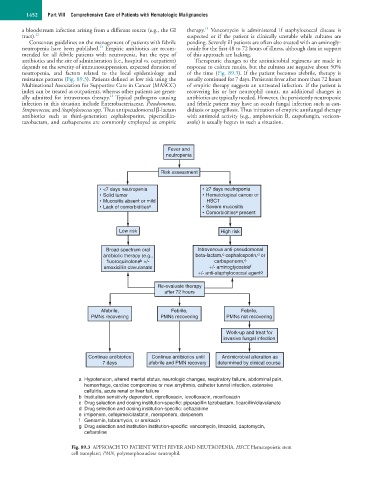
        neutropenia,  and  factors  related  to  the  local  epidemiology  and   of the time (Fig. 89.3). If the patient becomes afebrile, therapy is
        resistance patterns (Fig. 89.3). Patients defined as low risk using the   usually continued for 7 days. Persistent fever after more than 72 hours
        Multinational Association for Supportive Care in Cancer (MASCC)   of empiric therapy suggests an untreated infection. If the patient is
        index can be treated as outpatients, whereas other patients are gener-  recovering  his  or  her  neutrophil  count,  no  additional  changes  in
                                     14
        ally  admitted  for  intravenous  therapy.  Typical  pathogens  causing   antibiotics are typically needed. However, the persistently neutropenic
        infection in this situation include Enterobacteriaceae, Pseudomonas,   and febrile patient may have an occult fungal infection such as can-
        Streptococcus, and Staphylococcus spp. Thus antipseudomonal β-lactam   didiasis or aspergillosis. Thus initiation of empiric antifungal therapy
        antibiotics  such  as  third-generation  cephalosporins,  piperacillin-  with antimold activity (e.g., amphotericin B, caspofungin, voricon-
        tazobactam,  and  carbapenems  are  commonly  employed  as  empiric   azole) is usually begun in such a situation.


                                                        Fever and
                                                       neutropenia

                                                      Risk assessment


                                  • <7 days neutropenia            • ≥7 days neutropenia
                                  • Solid tumor                    • Hematological cancer or
                                  • Mucositis absent or mild          HSCT
                                  • Lack of comorbidities a        • Severe mucositis
                                                                   • Comorbidities a  present

                                        Low risk                         High risk


                                    Broad spectrum oral           Intravenous anti-pseudomonal
                                                                          c
                                                                                     d
                                   antibiotic therapy (e.g.,     beta-lactam,  cephalosporin,  or
                                    fluoroquinolone  +/-               carbapenerm, e
                                               b
                                   amoxicillin clavulanate            +/- aminoglycoside f
                                                                  +/- anti-staphylococcal agent g
                                                     Re-evaluate therapy
                                                       after 72 hours


                                  Afebrile,              Febrile,               Febrile,
                               PMNs recovering        PMNs recovering      PMNs not recovering

                                                                           Work-up and treat for
                                                                          invasive fungal infection


                              Continue antibiotics  Continue antibiotics until  Antimicrobial alteration as
                                   7 days         afebrile and PMN recovery   determined by clinical course


                           a  Hypotension, altered mental status, neurologic changes, respiratory failure, abdominal pain,
                             hemorrhage, cardiac compromise or new arrythmia, catheter tunnel infection, extensive
                             cellulitis, acute renal or liver failure
                           b  Institution sensitivity dependent, ciprofloxacin, levofloxacin, moxifloxacin
                           c  Drug selection and dosing institution-specific: piperacillin tazobactam, ticarcillin/clavulanate
                           d  Drug selection and dosing institution-specific: ceftazidime
                           e  imipenem, cefepime/cilastatin, meropenem, doripenem
                           f  Gentamin, tobramycin, or amikacin
                           g  Drug selection and institution institution-specific: vancomycin, linezolid, daptomycin,
                             ceftaroline

                        Fig. 89.3  APPROACH TO PATIENT WITH FEVER AND NEUTROPENIA. HSCT, Hematopoietic stem
                        cell transplant; PMN, polymorphonuclear neutrophil.

