


Page 1632 - Hematology_ Basic Principles and Practice ( PDFDrive )
P. 1632
Chapter 89  Clinical Approach to Infections in the Compromised Host  1453


             TABLE   Pulmonary Infiltrates and Their Association With
              89.3   Specific Infectious and Noninfectious Etiologies
             Radiologic Sign  Differential Diagnosis
             Interstitial   Pulmonary edema
               infiltrates  Diffuse alveolar damage
                           Idiopathic pneumonia syndrome
                           Respiratory viruses: respiratory syncytial virus,
                             parainfluenza, influenza, adenovirus, enterovirus
                           Herpes viruses: cytomegalovirus, herpes simplex
                             virus, varicella zoster virus, human herpes virus
                             type 6
                           Pneumocystis pneumonia                  A
             Focal airspace   Bacterial pneumonia
               disease     Fungal pneumonia
             Nodules       Fungal pneumonia (aspergillosis)
                           Nocardia
                           Legionella
                           Septic bacterial emboli
                           Mycobacterial infection (with cavitation)
                           Epstein-Barr virus lymphoproliferative disorder
                           Relapsed malignancy
                           Pulmonary embolism (pleural based)
             Halo sign or air   Aspergillosis
               crescent sign


              Two  common  anaerobic  infections  occur  during  neutropenia   B
            at  sites  where  biopsy  is  difficult  or  contraindicated.  Neutropenic
            enterocolitis, also known as typhlitis, manifests as fever, abdominal
            pain,  and  tenderness.  CT  scan  of  the  abdomen  shows  signs  of
                                             16
            right-sided  colonic  and  ileal  inflammation.   Excessive  soft-tissue
            swelling of the neck during mucositis can present as a Ludwig angina
            variant. Broadly active antianaerobic, aerobic, and possibly antifungal
            antimicrobial  agents  should  be  added  for  either  of  these  clinical
            findings.

            Pulmonary Infiltrates

            Pulmonary infections are common in the immunocompromised host
            (see box on Approach to Pulmonary Infiltrates). Plain chest radiog-
            raphy is a good initial screen but lacks the sensitivity of CT, which
            generally provides more useful information in terms of characterizing
            the nature of an infiltrate and assists the pulmonologist in determin-  C
            ing  where  to  direct  the  bronchoscope  for  highest  yield.  A  specific
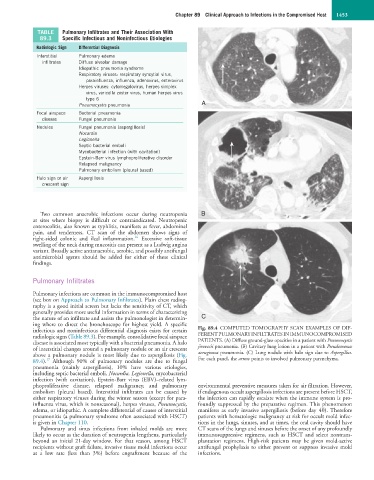
            infectious and noninfectious differential diagnosis exists for certain   Fig. 89.4  COMPUTED TOMOGRAPHY SCAN EXAMPLES OF DIF-
            radiologic signs (Table 89.3). For example, consolidative focal airspace   FERENT PULMONARY INFILTRATES IN IMMUNOCOMPROMISED
            disease is associated most typically with a bacterial pneumonia. A halo   PATIENTS. (A) Diffuse ground-glass opacities in a patient with Pneumocystis
            of interstitial changes around a pulmonary nodule or an air crescent   jirovecii pneumonia. (B) Cavitary lung lesion in a patient with Pseudomonas
            above a pulmonary nodule is most likely due to aspergillosis (Fig.   aeruginosa pneumonia. (C) Lung nodule with halo sign due to Aspergillus.
                17
            89.4).   Although  90%  of  pulmonary  nodules  are  due  to  fungal   For each panel, the arrow points to involved pulmonary parenchyma.
            pneumonia  (mainly  aspergillosis),  10%  have  various  etiologies,
            including septic bacterial emboli, Nocardia, Legionella, mycobacterial
            infection  (with  cavitation),  Epstein-Barr  virus  (EBV)–related  lym-
            phoproliferative  disease,  relapsed  malignancy,  and  pulmonary   environmental preventive measures taken for air filtration. However,
            embolism  (pleural  based).  Interstitial  infiltrates  can  be  caused  by   if endogenous occult aspergillosis infections are present before HSCT,
            either respiratory viruses during the winter season (except for para-  the infection can rapidly escalate when the immune system is pro-
            influenza virus, which is nonseasonal), herpes viruses, Pneumocystis,   foundly suppressed by the preparative regimen. This phenomenon
            edema, or idiopathic. A complete differential of causes of interstitial   manifests  as  early  invasive  aspergillosis  (before  day  40). Therefore
            pneumonitis (a pulmonary syndrome often associated with HSCT)   patients with hematologic malignancy at risk for occult mold infec-
            is given in Chapter 110.                              tions in the lungs, sinuses, and at times, the oral cavity should have
              Pulmonary  and  sinus  infections  from  inhaled  molds  are  more   CT scans of the lungs and sinuses before the onset of any profoundly
            likely to occur as the duration of neutropenia lengthens, particularly   immunosuppressive regimens, such as HSCT and select nontrans-
            beyond  an  initial  21-day  window.  For  that  reason,  among  HSCT   plantation  regimens.  High-risk  patients  may  be  given  mold-active
            recipients without graft failure, invasive tissue mold infections occur   antifungal  prophylaxis  to  either  prevent  or  suppress  invasive  mold
            at  a  low  rate  (less  than  3%)  before  engraftment  because  of  the   infections.

