


Page 1635 - Hematology_ Basic Principles and Practice ( PDFDrive )
P. 1635
1456   Part VIII  Comprehensive Care of Patients with Hematologic Malignancies


                                                               Use of Antifungal Agents in Combination
                                                                The  development  of  new  antifungal  drugs  gives  the  clinician  more
                                                                options for prophylaxis and therapy than in previous years. There is an
                                                                overall level of simplicity to the drug choices once their mechanisms of
                                                                action are understood. The polyenes, including amphotericin products
                                                                and  the  topical  agent  nystatin,  attach  onto  ergosterol  in  the  fungal
                                                                cell  membrane  and  are  considered  fungicidal,  because  cytoplasm
                                                                leaks out, and individual cells die. The azoles, including fluconazole,
                                                                itraconazole, voriconazole, and posaconazole, prevent the formation of
                                                                new ergosterol. Azoles are considered fungistatic, because removal of
                                                                the drug permits cell regrowth. Theoretically, use of an azole together
                                                                with  a  polyene  may  have  an  overall  static  effect  for  an  established
                                                                infection as the ergosterol target for the fungicidal polyene is depleted.
                                                                However, this combination may have advantages in terms of enhanced
                                                                spectrum of activity. The echinocandins, including caspofungin, mica-
                                                                fungin,  and  anidulafungin,  prevent  interaction  of  the  catalytic  and
                                                                regulatory subunits of the β-glucan synthesis enzyme, so less β-glucan
                                                                is formed for the cell wall. The scaffolding for the fungal cell wall is
                                                                not  maintained,  and  a  dividing  cell  may  burst  open  when  trying  to
                                                                extend the new cell wall over daughter cells. The echinocandins are
                                                                considered fungicidal for yeasts but fungistatic for molds, because drug
                                                                activity is concentrated at only the tips of the extending hyphae with
                                                                little effect on less metabolically active subapical compartments of the
                                                                fungus. Combination therapy may have the most effect when a cell wall
                                                                agent (an echinocandin) is used together with a cell membrane agent
                                                                (a  polyene or an  azole). There is no role for three-drug therapy (an
         A                                                      echinocandin, a polyene, and an azole). Aside from cases of cryptococ-
                                                                cal meningitis, in which the importance of combination therapy is well
                                                                established, the benefits of frontline use of combination antifungal for
                                                                molds remain controversial, although active investigation continues in
                                                                clinical trials. The value of combination regimens as salvage therapy
                                                                for refractory mold infections remains uncertain.


                                                              bloodstream or invasive isolates can be helpful in the management of
                                                              infections, especially if the patient will require transition to longer-
                                                              term oral therapy. Long-term treatment with newer azoles may be
                                                              valuable  in  responding  patients.  Echinocandins  cannot  be  used  to
                                                              treat Cryptococcus or Mucorales as monotherapy, but there may be
                                                              a  role  for  echinocandin  in  combination  treatment  for  Mucorales.
                                                              Mucorales  species  are  generally  susceptible  to  amphotericin  B  and
                                                              posaconazole and isavuconazole, although there are interspecies varia-
                                                              tions in susceptibility. In the case of mold infections, echinocandin
                                                              agents may be fungistatic, rather than fungicidal, because interrup-
                                                              tion of fungal cell wall synthesis is limited to areas of hyphal branch
         B                                                    points and growing hyphal tips. Because susceptibility testing for the
                                                              echinocandin agents is of uncertain reliability, use of an echinocandin
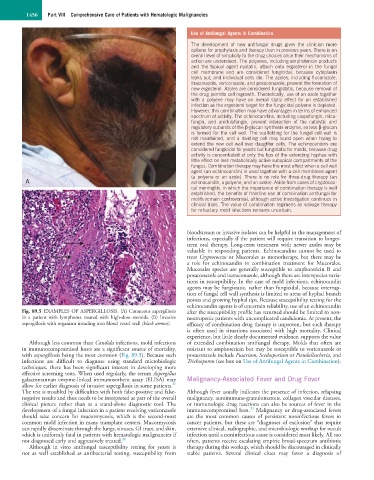
        Fig. 89.5  EXAMPLES OF ASPERGILLOSIS. (A) Cutaneous aspergillosis   after the susceptibility profile has returned should be limited to non-
        in  a  patient  with  lymphoma  treated  with  high-dose  steroids.  (B)  Invasive   neutropenic patients with uncomplicated candidemia. At present, the
        aspergillosis with organism invading into blood vessel wall (black arrows).   efficacy of combination drug therapy is unproven, but such therapy
                                                              is  often  used  in  situations  associated  with  high  mortality.  Clinical
                                                              experience, but little clearly documented evidence, supports the value
           Although less common than Candida infections, mold infections   of  extended  combination  antifungal  therapy.  Molds  that  often  are
        in immunocompromised hosts are a significant source of mortality,   resistant to amphotericin but may be susceptible to voriconazole or
        with aspergillosis being the most common (Fig. 89.5). Because such   posaconazole include Fusarium, Scedosporium or Pseudallescheria, and
        infections  are  difficult  to  diagnose  using  standard  microbiologic   Trichosporon (see box on Use of Antifungal Agents in Combination).
        techniques,  there  has  been  significant  interest  in  developing  more
        effective screening tests. When used regularly, the serum Aspergillus
        galactomannan  enzyme-linked  immunosorbent  assay  (ELISA)  may   Malignancy-Associated Fever and Drug Fever
                                                         27
        allow for earlier diagnosis of invasive aspergillosis in some patients.
        The test is troubled by difficulties with both false-positive and false-  Although fever usually indicates the presence of infection, relapsing
        negative results and thus needs to be interpreted as part of the overall   malignancy, autoimmune-granulomatous, collagen vascular diseases,
        clinical  picture  rather  than  as  a  stand-alone  diagnostic  tool.  The   or immunologic drug reactions can also be sources of fever in the
                                                                                   29
        development of a fungal infection in a patient receiving voriconazole   immunocompromised host.  Malignancy or drug-associated fevers
        should  raise  concern  for  mucormycosis,  which  is  the  second-most   are  the  most  common  causes  of  persistent  noninfectious  fevers  in
        common mold infection in many transplant centers. Mucormycosis   cancer patients, but these are “diagnoses of exclusion” that require
        can rapidly disseminate through the lungs, sinuses, GI tract, and skin,   extensive clinical, radiographic, and microbiologic workup for occult
        which is uniformly fatal in patients with hematologic malignancies if   infection until a noninfectious cause is considered most likely. All too
        not diagnosed early and aggressively treated. 28      often, patients receive escalating empiric broad-spectrum antibiotic
           Although  in  vitro  antifungal  susceptibility  testing  for  yeasts  is    therapy during this workup, which should be discouraged in clinically
        not  as  well  established  as  antibacterial  testing,  susceptibility  from   stable  patients.  Several  clinical  clues  may  favor  a  diagnosis  of

