


Page 1636 - Hematology_ Basic Principles and Practice ( PDFDrive )
P. 1636
Chapter 89  Clinical Approach to Infections in the Compromised Host  1457


            malignancy-associated fever, including (1) a prior history of fever at   when the infecting inoculum of organisms is large, when diagnostic
            the time of initial malignancy diagnosis and (2) response of the fever   methods are not sensitive enough for early detection, or when infect-
                             2
            to  a  trial  of  naproxen.   Patients  with  drug-associated  fever  often   ing agents overcome the effect of the antimicrobial agents. Measures
            appear clinically well with relative bradycardia during periods of fever.   taken  to  prevent  infection  in  the  preengraftment  HSCT  patient
            Drug fevers typically develop 1 to 3 weeks after the start of a drug   include pretransplantation serostatus blood workup, environmental
            (β-lactams, sulfas, vancomycin, and phenytoin are among the most   measures to prevent infection (including frequent handwashing), and
            common inciting agents) and resolve, on average, within 48 hours of   common sense.
            drug discontinuation unless the patient also has an accompanying
            rash.  Drug-associated  fever  with  rash  and  liver  function  test  or
            complete  blood  count  abnormalities  (e.g.,  thrombocytopenia  and   Assessment of Pretransplantation Serostatus
            eosinophilia) are often indicative of more severe reactions that should
            prompt  immediate  discontinuation  or  substitution  of  the  likely   Current  pretransplant  serologic  testing  of  donor  and  recipient
            offending medications.                                includes assaying for latent viruses (herpesvirus antibodies, hepatitis
                                                                  panels,  and  human  T-cell  lymphotropic  virus  antibodies  [human
                                                                  T-lymphotropic virus I/II and HIV 1/2]) and syphilis. Antibody tests
            INFECTION MANAGEMENT IN THE HEMATOPOIETIC             that are checked variably among individual transplantation centers
            STEM CELL TRANSPLANT RECIPIENT: A MODEL OF            include VZV, EBV, and Toxoplasma.
            SEVERE IMMUNE DEFICIENCY
                                                                  Herpes Simplex Virus
            Infection is a major cause of morbidity and mortality in HSCT recipi-
            ents. Such patients are susceptible to a wide range of infections, but   If the antibody test for HSV indicates prior infection or if the patient
            the risk for a particular infection depends on a multitude of factors,   provides a clinical history of prior HSV infection (i.e., mucosal sores),
            including the type of transplantation, the length of time since trans-  latent  infection  exists  and  has  the  potential  to  reactivate  during
            plantation, and the development of GVHD. A summary of common   periods of T-cell suppression and neutropenia. This patient requires
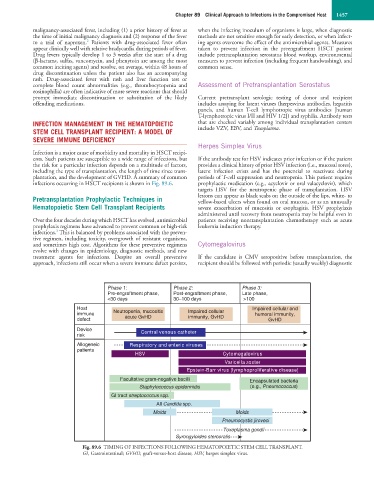
            infections occurring in HSCT recipients is shown in Fig. 89.6.  prophylactic medication (e.g., acyclovir or oral valacyclovir), which
                                                                  targets  HSV  for  the  neutropenic  phase  of  transplantation.  HSV
            Pretransplantation Prophylactic Techniques in         lesions can appear as black scabs on the outside of the lips, white- to
                                                                  yellow-based ulcers when found on oral mucosa, or as an unusually
            Hematopoietic Stem Cell Transplant Recipients         severe  exacerbation  of  mucositis  or  esophagitis.  HSV  prophylaxis
                                                                  administered until recovery from neutropenia may be helpful even in
            Over the four decades during which HSCT has evolved, antimicrobial   patients  receiving  nontransplantation  chemotherapy  such  as  acute
            prophylaxis regimens have advanced to prevent common or high-risk   leukemia induction therapy.
                   3
            infections.  This is balanced by problems associated with the preven-
            tive regimen, including toxicity, overgrowth of resistant organisms,
            and sometimes high cost. Algorithms for these preventive regimens   Cytomegalovirus
            evolve with changes in epidemiology, diagnostic methods, and new
            treatment  agents  for  infections.  Despite  an  overall  preventive   If  the  candidate  is  CMV  seropositive  before  transplantation,  the
            approach, infections still occur when a severe immune defect persists,   recipient should be followed with periodic (usually weekly) diagnostic


                                    Phase 1:              Phase 2:              Phase 3:
                                    Pre-engraftment phase,  Post-engraftment phase,  Late phase,
                                    <30 days              30–100 days            >100
                          Host                                                      Impaired cellular and
                          immune      Neutropenia, mucositis   Impaired cellular    humoral immunity,
                          defect          acute GvHD           immunity, GvHD            GvHD

                          Device               Central venous catheter
                          risk
                          Allogeneic       Respiratory and enteric viruses
                          patients
                                             HSV                          Cytomegalovirus
                                                                           Varicella zoster
                                                              Epstein-Barr virus (lymphoproliferative disease)
                                        Facultative gram-negative bacilli          Encapsulated bacteria
                                               Staphylococcus epidermidis          (e.g., Pneumococcus)
                                     GI tract streptococcus spp.
                                                    All Candida spp.
                                                   Molds                      Molds
                                                                          Pneumocystis jiroveci
                                                                          Toxoplasma gondii
                                                          Syrongyloides stercoralis

                            Fig. 89.6  TIMING OF INFECTIONS FOLLOWING HEMATOPOIETIC STEM CELL TRANSPLANT.
                            GI, Gastrointestinal; GVHD, graft-versus-host disease; HSV, herpes simplex virus.

