


Page 1634 - Hematology_ Basic Principles and Practice ( PDFDrive )
P. 1634
Chapter 89  Clinical Approach to Infections in the Compromised Host  1455


                                                                  alveolar hemorrhage associated with parainfluenza virus infection has
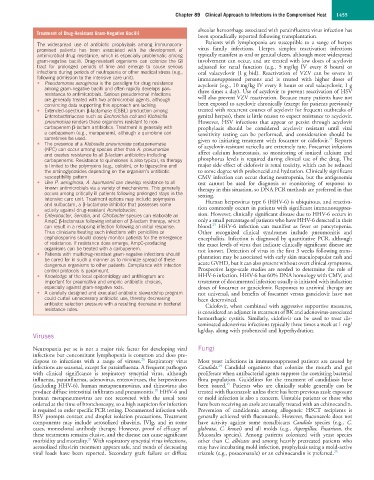
             Treatment of Drug-Resistant Gram-Negative Bacilli
                                                                  been sporadically reported following transplantation.
             The  widespread  use  of  antibiotic  prophylaxis  among  immunocom-  Patients with lymphopenia are susceptible to a range of herpes
             promised  patients  has  been  associated  with  the  development  of   virus  family  infections.  Herpes  simplex  reactivation  infections
             antimicrobial drug resistance, which is especially problematic among   typically manifest as oral or genital ulcers, although more widespread
             gram-negative  bacilli.  Drug-resistant  organisms  can  colonize  the  GI   involvement can occur, and are treated with low doses of acyclovir
             tract  for  prolonged  periods  of  time  and  emerge  to  cause  serious   adjusted  for  renal  function  (e.g.,  5 mg/kg  IV  every  8  hours)  or
             infections during periods of neutropenia or other medical stress (e.g.,   oral  valacyclovir  (1 g  bid).  Reactivation  of  VZV  can  be  severe  in
             following admission to the intensive care unit).     immunosuppressed  persons  and  is  treated  with  higher  doses  of
             •  Pseudomonas aeruginosa is the paradigm for drug resistance   acyclovir (e.g., 10 mg/kg IV every 8 hours or oral valacyclovir, 1 g
                among gram-negative bacilli and often rapidly develops pan-  three times a day). Use of acyclovir to prevent reactivation of HSV
                resistance to antimicrobials. Serious pseudomonal infections
                are generally treated with two antimicrobial agents, although   will also prevent VZV reactivation. Because many patients have not
                convincing data supporting this approach are lacking.  been exposed to acyclovir chronically (except for patients previously
             •  Extended-spectrum β-lactamase (ESBL) production among   treated with recurrent courses of acyclovir for frequent outbreaks of
                Enterobacteriaceae such as Escherichia coli and Klebsiella   genital herpes), there is little reason to expect resistance to acyclovir.
                pneumoniae renders these organisms resistant to non-  However,  HSV  infections  that  appear  or  persist  through  acyclovir
                carbapenem β-lactam antibiotics. Treatment is generally with   prophylaxis  should  be  considered  acyclovir  resistant  until  viral
                a carbapenem (e.g., meropenem), although a quinolone can   sensitivity  testing  can  be  performed,  and  consideration  should  be
                sometimes be used.                                given to initiating treatment with foscarnet or cidofovir.  Reports
                                                                                                             22
             •  The presence of a Klebsiella pneumoniae carbapenemase   of acyclovir-resistant varicella are extremely rare. Foscarnet infusions
                (KPC) can occur among species other than K. pneumoniae
                and creates resistance to all β-lactam antibiotics including   affect  calcium  homeostasis,  so  monitoring  of  ionized  calcium  and
                carbapenems. Resistance to quinolones is also typical, so therapy   phosphorus  levels  is  required  during  clinical  use  of  the  drug. The
                is limited to the polymyxins (e.g., colistin), or to tigecycline and   major side effect of cidofovir is renal toxicity, which can be reduced
                the aminoglycosides depending on the organism’s antibiotic   to some degree with probenecid and hydration. Clinically significant
                susceptibility pattern.                           CMV infection can occur during neutropenia, but the antigenemia
             •  Like P. aeruginosa, A. baumannii can develop resistance to all   test  cannot  be  used  for  diagnosis  or  monitoring  of  response  to
                known antimicrobials via a variety of mechanisms. This generally   therapy in this situation, so DNA PCR methods are preferred in that
                occurs among critically ill patients following prolonged stays in the   setting.
                intensive care unit. Treatment options may include polymyxins   Human herpesvirus type 6 (HHV-6) is ubiquitous, and reactiva-
                and sulbactam, a β-lactamase inhibitor that possesses some
                activity against drug-resistant Acinetobacter.    tion commonly occurs in patients with significant immunosuppres-
             •  Enterobacter, Serratia, and Citrobacter species can elaborate an   sion. However, clinically significant disease due to HHV-6 occurs in
                AmpC β-lactamase following initiation of β-lactam therapy, which   only a small percentage of patients who have HHV-6 detected in their
                                                                       23
                can result in a relapsing infection following an initial response.   blood.   HHV-6  infection  can  manifest  as  fever  or  pancytopenia.
                Thus clinicians treating such infections with penicillins or   Other  recognized  clinical  syndromes  include  pneumonitis  and
                cephalosporins should closely monitor patients for the emergence   encephalitis. Infection is diagnosed by quantitative PCR, although
                of resistance. If resistance does emerge, AmpC-producing   the exact levels of virus that indicate clinically significant disease are
                organisms can be treated with a carbapenem.       not known. Detection of virus in the first 3 weeks following trans-
             •  Patients with multidrug-resistant gram-negative infections should   plantation may be associated with early skin maculopapular rash and
                be cared for in such a manner as to minimize spread of these
                dangerous organisms to other patients. Compliance with infection   acute GVHD, but it can also present without overt clinical symptoms.
                control protocols is paramount.                   Prospective  large-scale  studies  are  needed  to  determine  the  role  of
             •  Knowledge of the local epidemiology and antibiogram are   HHV-6 infection. HHV-6 has 60% DNA homology with CMV, and
                important for preemptive and empiric antibiotic choices,   treatment of documented infection usually is initiated with induction
                especially against gram-negative rods.            doses of foscarnet or ganciclovir. Responses to antiviral therapy are
             •  A carefully designed and executed antibiotic stewardship program   not universal, and benefits of foscarnet versus ganciclovir have not
                could curtail unnecessary antibiotic use, thereby decreasing   been determined.
                antibiotic selection pressure with a resulting decrease in bacterial   Cidofovir, when combined with aggressive supportive measures,
                resistance rates.
                                                                  is considered an adjunct in treatment of BK and adenovirus-associated
                                                                  hemorrhagic  cystitis.  Similarly,  cidofovir  can  be  used  to  treat  dis-
                                                                  seminated adenovirus infections typically three times a week at 1 mg/
                                                                  kg/day, along with probenecid and hyperhydration.
            Viruses
            Neutropenia  per  se  is  not  a  major  risk  factor  for  developing  viral   Fungi
            infections but concomitant lymphopenia is common and does pre-
                                               20
            dispose  to  infections  with  a  range  of  viruses.   Respiratory  virus   Most yeast infections in immunosuppressed patients are caused by
                                                                        24
            infections are seasonal, except for parainfluenza. A frequent pathogen   Candida.   Candidal  organisms  that  colonize  the  mouth  and  gut
            with  clinical  significance  is  respiratory  syncytial  virus,  although   proliferate when antibacterial agents suppress the coexisting bacterial
            influenza, parainfluenza, adenovirus, enteroviruses, the herpesviruses   flora  population.  Guidelines  for  the  treatment  of  candidiasis  have
                                                                           25
            (including HHV-6), human metapneumovirus, and rhinovirus also   been  issued.   Patients  who  are  clinically  stable  generally  can  be
                                                    20
            produce diffuse interstitial infiltrates and pneumonitis.  HHV-6 and   treated with fluconazole unless there has been previous azole exposure
            human  metapneumovirus  are  not  recovered  with  the  usual  tests   or mold infection is also a concern. Unstable patients or those who
            ordered at the time of bronchoscopy, so a high suspicion for infection   have been receiving an azole are usually treated with an echinocandin.
            is required to order specific PCR testing. Documented infection with   Prevention  of  candidemia  among  allogeneic  HSCT  recipients  is
            RSV prompts contact and droplet isolation precautions. Treatment   generally achieved with fluconazole. However, fluconazole does not
            components  may  include  aerosolized  ribavirin,  IVIg,  and  in  some   have  activity  against  some  nonalbicans  Candida  species  (e.g.,  C.
            cases, monoclonal antibody therapy. However, proof of efficacy of   glabrata,  C.  krusei)  and  all  molds  (e.g.,  Aspergillus,  Fusarium,  the
            these treatments remains elusive, and the disease can cause significant   Mucorales  species).  Among  patients  colonized  with  yeast  species
                              21
            morbidity and mortality.  With respiratory syncytial virus infections,   other than C. albicans and among heavily pretreated patients who
            aerosolized ribavirin treatment appears safe, and trends of decreasing   may have incubating mold infection, prophylaxis using a mold-active
            viral  loads  have  been  reported.  Secondary  graft  failure  or  diffuse   triazole (e.g., posaconazole) or an echinocandin is preferred. 26

