


Page 1799 - Hematology_ Basic Principles and Practice ( PDFDrive )
P. 1799
Chapter 104  Indications and Outcomes of Allogeneic Hematopoietic Cell Transplantation for Hematologic Malignancies in Adults  1603


             BOX 104.2  Hematopoietic Cell Transplantation-Specific Comorbidity Index (HCT-CI)
             Comorbidity                            Explanation                                           HCT-CI score
             Arrhythmia                             Atrial fibrillation or flutter, sick sinus syndrome, or ventricular   1
                                                      arrhythmias
             Cardiac                                Coronary artery disease, congestive heart failure, myocardial   1
                                                      infarction, or ejection fraction ≤50%
             Inflammatory bowel disease             Crohn disease or ulcerative colitis                       1
             Diabetes                               Requiring treatment with insulin or oral hypoglycemics    1
             Cerebrovascular disease                Transient ischemic attack or cerebrovascular accident     1
             Psychiatric disturbance                Depression or anxiety requiring psychiatric consult or treatment  1
             Hepatic, mild                          Chronic hepatitis, bilirubin > ULN to 1.5 × ULN, or AST/ALT >   1
                                                      ULN to 2.5 × ULN
             Obesity                                Patients with a body mass index >35 kg/m +                1
             Infection                              Requiring treatment after day 0                           1
             Rheumatologic                          SLE, rheumatoid arthritis, polymyositis, mixed connective tissue   2
                                                      disease, or polymyalgia rheumatica
             Peptic ulcer                           Requiring treatment                                       2
             Moderate/severe renal                  Serum creatinine >2 mg/dL, on dialysis, or prior renal    2
                                                      transplantation
             Moderate pulmonary                     DLCO and/or FEV 1 66% to 80% or dyspnea on slight activity  2
             Prior solid tumor                      Treated at any time point in the patient’s past history, excluding   3
                                                      nonmelanoma skin cancer
             Heart valve disease                    Except mitral valve prolapse                              3
             Severe pulmonary                       DLCO and/or FEV 1 ≤65% or dyspnea at rest or requiring oxygen  3
             Moderate/severe hepatic                Liver cirrhosis, bilirubin > 1.5 × ULN, or AST/ALT > 2.5 × ULN  3
             HCT-CI of 0 predicts 2 year TRM of 14%
             HCT-CI of 1-2 predicts 2 year TRM of 21%
             HCT-CI of ≥3 predicts 2 year TRM of 41%
             ALT, Alanine aminotransferase; AST, aspartate aminotransferase; CI, confidence interval; DLCO, diffusing capacity of the lungs for carbon monoxide; FEV 1, forced
             expiratory volume in the first second of expiration; HCT, hematopoietic cell transplantation; SLE, systemic lupus erythematosus; ULN, upper limit of normal.


             BOX 104.3  Refined Disease Risk Index (DRI)
             Refined DRI Category  Definition of Refined DRI category                              2-Year Overall Survival
             Low                 •  Hodgkin lymphoma, mantle cell lymphoma, indolent non-Hodgkin lymphoma (NHL),   66%
                                   chronic lymphocytic leukemia (CLL) or favorable-cytogenetics acute myeloid
                                   leukemia (AML) in complete remission (CR)
                                 •  CLL or indolent NHL in partial remission (PR)
                                 •  First or second chronic phase chronic myelogenous leukemia (CML).
             Intermediate        •  CML advance phase                                                    51%
                                 •  Mantle cell lymphoma, T-cell NHL, Hodgkin lymphoma, or aggressive NHL in PR
                                 •  CLL or indolent NHL with stable or progressive disease
                                 •  Acute lymphoblastic leukemia (ALL) in first CR
                                 •  Intermediate-cytogenetics AML or aggressive NHL in CR
                                 •  Myeloproliferative neoplasm
                                 •  Low-risk myelodysplastic syndrome (MDS) with adverse-cytogenetic or high-risk
                                   MDS with intermediate-cytogenetics
                                 •  Multiple myeloma in CR/very good PR/PR
             High                •  T-cell NHL, Hodgkin lymphoma, mantle cell lymphoma, myeloma with stable or   33%
                                   progressive disease
                                 •  Burkitt lymphoma in CR
                                 •  ALL in second or third CR
                                 •  Adverse-cytogenetics AML in CR
                                 •  Intermediate-cytogenetic AML with induction failure or active relapse
                                 •  High-risk MDS with intermediate cytogenetics and advanced disease
                                 •  Any-risk MDS with adverse cytogenetics and advanced disease
             Very High           •  CML blast phase                                                      23%
                                 •  Burkitt lymphoma in PR
                                 •  Adverse-cytogenetic AML or ALL with induction failure or active relapse
                                 •  Aggressive NHL with stable or progressive disease


            performance scores and no active infection. While age is still a sig-  Although many factors influence the outcome of allogeneic HCT,
            nificant barrier to successful allogeneic HCT, the presence and extent   disease type and disease status at the time of transplantation are the
            of medical comorbid conditions rather than an arbitrary chronologic   strongest determinants of post-HCT survival. The CIBMTR recently
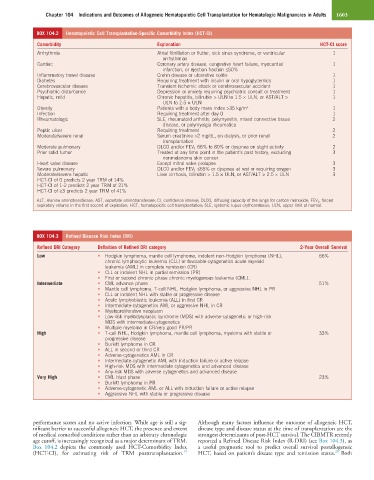
            age cutoff, is increasingly recognized as a major determinant of TRM.   reported a Refined Disease Risk Index (R-DRI) (see Box 104.3), as
            Box  104.2  depicts  the  commonly  used  HCT-Comorbidity  Index   a  useful  prognostic  tool  to  predict  overall  survival  postallogeneic
                                                             19
                                                                                                               20
            (HCT-CI),  for  estimating  risk  of  TRM  posttransplantation.    HCT,  based  on  patient’s  disease  type  and  remission  status.   Both

