


Page 1797 - Hematology_ Basic Principles and Practice ( PDFDrive )
P. 1797
Chapter 104  Indications and Outcomes of Allogeneic Hematopoietic Cell Transplantation for Hematologic Malignancies in Adults  1601


                                                    Cause of Death after HCT-United States, 2008−2013

                                 Primary            52
                                 disease                                          38

                              Graft failure                          0  1


                                 GVHD                             8 7     10

                            Colume Percent, %  IPn/ARDS             1   2
                                                                          11
                                Infection


                             Organ failure

                              Secondary                            5  1   9
                              malignancy                               1

                             Other cause                     21               24

                               Unknown                              4   24


                                       -100           -50             0              50            100

                                                         HLA-identical sibling  Unrelated donor
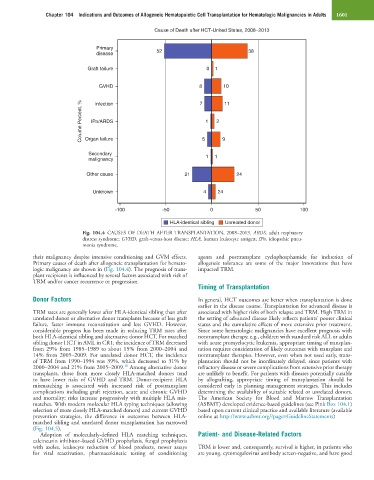
                            Fig. 104.4  CAUSES OF DEATH AFTER TRANSPLANTATION, 2008–2013. ARDS, adult respiratory
                            distress syndrome; GVHD, graft-versus-host disease; HLA, human leukocyte antigen; IPn, idiopathic pneu-
                            monia syndrome.

            their malignancy despite intensive conditioning and GVM effects.   agents  and  posttransplant  cyclophosphamide  for  induction  of
            Primary causes of death after allogeneic transplantation for hemato-  allogeneic  tolerance  are  some  of  the  major  innovations  that  have
            logic malignancy are shown in (Fig. 104.4). The prognosis of trans-  impacted TRM.
            plant recipients is influenced by several factors associated with risk of
            TRM and/or cancer recurrence or progression.
                                                                  Timing of Transplantation
            Donor Factors                                         In general, HCT outcomes are better when transplantation is done
                                                                  earlier in the disease course. Transplantation for advanced disease is
            TRM rates are generally lower after HLA-identical sibling than after   associated with higher risks of both relapse and TRM. High TRM in
            unrelated donor or alternative donor transplants because of less graft   the setting of advanced disease likely reflects patients’ poorer clinical
            failure,  faster  immune  reconstitution  and  less  GVHD.  However,   status and the cumulative effects of more extensive prior treatment.
            considerable  progress  has  been  made  in  reducing TRM  rates  after   Since some hematologic malignancies have excellent prognosis with
            both HLA-identical sibling and alternative donor HCT. For matched   nontransplant therapy, e.g., children with standard risk ALL or adults
            sibling donor HCT in AML in CR1, the incidence of TRM decreased   with acute promyelocytic leukemia, appropriate timing of transplan-
            from  29%  from  1985–1989  to  about  15%  from  2000–2004  and   tation requires consideration of likely outcomes with transplant and
            14%  from  2005–2009.  For  unrelated  donor  HCT,  the  incidence   nontransplant therapies. However, even when not used early, trans-
            of TRM  from  1990–1994  was  39%,  which  decreased  to  31%  by   plantation  should  not  be  inordinately  delayed,  since  patients  with
                                          18
            2000–2004 and 21% from 2005–2009.  Among alternative donor   refractory disease or severe complications from extensive prior therapy
            transplants,  those  from  more  closely  HLA-matched  donors  tend   are unlikely to benefit. For patients with diseases potentially curable
            to  have  lower  risks  of  GVHD  and  TRM.  Donor-recipient  HLA   by  allografting,  appropriate  timing  of  transplantation  should  be
            mismatching  is  associated  with  increased  risk  of  posttransplant   considered early in planning management strategies. This includes
            complications including graft rejection, acute and chronic GVHD   determining the availability of suitable related or unrelated donors.
            and mortality; risks increase progressively with multiple HLA mis-  The  American  Society  for  Blood  and  Marrow  Transplantation
            matches. With modern molecular HLA typing techniques (allowing   (ASBMT) developed evidence-based guidelines (see Pink Box 104.1)
            selection of more closely HLA-matched donors) and current GVHD   based upon current clinical practice and available literature (available
            prevention  strategies,  the  difference  in  outcomes  between  HLA-  online at http://www.asbmt.org/?page=GuidelineStatements)
            matched sibling and unrelated donor transplantation has narrowed
            (Fig. 104.5).
              Adoption  of  molecularly-defined  HLA  matching  techniques,   Patient- and Disease-Related Factors
            calcineurin inhibitor–based GVHD prophylaxis, fungal prophylaxis
            with  azoles,  leukocyte  reduction  of  blood  products,  newer  assays   TRM is lower and, consequently, survival is higher, in patients who
            for  viral  reactivation,  pharmacokinetic  testing  of  conditioning   are young, cytomegalovirus antibody screen-negative, and have good

