


Page 1794 - Hematology_ Basic Principles and Practice ( PDFDrive )
P. 1794
1598   Part X  Transplantation


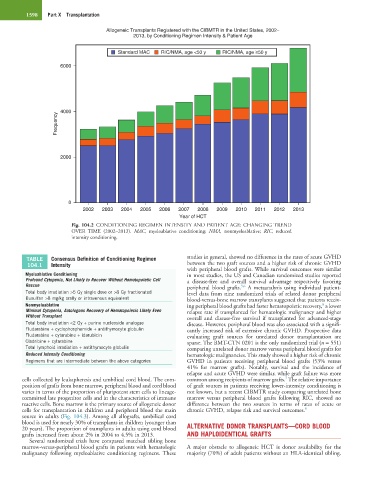
                                    Allogeneic Transplants Registered with the CIBMTR in the United States, 2002−
                                             2013, by Conditioning Regimen Intensity & Patient Age

                                        Standard MAC  RIC/NMA, age <50 y  RIC/NMA, age ≥50 y

                     6000


                    Frequency 4000


                     2000


                       0
                            2002  2003   2004  2005  2006  2007   2008  2009  2010  2011   2012  2013
                                                            Year of HCT
                        Fig. 104.2  CONDITIONING REGIMEN INTENSITY AND PATIENT AGE: CHANGING TREND
                        OVER  TIME  (2002–2013).  MAC,  myeloablative  conditioning;  NMA,  nonmyeloablative;  RIC,  reduced
                        intensity conditioning.


          TABLE   Consensus Definition of Conditioning Regimen   studies in general, showed no difference in the rates of acute GVHD
          104.1   Intensity                                   between the two graft sources and a higher risk of chronic GVHD
                                                              with peripheral blood grafts. While survival outcomes were similar
         Myeloablative Conditioning                           in most studies, the US and Canadian randomized studies reported
         Profound Cytopenia, Not Likely to Recover Without Hematopoietic Cell   a  disease-free  and  overall  survival  advantage  respectively  favoring
         Rescue                                               peripheral  blood  grafts.   A  metaanalysis  using  individual  patient-
                                                                                5,6
         Total body irradiation >5 Gy single dose or >8 Gy fractionated  level data from nine randomized trials of related donor peripheral
         Busulfan >8 mg/kg orally or intravenous equivalent   blood-versus-bone marrow transplants suggested that patients receiv-
         Nonmyeloablative                                     ing peripheral blood grafts had faster hematopoietic recovery,  a lower
                                                                                                          6
         Minimal Cytopenia, Autologous Recovery of Hematopoiesis Likely Even   relapse rate if transplanted for hematologic malignancy and higher
         Without Transplant                                   overall  and  disease-free  survival  if  transplanted  for  advanced-stage
         Total body irradiation <2 Gy + purine nucleoside analogue  disease. However, peripheral blood was also associated with a signifi-
         Fludarabine + cyclophosphamide + antithymocyte globulin  cantly increased risk of extensive chronic GVHD. Prospective data
         Fludarabine + cytarabine + idarubicin                evaluating  graft  sources  for  unrelated  donor  transplantation  are
         Cladribine + cytarabine                              sparse. The BMT-CTN 0201 is the only randomized trial (n = 551)
         Total lymphoid irradiation + antithymocyte globulin  comparing unrelated donor marrow versus peripheral blood grafts for
         Reduced Intensity Conditioning                       hematologic malignancies. This study showed a higher risk of chronic
         Regimens that are intermediate between the above categories  GVHD  in  patients  receiving  peripheral  blood  grafts  (53%  versus
                                                              41%  for  marrow  grafts).  Notably,  survival  and  the  incidence  of
                                                              relapse and acute GVHD were similar, while graft failure was more
                                                                                              7
        cells collected by leukapheresis and umbilical cord blood. The com-  common among recipients of marrow grafts.  The relative importance
        position of grafts from bone marrow, peripheral blood and cord blood   of graft sources in patients receiving lower-intensity conditioning is
        varies in terms of the proportion of pluripotent stem cells to lineage-  not known, but a recent CIBMTR study comparing unrelated bone
        committed late progenitor cells and in the characteristics of immune   marrow  versus  peripheral  blood  grafts  following  RIC,  showed  no
        reactive cells. Bone marrow is the primary source of allogeneic donor   difference  between  the  two  sources  in  terms  of  rates  of  acute  or
        cells for transplantation in children and peripheral blood the main   chronic GVHD, relapse risk and survival outcomes. 8
        source in adults (Fig. 104.3). Among all allografts, umbilical cord
        blood is used for nearly 30% of transplants in children (younger than
        20 years). The proportion of transplants in adults using cord blood   ALTERNATIVE DONOR TRANSPLANTS—CORD BLOOD
        grafts increased from about 2% in 2004 to 4.5% in 2013.  AND HAPLOIDENTICAL GRAFTS
           Several  randomized  trials  have  compared  matched  sibling  bone
        marrow-versus-peripheral blood grafts in patients with hematologic   A  major  obstacle  to  allogeneic  HCT  is  donor  availability  for  the
        malignancy  following  myeloablative  conditioning  regimens.  These   majority (70%) of adult patients without an HLA-identical sibling.

