


Page 1798 - Hematology_ Basic Principles and Practice ( PDFDrive )
P. 1798
1602   Part X  Transplantation


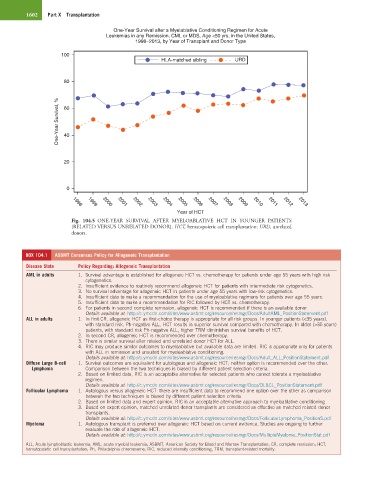
                                      One-Year Survival after a Myelablative Conditioning Regimen for Acute
                                    Leukemias in any Remission, CML or MDS, Age <50 yrs, in the United States,
                                             1998−2013, by Year of Transplant and Donor Type

                     100
                                                      HLA-matched sibling     URD


                      80


                    One-Year Survival, %  60


                      40


                      20


                       0


                                        2001
                                                 2003
                         1998
                              1999
                                             2002
                                                           2005
                                                                2006
                                                      2004
                                   2000
                                                           Year of HCT  2007  2008  2009  2010  2011  2012  2013
                        Fig.  104.5  ONE-YEAR  SURVIVAL  AFTER  MYELOABLATIVE  HCT  IN  YOUNGER  PATIENTS
                        (RELATED VERSUS UNRELATED DONOR). HCT, hematopoietic cell transplantation; URD, unrelated
                        donors.
         BOX 104.1  ASBMT Consensus Policy for Allogeneic Transplantation
          Disease State    Policy Regarding: Allogeneic Transplantation
          AML in adults    1.  Survival advantage is established for allogeneic HCT vs. chemotherapy for patients under age 55 years with high risk
                             cytogenetics.
                           2.  Insufficient evidence to routinely recommend allogeneic HCT for patients with intermediate risk cytogenetics.
                           3.  No survival advantage for allogeneic HCT in patients under age 55 years with low-risk cytogenetics.
                           4.  Insufficient data to make a recommendation for the use of myeloablative regimens for patients over age 55 years.
                           5.  Insufficient data to make a recommendation for RIC followed by HCT vs. chemotherapy.
                           6.  For patients in second complete remission, allogeneic HCT is recommended if there is an available donor.
                             Details available at: http://c.ymcdn.com/sites/www.asbmt.org/resource/resmgr/Docs/AdultAML_PositionStatement.pdf
          ALL in adults    1.  In first CR, allogeneic HCT as first-choice therapy is appropriate for all risk groups. In younger patients (<35 years),
                             with standard risk, Ph-negative ALL, HCT results in superior survival compared with chemotherapy. In older (>35 years)
                             patients, with standard risk Ph-negative ALL, higher TRM diminishes survival benefits of HCT.
                           2.  In second CR, allogeneic HCT is recommended over chemotherapy.
                           3.  There is similar survival after related and unrelated donor HCT for ALL.
                           4.  RIC may produce similar outcomes to myeloablative but available data are limited. RIC is appropriate only for patients
                             with ALL in remission and unsuited for myeloablative conditioning.
                             Details available at: http://c.ymcdn.com/sites/www.asbmt.org/resource/resmgr/Docs/Adult_ALL_PositionStatement.pdf
          Diffuse Large B-cell   1.  Survival outcomes are equivalent for autologous and allogeneic HCT; neither option is recommended over the other.
           Lymphoma          Comparison between the two techniques is biased by different patient selection criteria.
                           2.  Based on limited data, RIC is an acceptable alternative for selected patients who cannot tolerate a myeloablative
                             regimen.
                             Details available at: http://c.ymcdn.com/sites/www.asbmt.org/resource/resmgr/Docs/DLBCL_PositionStatement.pdf
          Follicular Lymphoma  1.  Autologous versus allogeneic HCT: there are insufficient data to recommend one option over the other as comparison
                             between the two techniques is biased by different patient selection criteria.
                           2.  Based on limited data and expert opinion, RIC is an acceptable alternative approach to myeloablative conditioning.
                           3.  Based on expert opinion, matched unrelated donor transplants are considered as effective as matched related donor
                             transplants.
                             Details available at: http://c.ymcdn.com/sites/www.asbmt.org/resource/resmgr/Docs/FollicularLymphoma_PositionS.pdf
          Myeloma          1.  Autologous transplant is preferred over allogeneic HCT based on current evidence. Studies are ongoing to further
                             evaluate the role of allogeneic HCT.
                             Details available at: http://c.ymcdn.com/sites/www.asbmt.org/resource/resmgr/Docs/MultipleMyeloma_PositionStat.pdf
         ALL, Acute lymphoblastic leukemia; AML, acute myeloid leukemia; ASBMT, American Society for Blood and Marrow Transplantation; CR, complete remission; HCT,
         hematopoietic cell transplantation; Ph, Philadelphia chromosome; RIC, reduced intensity conditioning, TRM, transplant-related mortality.

