


Page 1795 - Hematology_ Basic Principles and Practice ( PDFDrive )
P. 1795
Chapter 104  Indications and Outcomes of Allogeneic Hematopoietic Cell Transplantation for Hematologic Malignancies in Adults  1599


             TABLE   Retrospective Registry-Based Comparisons of NMA/RIC versus Myeloablative Allogeneic HCT
              104.2
                                                          TRM
             Group    Disease     Donor      RIC vs. MAC (N)  RIC vs. MAC  Relapse   Comments
             EBMT 33  MDS or sAML   MUD 39%  315 vs. 407  32% vs. 44%   41% vs. 33% at 4   Survival 31% at 4 years. RIC predicted for
                        >50                                at 4 years  years           greater relapse but lower TRM in
                                                                                       multivariate model. Wide variety of
                                                                                       different conditioning regimens used.
             EBMT 34  MM          MUD 12%    320 vs. 196  24% vs. 37%   27% vs. 54%  TRM lower after RIC but relapse risk is
                                                           at 2 years                  double
             EBMT 35  AML         Sibling    215 vs. 621  22% vs. 32%   45% vs. 27% at 3   Relapse rate higher and TRM lower in RIC
                                                           at 3 years  years           but OS similar (41% vs. 45%) in both
                                                                                       groups.
             EBMT 36  CLL         MUD 22%    73 vs. 82    19% vs. 26%  28% vs. 11%   Similar TRM but higher relapse risk after
                                                                                       RIC
             EBMT 37  HL          MUD 13%    89 vs. 79    23% vs. 46%   57% vs. 30%  Relapse rate higher and TRM lower in RIC
                                                           at 1 year                   but OS similar
             CIBMTR  38  Follicular NHL  Sibling  88 vs. 120  23% in both   17% vs. 8%  RIC associated with higher risk of relapse
                                                           at 1 year                   but similar TRM while lower KPS
                                                                                       impacted on TRM. OS was similar.
             EBMT 39  ALL         Sibling    127 vs. 449  21% vs. 29%  32% vs. 38%   TRM lower after RIC but higher relapse rate.
                                                                                       Leukemia-free survival similar to MAC
             CIBMTR  40  AML/MDS  MUD/Sibling  1448 vs. 3731  3-year TRM   Lower risk of relapse   Overall and disease-free survival was highest
                                                           similar     in Myeloablative  for myeloablative group
             ALL, Acute lymphoblastic leukemia; AML, acute myeloid leukemia; CIBMTR, Center for International Blood and Marrow Transplant Research; CLL, chronic lymphocytic
             leukemia; EBMT, European Society for Blood and Marrow transplantation; HCT, hematopoietic cell transplantation; HL, Hodgkin lymphoma; KPS, Karnofsky performance
             score; MAC, myeloablative conditioning; MDS, myelodysplastic syndrome; MM, multiple myeloma; MUD, matched unrelated donor; NHL, Non-Hodgkin lymphoma;
             NMA, nonmyeloablative; OS, overall survival; RIC, reduced intensity conditioning; TRM, transplant-related mortality; sAML, secondary acute myeloid leukemia.


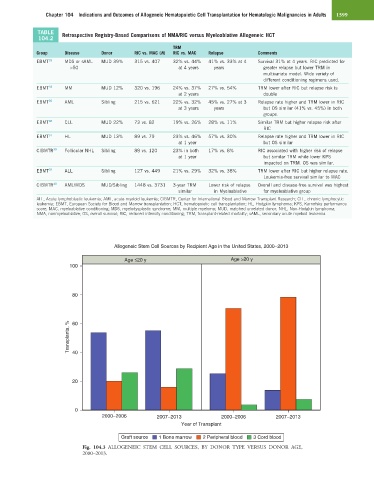
                                      Allogeneic Stem Cell Sources by Recipient Age in the United States, 2000−2013
                                          Age ≤20 y                          Age >20 y
                        100


                         80


                        Transplants, %  60


                         40


                         20


                          0
                                  2000−2006         2007−2013            2000−2006         2007−2013
                                                            Year of Transplant
                                         Graft source  1 Bone marrow  2 Peripheral blood  3 Cord blood

                            Fig.  104.3  ALLOGENEIC  STEM  CELL  SOURCES,  BY  DONOR  TYPE  VERSUS  DONOR  AGE,
                            2000–2013.

