


Page 1805 - Hematology_ Basic Principles and Practice ( PDFDrive )
P. 1805
Chapter 105  Unrelated Donor Hematopoietic Cell Transplantation  1609


                       Clinical Relevance to Reaching Transplantation From the   TABLE   Common Definitions in Human Leukocyte Antigen
             BOX 105.1  Initiation of an Unrelated Donor Search: Patient and   105.1  Genetics
                       Donor Factors
                                                                   Term      Definition        Example
             Outcome        Patient Factors  Donor Factors         Allele    Unique sequence of an   DRB1*04:01 allele is a
             Probability of the   Increased age a  HLA-A, HLA-B,              HLA gene defined   unique sequence defined as
               patient reaching                HLA-C, HLA-DRB1,               by molecular      DR4 by serologic methods
               transplantation                 HLA-DQB1 match                 methods
                                               status c            Antigen   Antibody-defined   DR4 antigen is a serologically-
                            Advanced disease risk b                           protein           defined protein product of
             Probability of   Karnofsky performance  Donor availability d
               patient survival  status (KPS) a                                                 an HLA gene
                                                                   Haplotype  HLA genes inherited   HLA-A1, HLA-B8, HLA-DR3 is
             After the initiation of a search for an unrelated donor, older patients with more   as a chromosomal   a common haplotype among
             advanced disease and no HLA-matched donor are associated with lower odds
             of reaching transplantation. Patients whose Karnofsky performance status is   unit  white populations
             90% to 100% and who have an available donor have significantly reduced   Genotype  Molecularly-defined   Genotypically-matched donor
             hazard of death. a
             a Pidala J, Kim J, Schell M et al: Race/ethnicity affects the probability of finding   HLA allele or   and recipient are identical
             an HLA-A, -B, -C and -DRB1 allele-matched unrelated donor and likelihood of   sequence  for the HLA alleles at a
             subsequent transplant utilization. Bone Marrow Transplant 48:346–350, 2013.        given HLA gene (e.g.,
             b Disease risk as categorized by the Center for International Blood and Marrow     HLA-DRB1*04:01)
             Transplantation Research.
             c Donor HLA matching remains the most significant risk factor for transplant   Phenotype  Serologically-defined   Phenotypically-matched donor
             outcomes.                                                        HLA protein or    and recipient share the
             d Identifying the primary donor with a backup will give flexibility in the
             scheduling of a transplant.                                      antigen           same HLA antigen (e.g.,
             Adapted from reference 3.                                                          HLA-DR4)
                                                                   HLA, Human leukocyte antigen.


            associated  with  transmissible  elements  akin  to  blood  transfusion   TABLE
            donors. Special focus is placed on risks of transmission of hepatitis,   105.2  Polymorphism of Human Leukocyte Antigen Genes
            human  immunodeficiency  virus  (HIV),  malaria,  West  Nile  virus,
            transmissible  spongiform  encephalitis  (Creutzfeldt-Jacob  disease),        Antigens             Alleles
            and Chagas disease. Donor screening includes blood tests for HIV 1   HLA-A      24                 3285
            and  2,  hepatitis  B  virus,  hepatitis  C  virus,  Treponema  pallidum,
            human T-cell lymphotrophic virus I and II, and cytomegalovirus.  HLA-B          50                 4077
              Increased  awareness  for  the  health  and  safety  of  the  unrelated   HLA-C  9               2801
            donor  has  led  to  the  establishment  of  standards  for  donation. 13,14    HLA-DRB1  15       1825
            These  standards  include  donor  recruitment,  confidentiality,  health   HLA-DQB1  9              876
            assessment and eligibility, donors as research participants, and adverse
            events  following  donation. With  the  use  of  peripheral-blood  stem   HLA-DPB1  6               587
                                                            15
            cells as a primary source of progenitor cells for transplantation,  a   HLA, Human leukocyte antigen.
            comprehensive review of the long-term effects of granulocyte colony-  Available at http://www.ebi.ac.uk/ipd/imgt/hla/stats.html.
            stimulating factor has not revealed increased incidence of hematologic
            malignancies among volunteer donors. 16

                                                                  HLA-A2 antigen family). The second set of numbers provides the
            PROCESS OF IDENTIFYING A SUITABLE                     unique protein that correspond to the subtype (HLA-A*02:101). The
            UNRELATED DONOR                                       third  set  of  numbers  indicate  synonymous  substitutions  (HLA-
                                                                  A*02:101:01). The last series of numbers give information on non-
            Human Leukocyte Antigen Typing and Donor Matching     coding  variation  often  denoting  expression  (HLA-A*02:101:01:02
            in the DNA Era: Genetics of the Human Leukocyte       N). Letter suffixes are used to denote alleles that are not expressed
                                                                  (also known as “null”; N), low cell surface expression (L), a soluble
            Antigen Complex                                       secreted molecule not present on the surface of the cell (S), a cyto-
                                                                  plasmic product not expressed on the cell surface (C), a protein with
            The advent of molecular techniques has made possible the definition   aberrant expression (A), and a sequence of questionable expression
            of unique sequence variants (alleles) that encode each HLA molecule   (Q). This new nomenclature has no limits on the number of digits
            that is recognized by an antibody (antigen; Table 105.1). Polymor-  for each of the four categories and in this way, obviates the need for
            phism ensures that a large array of foreign peptides can be presented   constant renumbering.
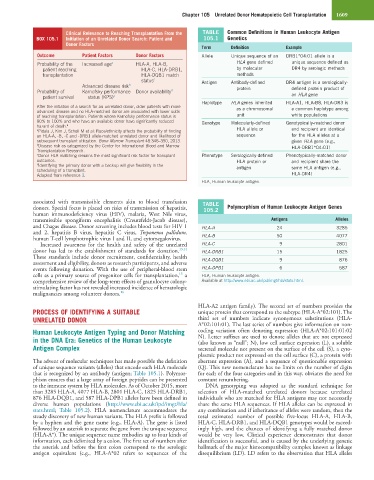
            to the immune system by HLA molecules. As of October 2015, more   DNA  genotyping  was  adopted  as  the  standard  technique  for
            than 3285 HLA-A, 4077 HLA-B, 2801 HLA-C, 1825 HLA-DRB1,   selection  of  HLA-matched  unrelated  donors  because  unrelated
            876 HLA-DQB1, and 587 HLA-DPB1 alleles have been defined in   individuals who are matched for HLA antigens may not necessarily
            diverse  human  populations  (http://www.ebi.ac.uk/ipd/imgt/hla/  share the same HLA sequences. If HLA alleles can be expressed in
            stats.html;  Table  105.2).  HLA  nomenclature  accommodates  the   any combination and if inheritance of alleles were random, then the
            steady discovery of new human variants. The HLA prefix is followed   total  estimated  number  of  possible  five-locus  HLA-A,  HLA-B,
            by a hyphen and the gene name (e.g., HLA-A). The gene is listed   HLA-C, HLA-DRB1, and HLA-DQB1 genotypes would be exceed-
            followed by an asterisk to separate the gene from the unique sequence   ingly  high,  and  the  chances  of  identifying  a  fully  matched  donor
            (HLA-A*). The unique sequence name embodies up to four kinds of   would  be  very  low.  Clinical  experience  demonstrates  that  donor
            information, each delimited by a colon. The first set of numbers after   identification is successful, and is caused by the underlying genetic
            the  asterisk  and  before  the  first  colon  correspond  to  the  serologic   hallmark of the major histocompatibility complex known as linkage
            antigen  equivalent  (e.g.,  HLA-A*02  refers  to  sequences  of  the   disequilibrium (LD). LD refers to the observation that HLA alleles

