


Page 1808 - Hematology_ Basic Principles and Practice ( PDFDrive )
P. 1808
1612   Part X  Transplantation


           When no related donor is available or suitable, a search for an   for two unrelated individuals who share the same HLA genotype to
        unrelated donor is initiated.  A  search of  all  available international    have different HLA haplotypes. The clinical significance of haplotype
        registries today includes consideration of more than 25 million donors   matching is described in the section entitled Beyond Classic HLA:
        worldwide  (http://www.nmdp.org;  http://www.worldmarrow.org).     Major Histocompatibility Complex Resident Variation.
        In the assessment of every unrelated donor, matching for each HLA
        genetic locus allele is considered. However, gene-by-gene identity for
        HLA-A,  HLA-B,  HLA-C,  HLA-DR,  and  HLA-DQ  between  two   CLINICAL IMPORTANCE OF DONOR HLA MATCHING IN
        unrelated individuals does not necessarily signify that the HLA alleles   CASES OF UNRELATED DONOR HCT
        are linked on the same chromosomal haplotype. Hence it is possible
                                                              The  first  successful  human  allogeneic  BM  transplantations  were
                                                              performed in 1968. Early clinical experience in allogeneic transplan-
                                                              tation identified both HLA and non-HLA factors as important in
                   Principles of Patient-Donor Human Leukocyte Antigen   defining posttransplantation complications. Donor HLA mismatch-
         BOX 105.2
                   Matching and Selection                     ing was identified as a risk factor for graft failure after HCT from
                                                              relatives. Non-HLA factors associated with an increased risk of graft
          Establish the Patient’s Haplotypes                  failure  included  transplantation  of  a  lower  BM  cell  dose,  use  of
          When an allogeneic transplant is being considered a part of the treat-  T cell–depleted BM, and transplantation of BM from a cross-match–
          ment regimen for a patient, HLA typing of the patient and first degree
          relatives is performed early in the planning process to identify suitable   positive donor (presence of antidonor lymphocyte antibodies in the
          related donors. Typing of family members provides two key pieces of   patient’s serum pretransplant). HLA mismatching was also shown to
          information: (1) the availability of an HLA genotypically-matched sibling   increase the incidence and severity of acute GVHD.
          or a suitable haploidentical related donor, and (2) confirmation of the   Use of HLA-matched unrelated donors as the source of BM was
          patient’s HLA tissue type. When both parents of the patient are avail-  first  applied  in  the  case  of  a  patient  with  severe  aplastic  anemia.
          able  for  tissue  typing,  the  family  study  allows  confirmation  of  the   Durable  engraftment  and  immunologic  reconstitution  were  early
          paternal and maternal HLA haplotypes, and this information is invalu-  barriers to successful unrelated donor HCT. As clinical experience
          able for predicting the probability of finding unrelated donors. In the   matured and tissue typing methods became more robust, unrelated
          absence of parents, tissue typing of available siblings might yield suf-  donor HCT was established as a therapeutic approach for treatment
          ficient information for the four parental haplotypes.
                                                              of hematologic disorders when an HLA-identical sibling is not avail-
          Characterize Human Leukocyte Antigens at High Resolution  able.  DNA-based  methods  have  become  established  as  the  gold
          DNA-based  methods  are  the  mainstay  for  tissue  typing.  Molecular   standard  for  HLA  testing  because  serologically  identical  recipients
          methods  provide  information  of  allelic  variants  at  HLA-A,  HLA-B,   and potential unrelated donors can be mismatched for one or more
          HLA-C, HLA-DRB1, HLA-DQB1, and HLA-DPB1 that have been shown   alleles that are identified by DNA testing methods.
          to have biologic implications in graft-versus-host and host-versus-graft   The collective worldwide experience demonstrates that patients
          allorecognition. When a search for an unrelated donor yields potential   have superior outcome after HLA-matched unrelated HCT than after
          registry donors that lack high-resolution typing, often knowledge of the
          patient’s haplotypes may help to direct typing of donors that have the   HLA-mismatched transplantation (Table 105.6). The general recom-
          highest probability of matching the patient’s alleles.  mendations  for  donor  selection  are:  (1)  If  the  patient  has  many
                                                              potential  8/8  donors,  additional  matching  for  HLA-DQB1  (HLA
          Determine the Presence of Antidonor Antibodies Against Mismatched   10/10) and HLA-DPB1 (HLA 12/12) may further enhance patient
          Human Leukocyte Antigen Mismatches                  outcomes. (2) When an HLA 8/8– or 10/10–matched donor cannot
          The risk of graft failure is significantly increased when the patient has   be identified, use of a donor mismatched for a single allele can be
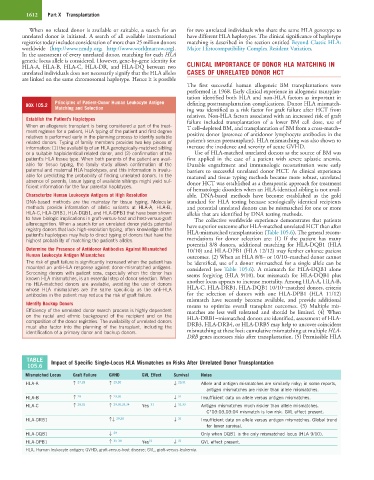
          mounted an anti-HLA response against donor-mismatched antigens.   considered  (see Table  105.6).  A  mismatch  for  HLA-DQB1  alone
          Screening  donors  with  patient  sera,  especially  when  the  donor  has   seems  forgiving  (HLA  9/10),  but  mismatch  for  HLA-DQB1  plus
          known HLA mismatches, is an essential step of donor selection. When
          no  HLA-matched  donors  are  available,  avoiding  the  use  of  donors   another locus appears to increase mortality. Among HLA-A, HLA-B,
          whose  HLA  mismatches  are  the  same  specificity  as  the  anti-HLA   HLA-C, HLA-DRB1, HLA-DQB1 10/10−matched donors, criteria
          antibodies in the patient may reduce the risk of graft failure.  for  the  selection  of  donors  with  one  HLA-DPB1  (HLA  11/12)
                                                              mismatch  have  recently  become  available,  and  provide  additional
          Identify Backup Donors                              means  to  optimize  overall  transplant  outcomes.  (3)  Multiple  mis-
          Efficiency of the unrelated donor search process is highly dependent   matches  are  less  well  tolerated  and  should  be  limited.  (4)  When
          on  the  racial  and  ethnic  background  of  the  recipient  and  on  the   HLA-DRB1−mismatched donors are identified, assessment of HLA-
          composition of the donor registries. The availability of unrelated donors
          must  also  factor  into  the  planning  of  the  transplant,  including  the   DRB3, HLA-DRB4, or HLA-DRB5 may help to uncover coincident
          identification of a primary donor and backup donors.  mismatching at these loci; cumulative mismatching at multiple HLA-
                                                              DRB genes increases risks after transplantation. (5) Permissible HLA


          TABLE   Impact of Specific Single-Locus HLA Mismatches on Risks After Unrelated Donor Transplantation
          105.6
         Mismatched Locus  Graft Failure  GVHD  GVL Effect  Survival  Notes
         HLA-A           ↑  27,28    ↑   29,30            ↓  29,31  Allele and antigen mismatches are similarly risky; in some reports,
                                                                     antigen mismatches are riskier than allele mismatches.
         HLA-B           ↑  28       ↑   29,30            ↓  31    Insufficient data on allele versus antigen mismatches.
         HLA-C           ↑  28,32    ↑   29,30,33,34  Yes  31  ↓  31,33  Antigen mismatches much riskier than allele mismatches.
                                                                     C*03:03,03:04 mismatch is low risk. GVL effect present.
         HLA-DRB1                    ↑↓  29,30            ↓  31    Insufficient data on allele versus antigen mismatches. Global trend
                                                                     for lower survival.
         HLA-DQB1                    ↓   29                        Only when DQB1 is the only mismatched locus (HLA 9/10).
         HLA-DPB1                    ↑   35–38  Yes 31    ↓  31    GVL effect present.
         HLA, Human leukocyte antigen; GVHD, graft-versus-host disease; GVL, graft-versus-leukemia.

