


Page 1807 - Hematology_ Basic Principles and Practice ( PDFDrive )
P. 1807
Chapter 105  Unrelated Donor Hematopoietic Cell Transplantation  1611


            serologic  to  DNA-based  methods,  development  of  dictionaries  of   TABLE
            HLA alleles and antigen equivalents has become a necessity because   105.5  Vector of Mismatch
            many  donors  in  the  registries  have  been  typed  only  by  serologic
            assays.  Interpretation  and  use  of  molecular  typing  data  for  donor           Examples
            search  and  selection  has  required  the  development  of  informatics   Vector  Definition  Donor  Recipient
            programs.                                                                              a
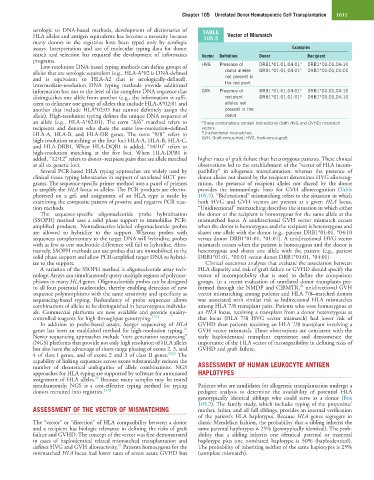
              Low-resolution DNA-based typing methods can define groups of   HVG  Presence of   DRB1*01:01,04:01 b  DRB1*01:01,04:10
            alleles that are serologic equivalent (e.g., HLA-A*02 is DNA-defined   donor alleles   DRB1*01:01,04:01  DRB1*01:01,01:01
            and  is  equivalent  to  HLA-A2  that  is  serologically-defined).   not present in
            Intermediate-resolution  DNA  typing  methods  provide  additional   the recipient
            information but not to the level of the complete DNA sequence that   GVH  Presence of   DRB1*01:01,04:01 a  DRB1*01:01,04:10
            distinguishes one allele from another (e.g., the information is suffi-  recipient   DRB1*01:01,01:01 b  DRB1*01:01,04:10
            cient to delineate one group of alleles that include HLA-A*02:01 and   alleles not
            another  that  include  HLA*02:05  but  cannot  definitely  assign  the   present in the
            allele). High-resolution typing defines the unique DNA sequence of   donor
            an  allele  (e.g.,  HLA-A*02:01). The  term  “6/6”  matched  refers  to   a These combinations contain bidirectional (both HVG and GVHD) mismatch
            recipients  and  donors  who  share  the  same  low-resolution–defined   vectors.
            HLA-A,  HLA-B,  and  HLA-DR  genes.  The  term  “8/8”  refers  to   b Unidirectional mismatches.
            high-resolution matching at the four loci HLA-A, HLA-B, HLA-C,   GVH, Graft-versus-host; HVG, host-versus-graft.
            and  HLA-DRB1.  When  HLA-DQB1  is  added,  “10/10”  refers  to
            high-resolution  matching  at  the  five  loci.  When  HLA-DPB1  is
            added, “12/12” refers to donor−recipient pairs that are allele matched   higher rates of graft failure than heterozygous patients. These clinical
            at all six genetic loci.                              observations led to the establishment of the “vector of HLA incom-
              Several PCR-based  HLA  typing approaches are  widely  used  by   patibility”  in  allogeneic  transplantation:  whereas  the  presence  of
            clinical tissue typing laboratories in support of unrelated HCT pro-  donor alleles not shared by the recipient determines HVG allorecog-
            grams. The sequence-specific primer method uses a panel of primers   nition,  the  presence  of  recipient  alleles  not  shared  by  the  donor
            to amplify the HLA locus or alleles. The PCR products are electro-  provides  the  immunologic  basis  for  GVH  allorecognition  (Table
            phoresed  on  a  gel,  and  assignment  of  an  HLA  type  is  made  by   105.5). “Bidirectional” mismatching refers to the situation in which
            examining the composite pattern of positive and negative PCR reac-  both  HVG  and  GVH  vectors  are  present  at  a  given  HLA  locus.
            tion methods.                                         “Unidirectional” mismatching describes the situation in which either
              The  sequence-specific  oligonucleotide  probe  hybridization   the donor or the recipient is homozygous for the same allele at the
            (SSOPH) method uses a solid phase support to immobilize PCR-  mismatched locus. A unidirectional GVH vector mismatch occurs
            amplified  products.  Nonradioactive-labeled  oligonucleotide  probes   when the donor is homozygous and the recipient is heterozygous and
            are  allowed  to  hybridize  to  the  support.  Whereas  probes  with   shares one allele with the donor (e.g., patient DRB1*01:01, *04:10
            sequences complementary to the target DNA will hybridize, probes   versus donor DRB1*01:01, *01:01). A unidirectional HVG vector
            with as few as one nucleotide difference will fail to hybridize. Alter-  mismatch occurs when the patient is homozygous and the donor is
            natively, SSOPH methods can use probes that are immobilized to the   heterozygous  and  shares  one  allele  with  the  patient  (e.g.,  patient
            solid phase support and allow PCR-amplified target DNA to hybrid-  DRB1*01:01, *01:01 versus donor DRB1*01:01, *04:01).
            ize to the support.                                     Clinical outcomes analyses that evaluate the association between
              A variation of the SSOPH method is oligonucleotide array tech-  HLA disparity and risk of graft failure or GVHD should specify the
            nology. Arrays can simultaneously query multiple regions of polymor-  vector  of  incompatibility  that  is  used  to  define  the  comparison
            phisms in many HLA genes. Oligonucleotide probes can be designed   groups.  In  a  recent  evaluation  of  unrelated  donor  transplants  per-
                                                                                                   26
            to all four potential nucleotides, thereby enabling detection of new   formed through the NMDP and CIBMTR,  unidirectional GVH
            sequence polymorphisms with the same sensitivity and specificity as   vector mismatching among patients and HLA 7/8–matched donors
            sequencing-based  typing.  Redundancy  of  probe  sequences  allows   was  associated  with  similar  risk  as  bidirectional  HLA  mismatches
            combinations of alleles to be distinguished in heterozygous individu-  among HLA 7/8 transplant pairs. Patients who were homozygous at
            als.  Commercial  platforms  are  now  available  and  provide  quality-  an HLA locus, receiving a transplant from a donor heterozygous at
            controlled reagents for high throughput genotyping. 17,18  that  locus  (HLA  7/8  HVG  vector  mismatch)  had  lower  risk  of
              In  addition  to  probe-based  assays,  Sanger  sequencing  of  HLA   GVHD than patients receiving an HLA 7/8 transplant involving a
                                                             19
            genes has been an established method for high-resolution typing.    GVH vector mismatch. These observations are consistent with the
            Newer sequencing approaches include “next generation sequencing”   early  haploidentical  transplant  experience  and  demonstrate  the
            (NGS) platforms that provide not only high resolution of HLA alleles   importance of the HLA vector of incompatibility in defining risks of
            but also have the advantage of short-range phasing of exons 2, 3, and   GVHD and graft failure.
            4 of class I genes, and of exons 2 and 3 of class II genes. 20,21  The
            capability of linking sequences across exons substantially reduces the
            number  of  theoretical  ambiguities  of  allele  combinations.  NGS   ASSESSMENT OF HUMAN LEUKOCYTE ANTIGEN
            approaches for HLA typing are supported by software for automated   HAPLOTYPES
                                22
            assignment of HLA alleles.  Because many samples may be tested
            simultaneously,  NGS  is  a  cost-effective  typing  method  for  typing   Patients who are candidates for allogeneic transplantation undergo a
            donors recruited into registries. 23,24               pedigree  analysis  to  determine  the  availability  of  potential  HLA
                                                                  genotypically  identical  siblings  who  could  serve  as  a  donor  (Box
                                                                  105.2). The family study, which includes typing of the propositus’
            ASSESSMENT OF THE VECTOR OF MISMATCHING               mother, father, and all full siblings, provides an internal verification
                                                                  of  the  patient’s  HLA  haplotypes.  Because  HLA  genes  segregate  in
            The “vector” or “direction” of HLA compatibility between a donor   classic Mendelian fashion, the probability that a sibling inherits the
            and a recipient has biologic relevance in defining the risks of graft   same parental haplotypes is 25% (genotypically identical). The prob-
            failure and GVHD. The concept of the vector was first demonstrated   ability  that  a  sibling  inherits  one  identical  paternal  or  maternal
            in  cases  of  haploidentical  related  mismatched  transplantation  and   haplotype  plus  one  nonshared  haplotype  is  50%  (haploidentical).
                                        25
            defines HVG and GVH alloreactivity.  Patients homozygous for the   The probability of inheriting neither of the same haplotypes is 25%
            mismatched HLA locus had lower rates of severe acute GVHD but   (complete mismatch).

