


Page 1859 - Hematology_ Basic Principles and Practice ( PDFDrive )
P. 1859
Chapter 108  Graft-Versus-Host Disease and Graft-Versus-Leukemia Responses  1651


              An independent committee of a multicenter phase III trial that   rapid and severe form of GVHD may occur in patients with severe
            assessed the presence and severity of GVHD was unable to confirm   HLA  mismatches  and  in  patients  who  receive T-cell  replete  trans-
                                                                                                                   21
            a high incidence of GVHD 16,17  Standard grading systems generally   plants  without  or  with  inadequate  in  vivo  GVHD  prophylaxis.
            include clinical changes in the skin, GI tract, liver, and performance   Although such GVHD is sometimes called “hyperacute,” this term
                           18
            status (Table 108.1).  Although the severity of GVHD is often dif-  is misleading because it is pathophysiologically distinct from hyper-
            ficult to quantify, the overall maximal grade correlates with disease   acute  rejection  after  solid  organ  allografting,  which  is  caused  by
            outcome: mild GVHD (grade I or II) is associated with little mortal-  preformed antibodies. This form of GVHD, which is manifested by
            ity, whereas higher grades are associated with significantly decreased   fever, generalized erythroderma and desquamation, and often edema,
            survival. 18,19  Recent advances in the use of biomarkers at the onset of   typically occurs about 1 week after stem cell infusion and may be
            disease may soon be sufficiently accurate to guide therapy. 19  rapidly fatal. In patients receiving standard (in vivo) GVHD prophy-
                                                                  laxis such as a combination of cyclosporine and methotrexate, the
            Clinical Features of Acute                            median onset of GVHD is typically 21–25 days after transplantation;
                                                                  however,  after  in  vitro  T-cell  depletion  of  the  graft,  the  onset  of
            Graft-Versus-Host Disease                             GVHD symptoms may be much later.  Thus the findings of rash
                                                                                               21
                                                                  and  diarrhea by 1  week  after transplantation  would very likely  be
            The clinical features, staging, and grading of acute GVHD are sum-  because of ineffective prophylaxis and would be very unlikely with
            marized in Tables 108.1 and 108.2. In a comprehensive review of   the use of calcineurin inhibitors or in vitro T-cell depletion of the
                                                             20
            patients receiving therapy for acute GVHD, Martin and colleagues    stem cell inoculum. A less ominous syndrome of fever, rash, and fluid
            found that 81% had skin involvement, 54% had GI involvement,   retention occurring in the first 1–2 weeks after stem cell infusion is
            and  50%  had  liver  involvement  at  the  initiation  of  therapy.  After   the “engraftment syndrome.” These manifestations may be seen with
            high-intensity (myeloablative) conditioning, acute GVHD generally   either allogeneic or autologous transplantation. Although this syn-
            occurs within 14–35 days of stem cell infusion. The time of onset   drome’s pathophysiology is poorly understood, it is thought to be
            may  depend  on  the  degree  of  histocompatibility,  the  number  of   caused by a wave of cytokine production as the graft starts to recover.
            donor T cells infused, and the prophylactic regimen for GVHD. A   These  symptoms  are  related  to,  but  distinct  from,  the  “cytokine
                                                                       22
                                                                  storm”  of acute GVHD because there is no concomitant T-cell–
                                                                  mediated attack. This syndrome responds immediately to steroids in
             TABLE   Clinical Manifestations and Staging of Acute    most patients, and it typically presents earlier than acute GVHD. 15
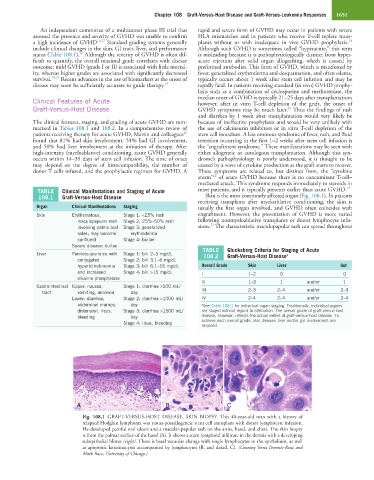
              108.1   Graft-Versus-Host Disease                     Skin is the most commonly affected organ (Fig. 108.1). In patients
                                                                  receiving  transplants  after  myeloablative  conditioning,  the  skin  is
             Organ       Clinical Manifestations  Staging         usually  the  first  organ  involved,  and  GVHD  often  coincides  with
             Skin        Erythematous,   Stage 1: <25% rash       engraftment.  However,  the  presentation  of  GVHD  is  more  varied
                          maculopapular rash   Stage 2: 25%–50% rash  following nonmyeloablative transplants or donor lymphocyte infu-
                                                                      23
                          involving palms and  Stage 3: generalized   sions.  The characteristic maculopapular rash can spread throughout
                          soles; may become   erythroderma
                          confluent      Stage 4: bullae
                         Severe disease: bullae
                                                                   TABLE   Glucksberg Criteria for Staging of Acute
             Liver       Painless jaundice with  Stage 1: bili 2–3 mg/dL  108.2   Graft-Versus-Host Disease a
                          conjugated     Stage 2: bili 3.1–6 mg/dL
                          hyperbilirubinemia   Stage 3: bili 6.1–15 mg/dL  Overall Grade  Skin  Liver           Gut
                          and increased   Stage 4: bili >15 mg/dL  I              1–2        0                   0
                          alkaline phosphatase
                                                                   II             1–3        1       and/or      1
             Gastrointestinal  Upper: nausea,   Stage 1: diarrhea >500 mL/
               tract      vomiting, anorexia  day                  III            2–3       2–4      and/or     2–3
                         Lower: diarrhea,   Stage 2: diarrhea >1000 mL/  IV       2–4       2–4      and/or     2–4
                          abdominal cramps,   day                  a See Table 108.1 for individual organ staging. Traditionally, individual organs
                          distension, ileus,   Stage 3: diarrhea >1500 mL/  are staged without regard to attribution. The overall grade of graft-versus-host
                          bleeding          day                    disease, however, reflects the actual extent of graft-versus-host disease. To
                                         Stage 4: ileus, bleeding  achieve each overall grade, skin disease, liver and/or gut involvement are
                                                                   required.


                          A                            B                   C
                            Fig.  108.1  GRAFT-VERSUS-HOST DISEASE, SKIN BIOPSY. This 40-year-old man with  a  history of
                            relapsed Hodgkin lymphoma was status-postallogeneic stem cell transplant with donor lymphocyte infusion.
                            He developed painful oral ulcers and a macular-papular rash on the arms, hand, and chest. The skin biopsy
                            is from the palmar surface of the hand (A). It shows a scant lymphoid infiltrate in the dermis with a developing
                            subepithelial blister (right). There is basal vacuolar change with single lymphocytes in the epithelium, as well
                            as apoptotic keratinocytes accompanied by lymphocytes (B, and detail, C). (Courtesy Vesna Petronic-Rosic and
                            Mark Racz, University of Chicago.)

