


Page 1864 - Hematology_ Basic Principles and Practice ( PDFDrive )
P. 1864
1656   Part X  Transplantation


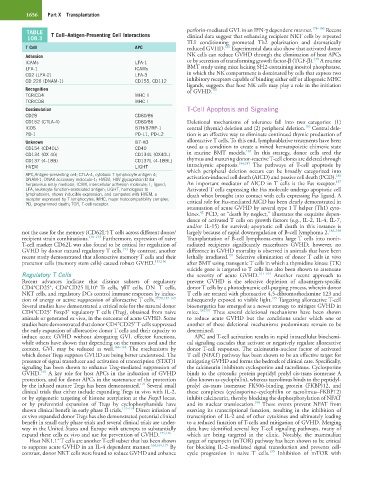
          TABLE   T Cell–Antigen-Presenting Cell Interactions  perforin-mediated GVL in an IFN-γ dependent manner. 178–180  Recent
          108.3                                               clinical data suggest that enhancing recipient NKT cells by repeated
                                                              TLI  conditioning  promoted  Th2  polarization  and  dramatically
                                                                           165
         T Cell                              APC              reduced GVHD.  Experimental data also show that activated donor
         Adhesion                                             NK cells can reduce GVHD through the elimination of host APCs
                                                                                                        179
         ICAMs                               LFA-1            or by secretion of transforming growth factor-β (TGF-β).  A murine
         LFA-1                               ICAMs            BMT study using mice lacking SH2-containing inositol phosphatase,
         CD2 (LFA-2)                         LFA-3            in which the NK compartment is dominated by cells that express two
         CD 226 (DNAM-1)                     CD155, CD112     inhibitory receptors capable of binding either self or allogeneic MHC
                                                              ligands, suggests that host NK cells may play a role in the initiation
         Recognition                                          of GVHD. 181
         TCR/CD4                             MHC II
         TCR/CD8                             MHC I
         Costimulation                                        T-Cell Apoptosis and Signaling
         CD28                                CD80/86
         CD152 (CTLA-4)                      CD80/86          Deletional  mechanisms  of  tolerance  fall  into  two  categories:  (1)
                                                                                                     182
         ICOS                                B7H/B7RP-1       central (thymic) deletion and (2) peripheral deletion.  Central dele-
         PD-1                                PD-L1, PD-L2     tion is an effective way to eliminate continued thymic production of
         Unknown                             B7-H3            alloreactive T cells. To this end, lymphoablative treatments have been
         CD154 (CD40L)                       CD40             used as a condition to create a mixed hematopoietic chimeric state
                                                                                  183
         CD134 (OX 40)                       CD134L (OX40L)   in  murine  BMT  models.   In  this  strategy,  donor  cells  seed  the
         CD137 (4-1BB)                       CD137L (4-1BBL)  thymus and maturing donor-reactive T-cell clones are deleted through
                                                                               184,185
         HVEM                                LIGHT            intrathymic  apoptosis.    The  pathways  of  T-cell  apoptosis  by
                                                              which  peripheral  deletion  occurs  can  be  broadly  categorized  into
         APC,Antigen-presenting cell; CTLA-4, cytotoxic T lymphocyte antigen 4;   activation-induced cell death (AICD) and passive cell death (PCD).
                                                                                                               186
         DNAM-1, DNAX accessory molecule-1; HVEM, HSV glycoprotein D for                                       187
         herpesvirus entry mediator; ICAM, intercellular adhesion molecule; L, ligand;   An  important  mediator  of  AICD  in T  cells  is  the  Fas  receptor.
         LFA, leukocyte function–associated antigen; LIGHT, homologous to   Activated T cells expressing the Fas molecule undergo apoptotic cell
         lymphotoxins, shows inducible expression, and competes with HVEM, a   death when brought into contact with cells expressing Fas ligand. A
         receptor expressed by T lymphocytes; MHC, major histocompatibility complex;   critical role for Fas-mediated AICD has been clearly demonstrated in
         PD, programmed death; TCR, T-cell receptor.
                                                              attenuation of acute GVHD by several type 1 T helper (Th1) cyto-
                                                                  42
                                                              kines.  PCD, or “death by neglect,” illustrates the exquisite depen-
                                                              dence of activated T cells on growth factors (e.g., IL-2, IL-4, IL-7,
                                                              and/or  IL-15)  for  survival;  apoptotic  cell  death  in  this  instance  is
                                   –
        not the case for the memory (CD62L ) T cells across different donor/  largely because of rapid downregulation of B-cell lymphoma 2. 188–190
        recipient strain combinations. 150–153  Furthermore, expression of naive   Transplantation of B-cell lymphoma-extra large T cells into nonir-
        T-cell marker CD62L was also found to be critical for regulation of   radiated  recipients  significantly  exacerbates  GVHD;  however,  no
                                         154
        GVHD by donor natural regulatory T cells.  By contrast, another   difference in GVHD mortality is observed in animals that have been
                                                                            191
        recent study demonstrated that alloreactive memory T cells and their   lethally irradiated.  Selective elimination of donor T cells in vivo
        precursor cells (memory stem cells) caused robust GVHD. 155,156  after BMT using transgenic T cells in which a thymidine kinase (TK)
                                                              suicide gene is targeted to T cells has also been shown to attenuate
        Regulatory T Cells                                    the  severity  of  acute  GVHD. 191–194   Another  recent  approach  to
        Recent  advances  indicate  that  distinct  subsets  of  regulatory   prevent  GVHD  is  the  selective  depletion  of  alloantigen-specific
                 +
            +
                                +
                       +
                                                    –
                            –
        CD4 CD25 ,  CD4 CD25 IL10  Tr  cells,  γδT  cells,  DN  T  cells,   donor T cells by a photodynamic cell-purging process, wherein donor
        NKT cells, and regulatory DCs control immune responses by induc-  T cells are treated with photoactive 4,5-dibromorhodamine 123 and
                                                                                          195
        tion of anergy or active suppression of alloreactive T cells. 97,98,157–165    subsequently exposed to visible light.  Targeting alloreactive T-cell
        Several studies have demonstrated a critical role for the natural donor   bioenergetics has emerged as a newer strategy to mitigate GVHD in
                       +
                 +
            +
        CD4 CD25  Foxp3  regulatory T cells (Treg), obtained from naive   mice. 196,197   Thus  several  deletional  mechanisms  have  been  shown
        animals or generated ex vivo, in the outcome of acute GVHD. Some   to  reduce  acute  GVHD  but  the  conditions  under  which  one  or
                                       +
                                             +
        studies have demonstrated that donor CD4 CD25  T cells suppressed   another of these deletional mechanisms predominate remain to be
        the early expansion of alloreactive donor T cells and their capacity to   determined.
        induce  acute  GVHD  without  abrogating  GVL  effector  functions,   APC and T-cell activation results in rapid intracellular biochemi-
        while others have shown that depending on the tumors used and the   cal signaling cascades that activate or negatively regulate alloreactive
        context,  GVL  may  be  reduced  as  well. 166–168   The  mechanisms  by   donor T-cell  responses. The  calcineurin-nuclear  factor  of  activated
        which donor Tregs suppress GVHD are being better understood. The   T cell (NFAT) pathway has been shown to be an effective target for
        presence of signal transducer and activation of transcription (STAT)1   mitigating GVHD and forms the bedrock of clinical care. Specifically,
        signaling has been shown to enhance Treg-mediated suppression of   the calcineurin inhibitors cyclosporine and tacrolimus. Cyclosporine
              169
        GVHD.   A  key  role  for  host  APCs  in  the  induction  of  GVHD   binds to the cytosolic protein peptidyl prolyl cis-trans isomerase A
        protection, and for donor APCs in the sustenance of the protection   (also known as cyclophilin), whereas tacrolimus binds to the peptidyl-
                                               170
        by the infused mature Tregs has been demonstrated.  Several small   prolyl  cis-trans  isomerase  FK506-binding  protein  (FKBP)12,  and
        clinical trials that either include expanding Tregs in vivo with IL-2,   these  complexes  (cyclosporine–cyclophilin  or  tacrolimus–FKBP12)
        or by epigenetic targeting of histone acetylation at the Foxp3 locus,   inhibit calcineurin, thereby blocking the dephosphorylation of NFAT
                                                                                    198
        or  by  preferential  expansion  of  Tregs  by  cyclophosphamide  have   and  its  nuclear  translocation.  These  events  prevent  NFAT  from
        shown clinical benefit in early phase II trials. 171–174  Direct infusion of   exerting  its  transcriptional  function,  resulting  in  the  inhibition  of
        ex vivo expanded donor Tregs has also demonstrated potential clinical   transcription of IL-2 and of other cytokines and ultimately leading
        benefit in small early phase trials and several clinical trials are under-  to a reduced function of T-cells and mitigation of GVHD. Merging
        way in the United States and Europe with attempts to substantially   data have identified several key T-cell signaling pathways, many of
        expand these cells ex vivo and use for prevention of GVHD. 175,176  which  are  being  targeted  in  the  clinic.  Notably,  the  mammalian
                    +
           Host NK1.1  T cells are another T-cell subset that has been shown   target of rapamycin (mTOR) pathway has been shown to be critical
        to suppress acute GVHD in an IL-4 dependent manner. 164,165,177  By   for  blocking  IL-2–mediated  signal  transduction  and  prevents  cell-
                                                                                         199
        contrast, donor NKT cells were found to reduce GVHD and enhance   cycle  progression  in  naive  T  cells.   Inhibition  of  mTOR  with

